

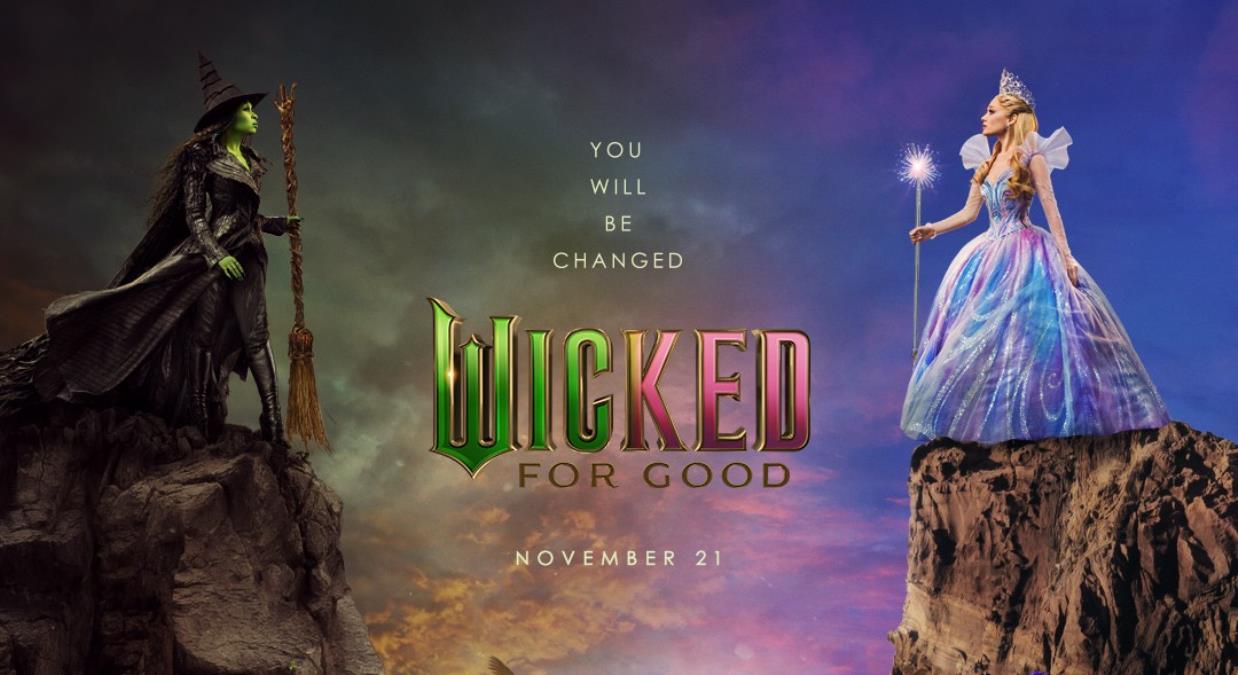
For fans of Wicked, the story’s spell is almost irresistible—its songs, spectacle, and the powerful friendship between two unlikely companions often take center stage. Yet beneath the enchantment lies a world shaped as much by political tension as by musical triumph, and that current becomes even stronger in Wicked: For Good, now playing in theaters.
The first film in Jon M. Chu’s cinematic retelling used identity and division as a quiet foundation for its world-building. It imagined a backstory for the green-skinned Elphaba, later known as the Witch of the West, while tracing her evolving relationship with Glinda. Their connection begins in discomfort and misunderstanding, with Glinda initially keeping her distance from Elphaba before gradually forming a bond built on empathy rather than judgment.
The story’s conflict deepens when they learn that the Wizard of Oz is not simply a figure of wonder, but a strategist who uses influence to reshape perception. Working with Madame Morrible, he spreads messaging across Oz that ultimately frames Elphaba as a national threat. In doing so, he shows how public fear and admiration can be engineered through information control rather than earned through truth.
Movement, Restriction, and Real-World Echoes
For Good expands those ideas further, touching on issues of mobility, exclusion, and authority. One of the teaser’s most memorable moments follows Boq, a young Munchkin hoping to travel to the Emerald City. His excitement collapses when he discovers that new rules block both Munchkins and animals from moving freely without government authorization. The policy is introduced by Nessarose, now Governor of Munchkinland, whose personal desires intersect with political power in ways that shape the story’s emotional and societal tension.
The imagery of separation, permits, and silenced voices has sparked comparisons among viewers and analysts to real-world immigration debates in the United States. While Chu’s adaptation never directly references contemporary politics, its themes of division, state-controlled narratives, and targeted enforcement mirror discussions happening far beyond the fictional borders of Oz.
In recent weeks, U.S. immigration policy has returned to public attention, particularly following high-profile operations in major cities. Officials have emphasized that enforcement focuses on individuals connected to criminal networks, while outside investigations have continued to highlight conflicting data and unanswered questions around classification and transparency.
The Power to Define “Truth”
One of the most repeated ideas from the original novel’s legacy reaches its clearest form here: political authority belongs to those who control information. In Oz, that power defines reputations, threats, and social alignment, often independent of personal character or public consent.
Performers familiar with the stage production have echoed similar readings. Over more than a decade of touring, directors and choreographers often encouraged cast members to draw connections between the world around them and the emotions portrayed on stage, helping the story feel personal, grounded, and recognizable—even when set in a fantasy world.
Award Season Arrives With a Message
Wicked: For Good joins a noticeable trend in 2025 cinema, where major directors have explored social systems, institutional influence, and political identity through emotional storytelling rather than traditional commentary. Films from Ari Aster and Kathryn Bigelow, among others, have also stirred national conversation by touching on sensitive political themes through metaphor, consequence, and character-driven conflict.
Despite the occasional pushback labeling the movie as “too political,” many longtime followers of the franchise argue that the themes were never a detour—they were the destination. Wicked has always been about systems, voices, belonging, and the consequences of power.
The magic pulls audiences in. The politics gives them something to carry home.