
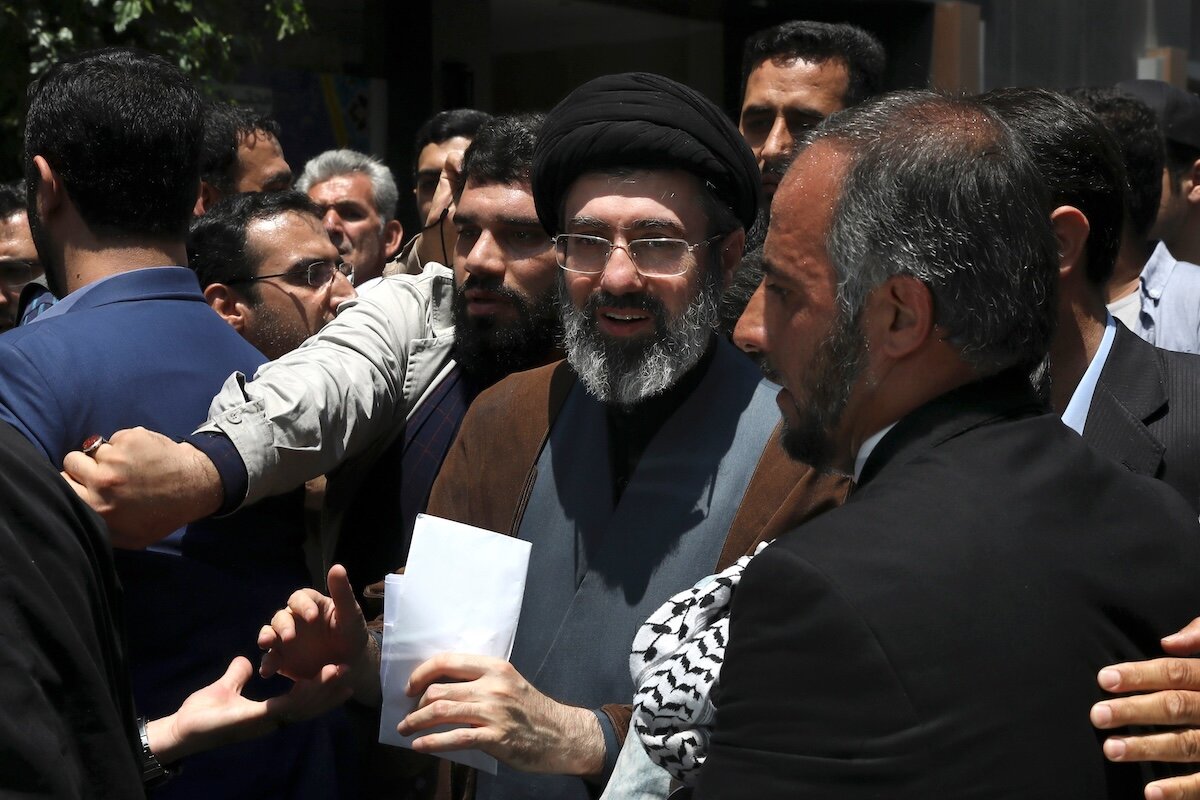
Mojtaba Khamenei, the son of Ayatollah Ali Khamenei, has been chosen as Iran’s new supreme leader after his father was killed in US-Israeli strikes. While his name has long circulated inside Iran’s political system, he has remained largely out of public view for years.
Unlike his father, Mojtaba has never held formal government office, rarely appeared in public, and has not built a political profile through speeches or interviews. Only a small number of photos and video clips of him have been made public. Even so, many observers inside and outside Iran have for years described him as an influential figure behind the scenes.
His rise now places a little-known but powerful cleric at the centre of the biggest crisis the Islamic Republic has faced in decades.
Seen by many as influential long before taking office
For years, Mojtaba Khamenei has been viewed as a figure with strong influence inside Iran’s ruling circle. Reports and diplomatic assessments published in past years described him as a forceful presence within the system, someone believed to hold real weight despite avoiding the spotlight.
That reputation grew partly because of his close relationship with key power centres in Iran, especially conservative clerical networks and elements of the security establishment.
Still, his selection is likely to be controversial. The Islamic Republic was founded after the overthrow of the monarchy in 1979, and its political identity has long been tied to the idea that leadership should come from religious standing and revolutionary legitimacy, not from family inheritance.
That makes the appointment of the late supreme leader’s son a sensitive and politically charged decision.
Born into Iran’s most powerful family
Mojtaba Khamenei was born on September 8, 1969, in Mashhad, a major city in northeastern Iran. He is the second of six children of Ali Khamenei. He completed his early education in Tehran, where he attended the religious Alavi School.
As a teenager, he reportedly spent short periods serving during the Iran-Iraq War. That conflict left a deep mark on Iran’s leadership and reinforced the state’s long-standing mistrust of the United States and Western powers.
In 1999, Mojtaba moved to Qom, one of the most important centres of Shia religious scholarship, to continue his clerical studies. Observers have noted that he entered seminary life relatively late compared with many clerics, and that decision has long drawn interest because it set him on the path toward a more formal religious role.

Questions over religious rank and legitimacy
One issue that may continue to follow Mojtaba Khamenei is his clerical status. He has generally been regarded as a mid-ranking cleric, which could be seen by critics as a weakness for someone now holding the highest religious and political office in the country.
In recent days, however, some Iranian media outlets and figures close to the centres of power have started referring to him with the higher clerical title of Ayatollah. To some observers, that appears to be an effort to strengthen his religious image and make his leadership look more credible.
In Iran’s clerical hierarchy, scholarly authority matters. Teaching advanced religious classes and holding a higher clerical title are often seen as important signs of fitness for leadership.
Still, there is precedent for rapid elevation. Ali Khamenei himself was quickly promoted in religious standing after becoming supreme leader in 1989.
His name emerged during key political battles
Mojtaba first became widely known to the Iranian public during the 2005 presidential election that brought Mahmoud Ahmadinejad to power. At the time, reformist politician Mehdi Karroubi accused him of interfering in the election through networks linked to the Revolutionary Guards and the Basij militia.
Similar accusations resurfaced after the disputed 2009 presidential election, which triggered the mass protests known as the Green Movement. During that period, some demonstrators openly voiced opposition to the possibility of Mojtaba one day succeeding his father.
Reformist figures later linked him to political repression during that era. Some opponents claimed he played a role in the crackdown that followed, including pressure placed on opposition leaders.
These allegations were deeply damaging to his image among reformist and anti-establishment circles, and they remain part of the controversy surrounding him today.
A hardline path is widely expected
Now that Mojtaba Khamenei has taken over as supreme leader, many expect him to follow a tough line similar to that of his father. Analysts believe he is unlikely to show early signs of compromise, particularly after the war and the personal losses he is said to have suffered in recent strikes.
That expectation is strengthened by his long-standing links to conservative institutions and the belief that his appointment reflects the continued strength of hardline factions within Iran’s leadership.
At the same time, he now inherits an enormous burden. Iran is facing military pressure, economic hardship, political uncertainty and public exhaustion. Leading the country through this moment will require more than influence behind closed doors.
A difficult test of authority lies ahead
Mojtaba Khamenei begins his rule under intense pressure. He must not only preserve the Islamic Republic during wartime, but also convince the public and the wider political establishment that he is capable of leading the country through one of its darkest periods.
His leadership skills have never been tested in full public view, and the idea that Iran’s highest office may now appear hereditary could deepen dissatisfaction among many citizens.
He also enters office under direct threat. Israeli officials have already warned that any successor to Ali Khamenei could become a target.
That means Mojtaba Khamenei is starting his tenure not from a position of calm authority, but in the middle of war, uncertainty and growing scrutiny both at home and abroad.