

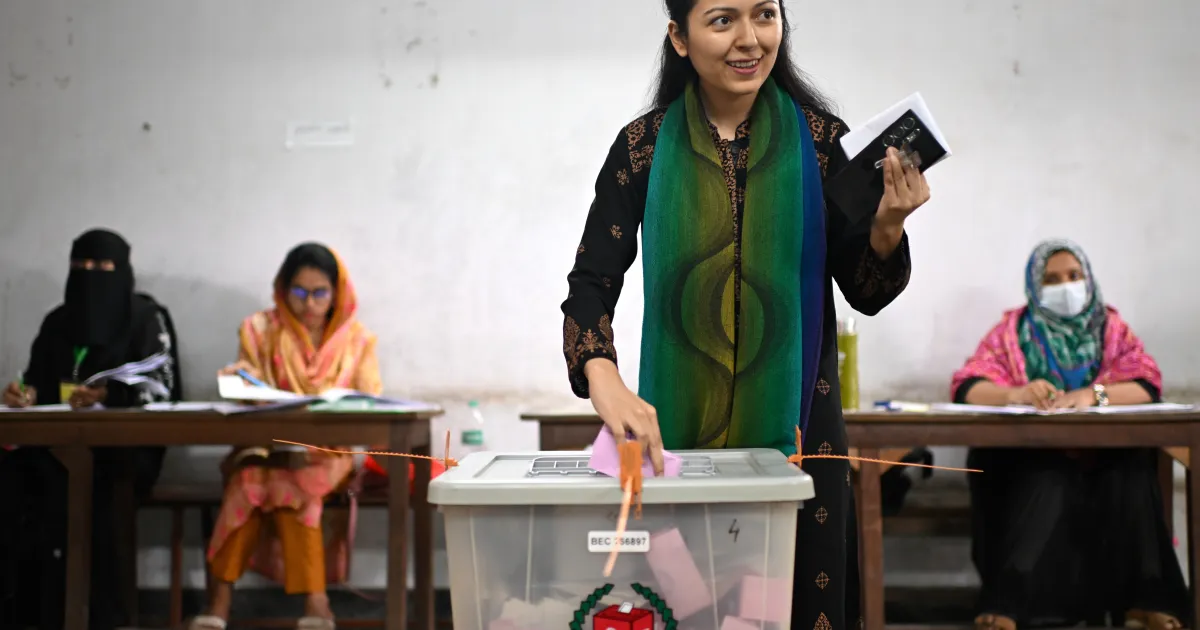
Ballots are being counted across Bangladesh following the country’s first general election since student-led protests forced former Prime Minister Sheikh Hasina from office in 2024.
More than 2,000 candidates competed for 350 parliamentary seats. Notably absent from the ballot was Hasina’s Awami League party, which has been banned from participating after she fled the country following a violent crackdown on demonstrators.
The vote marks a significant turning point for a nation seeking political stability after months of unrest.
A Competitive Race
The contest largely centers on the centre-right Bangladesh Nationalist Party (BNP) and a coalition led by the Islamist Jamaat-e-Islami, which has aligned with a party formed out of the student uprising.
Preliminary results are expected Friday.
For the first time in more than a decade, the outcome is uncertain. Previous elections had been widely criticized as being skewed in favour of Hasina, who ruled for 15 years before being convicted in absentia and sentenced to death over her handling of the protests. The United Nations estimates that up to 1,400 protesters were killed during the crackdown.
Now living in exile in India, Hasina has denied the charges and questioned the legitimacy of the current vote.
Voter Turnout and Security
More than 120 million citizens were eligible to cast ballots, with roughly 40 percent under the age of 37 — highlighting the strong influence of younger voters who played a major role in last year’s protests.
Turnout reached 49 percent by mid-afternoon, according to the Ministry of Information and Broadcasting.
Nearly one million police officers and soldiers were deployed nationwide to maintain security.
In addition to electing lawmakers, voters were also deciding on proposed constitutional reforms introduced by the interim administration that replaced Hasina’s government. Officials say the reforms aim to overhaul what they describe as a deeply flawed political system.
Interim leader and Nobel Peace Prize laureate Muhammad Yunus described the moment as a fresh start for the country.
“We have ended the nightmare and begun a new dream,” he said after casting his vote in the capital, Dhaka.
Main Contenders
BNP candidate Tarique Rahman, 60, expressed confidence ahead of the results, saying he had waited more than a decade for what he described as a meaningful election.
Rahman has pledged economic reform, democratic renewal and national reconciliation through a proposed commission aimed at bridging political divides.
The son of former Prime Minister Khaleda Zia, Rahman represents a continuation of Bangladesh’s tradition of dynastic politics — a feature some reform advocates hope to move beyond.
Meanwhile, Jamaat leader Shafiqur Rahman, 67, has positioned his party as a force for justice and anti-corruption. Though Jamaat’s prospects of securing a majority are viewed as limited, analysts say it has gained momentum and now plays a more prominent role than in previous elections.
Gender and Representation Concerns
Despite women’s active involvement in last year’s uprising, female representation among candidates remains low.
Jamaat fielded more than 200 candidates, all male, while the BNP included 10 women among over 250 nominees. Of the 30 candidates representing the student-led National Citizen Party alliance, only two are women.
The disparity has drawn criticism from voters who believe the political transition should reflect broader inclusivity.
A Defining Moment
With the Awami League absent and voter engagement high, many Bangladeshis say this election feels different from those held under Hasina’s rule.
Whether the results will usher in lasting political reform remains to be seen. But for many citizens, the vote represents a critical test of Bangladesh’s democratic future.