

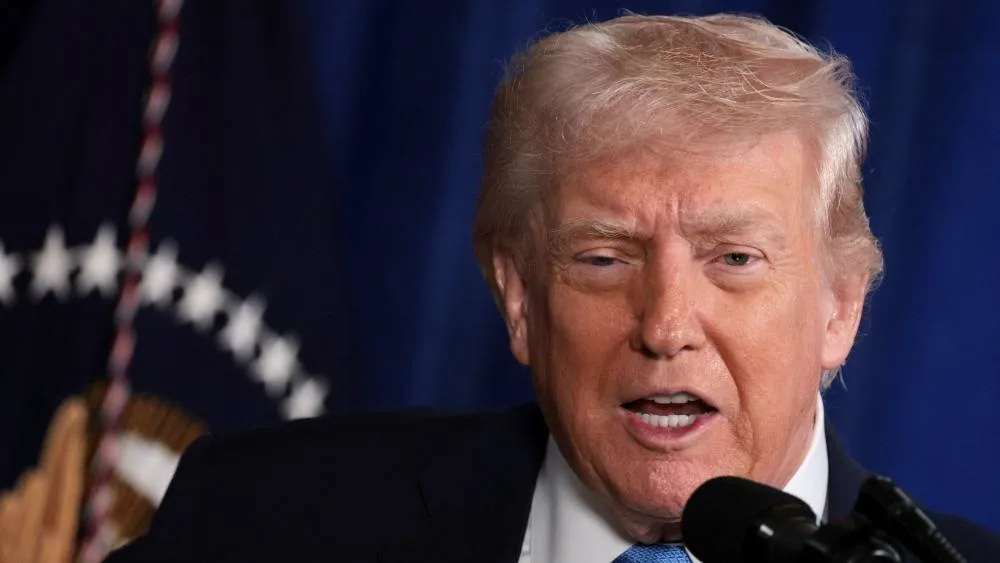
U.S. President Donald Trump has delivered a direct warning to Venezuela’s interim president, Delcy Rodríguez, saying she could face consequences if her government does not align with Washington’s expectations.
His remarks, published Sunday in U.S. magazine The Atlantic, came just hours before Venezuela’s removed president, Nicolás Maduro, was scheduled to appear in a New York federal court on Monday to face longstanding criminal charges tied to weapons and drug-related allegations—claims he has consistently denied.
The U.S. government has described Maduro’s administration as a “narco-terrorist regime,” an assertion the Venezuelan leader rejects. He has repeatedly accused Washington of using anti-drug operations as a pretext to expand its influence and gain access to Venezuela’s significant oil resources.
Rubio: “Not a War Against Venezuela”
Following Saturday’s air strikes on Caracas, which preceded the detention of Maduro and his wife Cilia Flores, U.S. Secretary of State Marco Rubio insisted the operation was not an act of war.
“We are targeting drug networks, not Venezuela itself,” Rubio told NBC’s Meet the Press on Sunday. He echoed similar statements to CBS, arguing the operation was tied to an arrest warrant, not a military invasion.
Rubio also referenced what he called a “quarantine” on Venezuelan oil shipments, describing it as one of several leverage tools Washington may retain.
“We will judge this by their next decisions,” he added, reiterating that the U.S. still holds diplomatic pressure points should Venezuela resist cooperation.
Trump: “Regime Change Is Better Than What Was There”
In his Atlantic interview, Trump said Rodríguez could “pay a bigger price than Maduro if she fails to do what the U.S. considers necessary.”
He also commented that replacing Maduro, whether labeled as regime change or transition, was preferable to the status quo, adding:
“It’s better than what was there. It can’t get worse.”
On Saturday, Trump also stated that the U.S. would guide Venezuela’s administration until a secure political transition can be arranged, including rebuilding the country’s oil infrastructure with the involvement of American energy firms.
Cuba Declares National Mourning
Cuba, a political ally of Maduro’s government, said 32 Cuban nationals died during the same operation. Havana announced two days of national mourning, describing those lost as “brave combatants” in official broadcasts.
Rodríguez Rejects Trump’s Version of Cooperation
Rodríguez, sworn in by Venezuela’s Supreme Court, has publicly contradicted Trump’s statement that she was willing to cooperate with U.S. plans for Venezuela’s restructuring.
In an address broadcast on state television Saturday, she said:
“There is only one president here, and his name is Nicolás Maduro.”
The Constitutional Chamber of Venezuela’s Supreme Court officially appointed Rodríguez as acting national leader to ensure administrative continuity, instructing her to maintain government operations and national defense.
U.S. Political Backlash Grows Ahead of Midterms
Democratic leaders strongly criticized the operation, framing it as a military intervention carried out without congressional approval.
House Minority Leader Hakeem Jeffries said on Sunday that the operation went beyond narcotics enforcement, calling it:
“A military act, not just a drug mission.”
Senate Minority Leader Chuck Schumer also questioned the legality of the raid in an interview on ABC’s This Week, saying:
“You don’t respond to lawlessness with more lawlessness.”
Both Schumer and Jeffries have signaled support for a congressional resolution that would restrict further military or administrative action in Venezuela unless approved by Congress, though its passage remains uncertain due to narrow Republican control of both chambers.
Latin American and European Governments Voice Alarm
In a rare unified response, Brazil, Chile, Colombia, Mexico, Uruguay, Spain, Brazil, Chile, Colombia, Mexico, Uruguay and Spain? No — all listed nations including Brazil, Chile, Colombia, Mexico, Uruguay, Spain, and several regional partners issued a joint statement condemning the action as a dangerous precedent for peace and regional stability.
The statement emphasized that Venezuela’s political future should be resolved through dialogue and negotiation, not external military oversight.
Current Status in Venezuela Remains Unclear
Despite Trump’s public claims, Maduro-aligned officials remain in operational control inside Venezuela, and the United States currently holds no direct institutional command over the country.
Rodríguez, constitutionally mandated to call new elections within 60 days, has not publicly confirmed how she plans to organize that process or what level of public authority she currently holds.