
Venezuela is entering one of the most unpredictable political moments in its modern history after the sudden detention of President Nicolás Maduro, who had led the country for 12 years. The removal of Maduro and his wife, Cilia Flores, during a U.S. special forces raid on Saturday has reshaped the power structure in Caracas, leaving both citizens and foreign governments questioning what comes next.
U.S. President Donald Trump issued a pointed warning to Venezuela’s interim president, Delcy Rodríguez, on Sunday, telling The Atlantic that she could face “a very big price, likely bigger than Maduro” if her leadership does not cooperate with U.S. plans to “fix” the country. The remarks marked a stark contrast to his initial comments after the raid, when he briefly described Rodríguez as “gracious” in public statements.
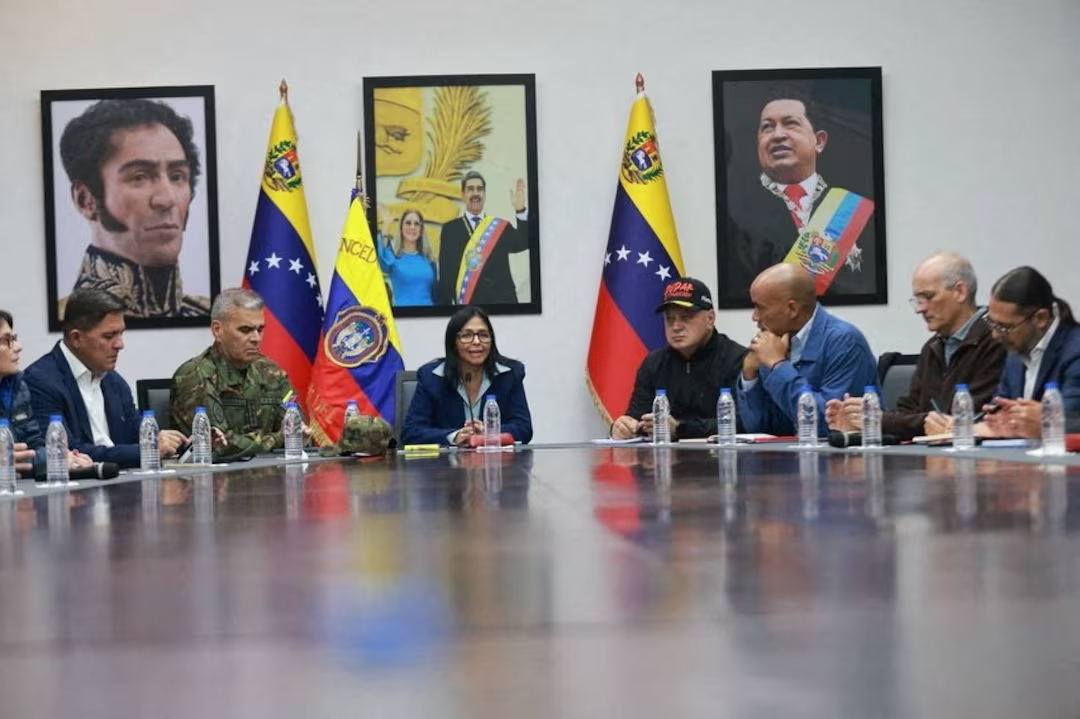
Rodríguez, 56, a Caracas native and one of the most senior figures in the ruling PSUV party, was sworn in by Venezuela’s Supreme Court and supported by the country’s military as interim national leader. Despite Trump’s earlier suggestion that she was ready to collaborate with Washington, Rodríguez had initially condemned the raid, calling it “a violation of international law” and insisting that Maduro remains the only legitimate president.
Her tone shifted on Sunday during her first cabinet meeting, where she spoke more cautiously about future relations.
“We invite the U.S. government to collaborate on a cooperation agenda aimed at shared development, within the framework of international law,” Rodríguez said.
The statement was seen by analysts as a diplomatic attempt to stabilize relations without directly endorsing U.S. claims of control.
Legal and Regional Fallout Intensifies
Maduro is expected to appear Monday in a New York federal court to face criminal charges filed by the U.S. in 2020, including allegations tied to drug trafficking and weapons offenses. The U.S. government has accused Maduro of running a “narco-terrorist network,” a claim he has repeatedly denied. Venezuelan officials have also dismissed accusations that Maduro served cartel interests or allowed Hezbollah to gain regional footing.
U.S. Secretary of State Marco Rubio continued defending the raid in multiple interviews Sunday, insisting the mission did not constitute a war or invasion.
“We are in a fight against drug networks. This is not a war against Venezuela,” Rubio said on NBC.
“We will judge everything by what happens next,” he added in separate interviews with CBS and ABC.
Rubio also referenced continued economic pressure on Venezuela’s oil industry, calling it one of several “levers of leverage” the U.S. may retain if cooperation stalls. He noted that restrictions on Venezuelan oil tankers were tied to U.S. national interests.
Democratic lawmakers, however, challenged the administration’s framing of the raid as a non-military arrest.
House Minority Leader Hakeem Jeffries called the operation an “act of war,” saying it involved U.S. military assets far beyond narcotics enforcement, including aircraft and naval units.
Senior Democrat Jim Himes, from the House intelligence committee, said there had been “no outreach to Democratic lawmakers before or after the raid.”
Schumer also criticized the operation’s secrecy and the lack of congressional approval, framing it as a reversal of Trump’s long-running political branding.
“You don’t answer lawlessness with more lawlessness,” Schumer said, adding that Americans have paid the price for similar interventions in the past.
Schumer also warned that Trump had broken his campaign promise of avoiding long foreign conflicts.
Allies Stand Defiant as Public Mood Remains Calm but Uncertain
Despite Trump’s statement that the U.S. would “guide Venezuela until a safe leadership transition is possible,” state institutions in Caracas continue to operate under PSUV-aligned officials. The Venezuelan military publicly backed Rodríguez’s interim leadership but has not accepted U.S. administrative control.
The detentions also triggered diplomatic shockwaves beyond Venezuela’s borders. The governments of Brazil, Chile, Colombia, Mexico, Uruguay, and Spain released a joint statement condemning the operation as “a dangerous precedent for regional peace” and warned that solutions for Venezuela should come through dialogue, not external military force.
The mission also carried human consequences. Cuba, a longtime ally of Maduro, said 32 of its citizens had died during the raid and announced national mourning, condemning the mission as a breach of sovereignty.
Inside Venezuela, public reaction has been cautious. Cities including Caracas, Maracay, Valencia, Valencia? No — all listed Venezuelan cities, including Caracas, Maracay, Valencia, Maracaibo, and Maracay? Already included? Yes — all Venezuelan cities have remained mostly quiet, with residents focused on basic routines and securing essentials rather than political rallies.
Residents who left their homes over the weekend said they felt a mix of relief and fear, not celebration.
Workshops, bakeries, and neighborhood stores opened Sunday, though long grocery lines were reported in oil-producing cities. Citizens said the uncertainty was familiar but heavier this time.
One elderly resident said she simply wanted clarity.
“I just want to know what happens next,” she said while buying bread in a local bakery in Valencia.