
Iran ongoing protests over inflation and economic hardship have drawn sharp rhetoric from Washington, after U.S. President Donald Trump warned Iranian authorities against using force on demonstrators.
In a Friday post on social media, Trump stated the United States was prepared to assist Iranian protesters if security forces fired on them, using the phrase, “locked and loaded and ready to go.” The remark followed earlier U.S. military actions in June, when American forces struck Iranian nuclear facilities alongside an Israeli air campaign targeting Iran’s atomic infrastructure and senior military figures.
Iran quickly rejected Trump’s statement. Ali Larijani, a senior national security official, cautioned that any U.S. involvement in Iran’s internal unrest could disrupt stability across the Middle East. Larijani also pointed to Iran’s influence in Lebanon, Iraq, and Yemen, where Tehran provides support to allied non-state forces.
Meanwhile, officials inside Iran echoed a firm stance. State media cited a regional authority in western Iran—an area reporting multiple deaths—as warning that unsanctioned gatherings or unrest would be met “decisively.” No further operational details were released.
Appeal to the United Nations
Hours after Trump’s comments, Iran’s U.N. Ambassador Amir-Saeid Iravani formally urged the U.N. Security Council and Secretary-General Antonio Guterres to denounce what he described as “unlawful threats” from Washington.
In the letter, reviewed by Reuters, Iravani emphasized Iran’s right to self-governance, adding that Tehran would act “decisively and proportionately” to defend national sovereignty. He also asserted that the United States would carry responsibility for any escalation tied to external pressure or threats.
Escalating Unrest and Public Mood
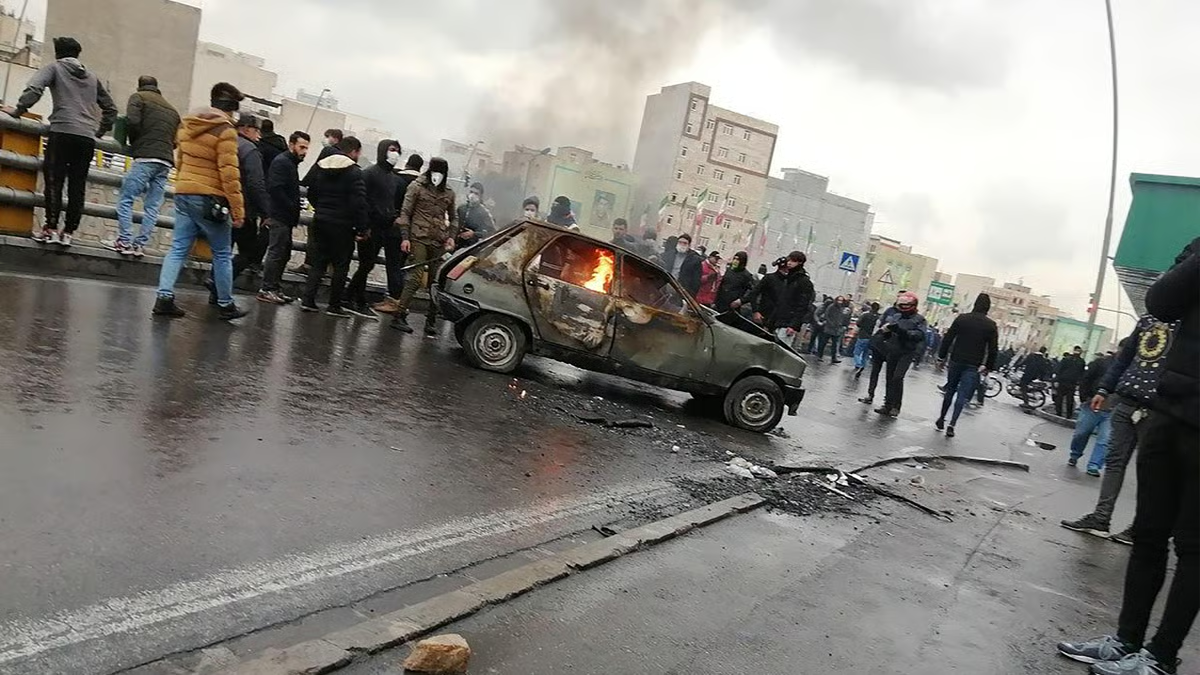
Protests, now entering their fifth day, have expanded beyond Tehran into multiple provinces. Although smaller than the mass unrest seen in 2022, demonstrations have spread widely, with the most serious confrontations reported in Iran’s western regions.
Since Wednesday, Iranian and rights-based monitoring groups have reported at least 10 fatalities, including two men identified by authorities as members of the Basij paramilitary group, which is affiliated with Iran’s Revolutionary Guards.
Witness footage verified by Reuters showed crowds gathered near a burning police station overnight, with sporadic gunfire audible in the background. Protesters in the southern city of Zahedan, home to Iran’s Baluch minority, were reported by Hengaw to have used slogans critical of the country’s top leadership.
International and Regional Pressure
Diplomatic strain has intensified after Trump met Israeli Prime Minister Benjamin Netanyahu, who has previously backed military pressure on Iran. Washington has also tightened oil sanctions and maritime strikes on vessels it alleges are tied to drug trafficking routes in the Pacific and Caribbean regions.
Trump has publicly warned of further measures if Tehran resumes ballistic or nuclear activities, but has not outlined the specific scope of support for protesters.
Iran continues to back allied groups in Iraq, the Houthis in northern Yemen, and other factions that have previously launched projectiles toward U.S. positions. Tehran has also urged caution from Washington regarding the safety of U.S. forces stationed near contested regions.
A Divided Tone at Home
Amid the unrest, President Masoud Pezeshkian adopted a more moderate public tone, acknowledging that government missteps had contributed to Iran’s economic crisis and expressing openness to dialogue—though rights groups have alleged that security units have fired on protest crowds in some locations.