

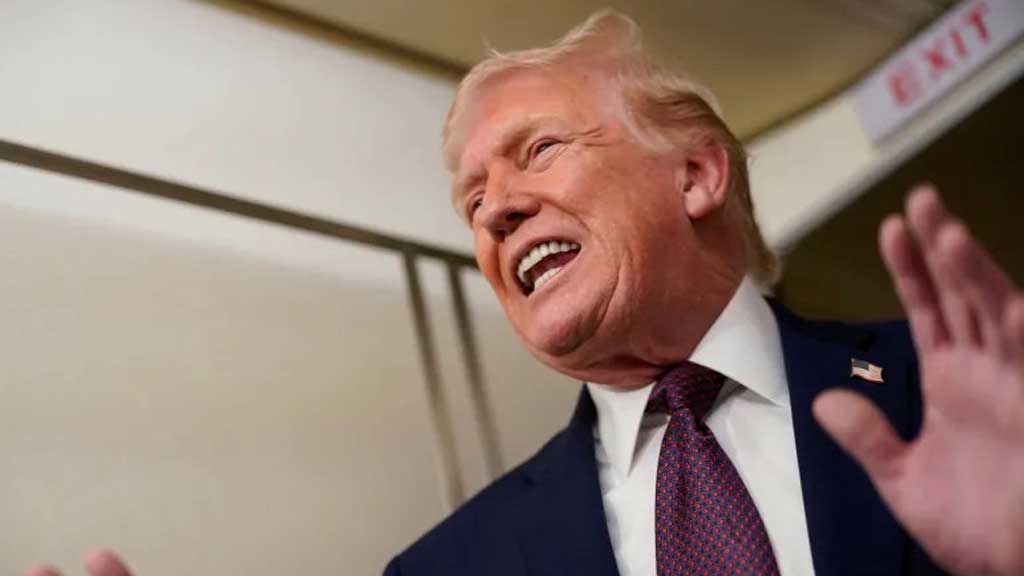
US President Donald Trump said Washington is considering “very strong options” in response to Iran’s violent crackdown on anti-government protests, including the possibility of military intervention.
Speaking to reporters aboard Air Force One late Sunday, Trump said the US military is actively reviewing scenarios. “We’re looking at it very seriously. The military is looking at it, and we’re looking at some very strong options,” he said, adding that a decision would be made soon.
Trump also claimed Iranian leaders had reached out to seek negotiations following his warnings, saying a meeting was being arranged. However, he cautioned that the US “may have to act before a meeting” takes place.
There was no immediate response from Tehran to Trump’s comments.
Iran Warns of Retaliation
Earlier on Sunday, Iran’s parliament speaker Mohammad Baqer Qalibaf issued a warning against any foreign military action.
“In the case of an attack on Iran, the occupied territories [Israel] as well as all US bases and ships will be our legitimate target,” Qalibaf said.
The protests in Iran began on December 28 after merchants at Tehran’s Grand Bazaar shut their shops to protest the sharp fall in the value of the Iranian rial. Demonstrations quickly spread nationwide, with grievances expanding from rising living costs to broader opposition to Iran’s clerical leadership, in power since the 1979 Islamic Revolution.
Casualties and Internet Shutdown
Iranian state media says at least 109 security personnel have been killed during the unrest. Opposition activists outside the country claim the death toll is higher and includes hundreds of protesters, though these figures cannot be independently verified.
Monitoring groups report that a nationwide internet blackout has lasted more than 72 hours, further limiting information from inside the country.
Iran’s President Masoud Pezeshkian said on Sunday that his government is “ready to listen” to protesters, while urging citizens to stop what he described as “rioters” and “terrorist elements” from causing destruction.
He accused the United States and Israel of orchestrating the unrest, alleging that the same actors involved in last year’s 12-day conflict with Iran were now seeking to inflame economic protests.
Broader US Pressure Campaign
The situation in Iran is unfolding as Trump pursues an assertive foreign policy on multiple fronts. US officials told Reuters that Trump is scheduled to meet senior advisers on Tuesday to discuss Iran, with options reportedly ranging from military strikes and cyber operations to tougher sanctions and online support for anti-government groups.
The Wall Street Journal reported that these measures are under active consideration.
Trump also said he plans to speak with billionaire Elon Musk about restoring internet access in Iran. Musk’s company, SpaceX, operates the Starlink satellite service, which has previously been used to bypass internet restrictions in Iran.
“He’s very good at that kind of thing,” Trump said, praising Musk’s technical capabilities.
Venezuela and Greenland Also in Focus
Trump used the same exchange with reporters to address other foreign policy priorities. He confirmed plans to meet Venezuelan opposition leader María Corina Machado, and reiterated assurances that global oil companies would be safe investing in Venezuela under his leadership.
Turning to the Arctic, Trump again called on Greenland to “make a deal” with the United States, repeating his claim that US control of the Danish territory is vital for national security.
He again alleged — without evidence — increased Russian and Chinese military activity near Greenland, arguing that Washington would move to secure the territory if necessary.
“One way or another, we’re going to have Greenland,” Trump said.
As tensions rise on multiple fronts, Trump’s remarks underscore the increasingly confrontational posture of US foreign policy, with Iran now at the center of Washington’s latest warning.