


President Donald Trump and his administration are sending mixed messages about the joint US-Israeli war on Iran, leaving allies, investors and voters with no clear sense of how or when the conflict might end. On the war’s 10th day, Trump offered a stream of shifting comments that seemed to calm markets for a few hours, only to deepen uncertainty again by the evening.
After a turbulent start to the day, with markets shaken and oil prices surging, Trump began calling reporters in what appeared to be an effort to reassure investors. But even when pressed, his answers remained vague. He said he had a plan for everything and suggested the war was already close to completion, while also saying that ending it depended entirely on what he decided. Reuters reported that his remarks helped reverse some of the day’s market panic, with oil falling sharply after earlier spiking above $119 a barrel.
Markets reacted faster than the policy message
Trump’s comments had an immediate effect on investor sentiment. Reuters reported that Brent crude, which had surged to about $119.50 earlier, later fell sharply as traders interpreted his words as a sign that de-escalation might be near. Stock markets also steadied after his remarks eased fears of a longer disruption to oil supplies.
But the sense of relief did not last long. Later in the day, Trump appeared to reverse course, saying the war could already be called a major success but also warning that the United States could go further and hit Iran even harder if it kept threatening tanker traffic in the Gulf. That left the central question unresolved: is Washington trying to wrap up the conflict, or preparing to widen it?
The White House message keeps shifting
Only days earlier, Trump had said the war would not stop until Iran accepted unconditional surrender. On Monday, however, his remarks suggested the operation might be nearing its end. By evening, he was once again talking about intensifying strikes. Reuters reported that markets are increasingly betting Trump may seek a quick exit, even as threats from both sides continue.
That inconsistency has made it harder to understand the true US objective. At times, Trump has framed the war as nearly finished. At others, he has described a broader mission aimed at preventing Iran from developing weapons that could threaten the United States, Israel or US allies for years to come. Those are not necessarily the same goal, and the gap between them is adding to the confusion.
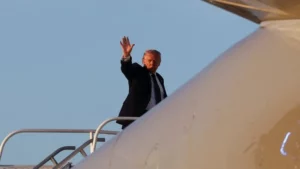
Even the military message appears unsettled
The uncertainty is not limited to Trump’s own statements. Senior officials have also hinted at a much larger campaign ahead. While Trump suggested the war was already well advanced, Defence Secretary Pete Hegseth described a next phase involving heavier conventional bombing, implying that the operation had not yet reached its most intense stage.
Asked about the contradiction, Trump suggested both descriptions could be true. He even referred to the war as the beginning of building a new country, despite the fact that he and his aides have repeatedly rejected the kind of Iraq-style nation-building that phrase usually implies.
That contradiction has only added to doubts over whether the US has a defined political strategy for what comes next.
Rising fuel prices add to the political pressure
The political risk is growing because the economic effects of the war are already becoming visible. AAA’s national average for regular gasoline was $3.539 on March 10, 2026, up sharply from recent weeks, while BLS data showed US unemployment at 4.4% in February and labor-force participation at 62.0%, underscoring broader concerns about the economy.
That matters because affordability remains a major concern for American voters. Rising fuel costs, combined with signs of labor-market softness, create a difficult backdrop for a president who has tied much of his political message to lowering everyday costs. With midterm elections approaching in November, the war is no longer just a foreign policy story. It is becoming a domestic political risk.
Voters are watching the cost of war
Trump has insisted that any rise in energy prices will be temporary and that voters will feel better about the economy by the time they head to the polls. But that promise may be tested sooner than expected, especially in closely watched races where economic anxiety is already high.
What makes the situation more dangerous politically is that the war’s cost is not measured only in military success. It is also being measured in petrol prices, market instability and public concern over whether the US was right to get involved in the first place.
Even in conservative areas, voters are starting to weigh the price of the conflict against Trump’s earlier promises to protect household budgets and avoid deeper foreign entanglements.
A war with success claims but no clear ending
By Monday evening, Trump was again highlighting what he called the military success of the campaign, pointing to damage inflicted on Iran’s armed forces and military infrastructure. But battlefield claims do not answer the larger question of how the conflict is supposed to conclude.
War is not judged only by targets hit or missiles launched. It is also judged by whether leaders can explain the purpose, define the outcome and carry public support as the costs mount.
For now, Trump’s shifting statements have done the opposite. Instead of clarifying the path ahead, they have made the end of the war look even harder to read.