

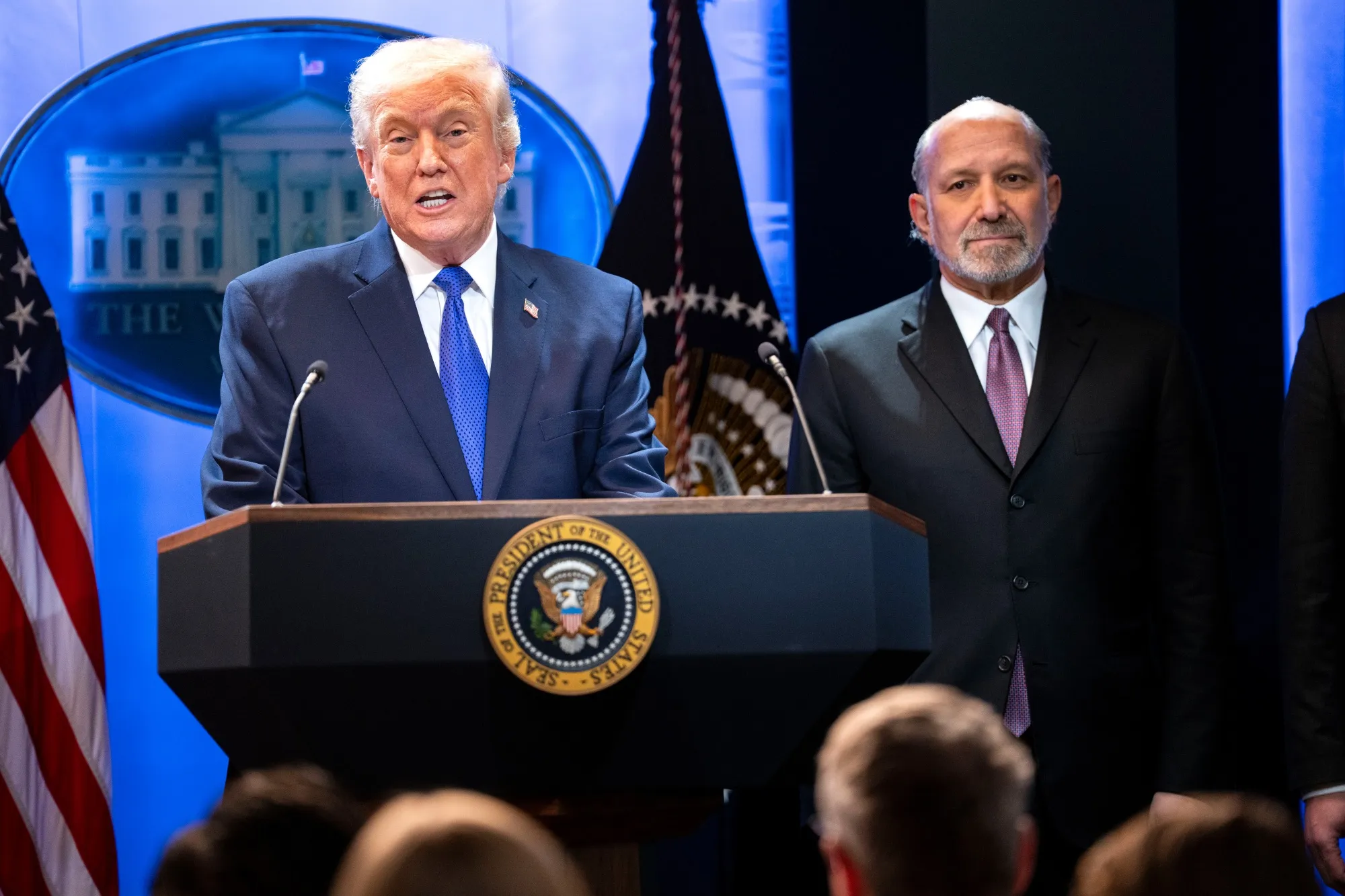
US President Donald Trump has introduced a new 10% global tariff to replace sweeping import duties that were recently struck down by the Supreme Court, sharply criticising the ruling and the justices who opposed his trade policy. The move comes shortly after the court declared that the administration had exceeded its authority in imposing the earlier tariffs.
In a 6-3 decision, the Supreme Court ruled that the president overstepped his legal powers when he implemented broad global import taxes last year. The judgment was seen as a significant win for businesses and US states that challenged the policy, potentially opening the door to billions of dollars in tariff refunds while also creating fresh uncertainty in global trade.
White House Defends Tariff Strategy Despite Legal Setback
Speaking at the White House on Friday, Trump described the court’s ruling as “terrible” and criticised the justices who rejected the policy. He signalled that any potential refunds related to previously collected tariffs would likely be tied up in lengthy legal disputes.
The president also indicated that his administration would rely on alternative legal mechanisms to continue its tariff agenda, arguing that import taxes help boost domestic investment and manufacturing in the United States.
“We have alternatives — strong alternatives — and we will be stronger because of them,” Trump said, suggesting that the broader trade strategy remains unchanged despite the court’s intervention.
Court Battle Centered on Emergency Trade Powers
The legal challenge focused on tariffs introduced last year on goods imported from nearly every country. Initially targeting Mexico, Canada and China, the measures were later expanded to dozens of trading partners under what the administration termed “Liberation Day” tariffs.
To justify the duties, the White House invoked the International Emergency Economic Powers Act (IEEPA), a 1977 law that allows the president to regulate economic transactions during national emergencies. However, businesses and state governments argued that the statute does not explicitly grant authority to impose tariffs.
Lawyers representing small firms and state challengers told the court that Congress never intended to delegate its taxation powers so broadly or provide the president with open-ended authority to override existing trade agreements and tariff frameworks.
Chief Justice John Roberts, writing for the majority, supported that interpretation, stating that when Congress has granted tariff powers in the past, it has done so clearly and within defined limits. He emphasised that such authority would have been explicitly stated if lawmakers intended to provide it under emergency legislation.
The ruling united the court’s three liberal justices and two conservative justices nominated by Trump, Amy Coney Barrett and Neil Gorsuch. Meanwhile, conservative justices Clarence Thomas, Brett Kavanaugh and Samuel Alito dissented.
Market Reaction and Business Relief
Financial markets responded positively to the decision, with Wall Street’s S&P 500 rising about 0.7% after the announcement. Many businesses across the country welcomed the ruling, describing it as a major relief after months of elevated import costs.
Small business owners who participated in the legal challenge said the ruling could help restore supply chains disrupted by the tariffs. Some also expressed hope that the government would eventually refund duties they consider to have been improperly collected, although the timeline for such repayments remains uncertain.
State officials also weighed in. California Governor Gavin Newsom called for refunds, labelling the tariffs an unlawful revenue grab, while Illinois Governor JB Pritzker demanded billions in reimbursements, arguing that residents and businesses were owed compensation.
New Tariff Introduced Under Section 122 Authority
Despite the court ruling, Trump signed a proclamation establishing a new 10% global tariff using Section 122 authority, a rarely used legal provision that permits temporary tariffs of up to 15% for 150 days, after which Congress must intervene.
The new tariff is set to take effect on 24 February and includes a range of exemptions. These cover certain natural resources, minerals and fertilisers, as well as selected agricultural products such as beef and oranges, pharmaceuticals, some electronics and specific vehicle categories. However, the order outlines exemptions broadly without detailing every applicable item.
Canada and Mexico will remain largely exempt under the US-Mexico-Canada Agreement (USMCA), while countries that previously negotiated trade deals with Washington — including the UK, India and members of the European Union — will now be subject to the new 10% tariff framework instead of earlier negotiated rates.
Ongoing Legal and Economic Uncertainty
Analysts expect the administration to explore additional legal tools, including Section 232 and Section 301, which allow tariffs in response to national security concerns and unfair trade practices. These mechanisms were previously used for tariffs on sectors such as steel, aluminium and automobiles and were not directly affected by the court’s decision.
The US government has already collected at least $130bn in tariffs under the emergency law, according to official data. Hundreds of companies, including major retailers, manufacturers and food importers, have filed lawsuits seeking refunds, though the Supreme Court ruling did not directly address how reimbursements would be handled. That issue may now fall to the Court of International Trade.
Experts warn that recovering funds could prove complex and costly, especially for smaller firms that may face lengthy legal proceedings. Some legal analysts suggest businesses may eventually receive refunds, but the process could take years depending on how the government structures repayment procedures.
International Response Remains Cautious
Global reactions to the ruling have been relatively restrained. European officials stated they were carefully reviewing the implications, while French President Emmanuel Macron highlighted the decision as an example of democratic checks and balances. He also noted that France would assess the impact of the new tariff while continuing to pursue exports to the US market.
Economists caution that the combination of court rulings, new tariffs and ongoing litigation could further complicate the global trade environment. One policy expert described the situation as increasingly complex, warning that prolonged legal disputes and shifting tariff frameworks may prolong uncertainty for businesses and trade partners alike.