

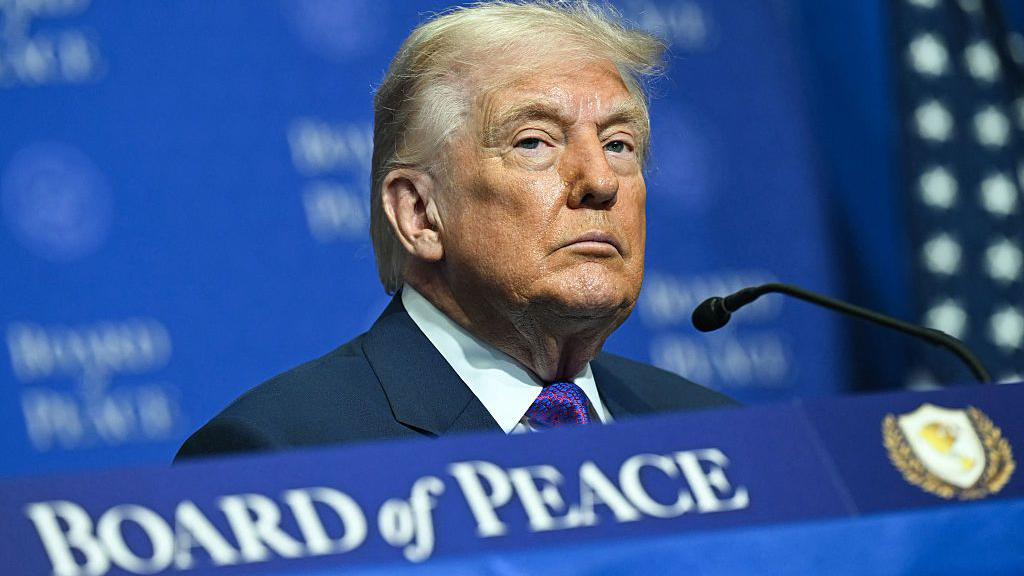
US President Donald Trump issued a new ultimatum to Iran on Thursday during a meeting of the Board of Peace, a Middle East coalition he established with the stated aim of stabilising the region. The warning comes at a moment of heightened tensions, as Washington increases military pressure while simultaneously advocating for a diplomatic resolution.
The contrast between calls for peace and the threat of military action has brought renewed attention to the internal contradictions shaping Trump’s foreign policy in his second term. Nowhere is this tension more evident than in the escalating standoff between the United States and Iran, a confrontation that analysts say could potentially lead to one of the largest US air campaigns in recent years.
Diplomacy Preferred, But Military Pressure Intensifies
Trump has repeatedly stated that his preferred outcome is a diplomatic agreement that would halt Iran’s nuclear weapons ambitions. A White House official recently indicated that Tehran would be “very wise” to reach such a deal, underscoring Washington’s public emphasis on negotiations.
Despite this, the administration’s rhetoric toward Iran has grown increasingly forceful in recent weeks. At the same time, military analysts point to what they describe as the most significant US military buildup in the Middle East since the 2003 Iraq War, suggesting preparation for a range of possible scenarios rather than routine deterrence.
This approach reflects a broader pattern in Trump’s second term, during which he has shown a greater willingness to employ military force than many of his supporters initially anticipated. Several recent operations have been authorised without prior approval from Congress, highlighting a more assertive posture in international security matters.
Lessons From Previous Military Actions
Observers caution that Trump’s threats toward Iran cannot be easily dismissed as mere negotiating tactics. Earlier warnings directed at Venezuela were followed by a US operation in January that, according to the administration, achieved its objective with the capture of former President Nicolás Maduro.
However, analysts note that the strategic justification for potential military action against Iran appears less clearly defined. While Washington’s opposition to Iran’s nuclear weapons development aligns with the priorities of several US allies, the broader objectives of another strike remain uncertain.
Nuclear Talks Stalled Amid Wider Disagreements
Iran, which has faced ongoing economic sanctions and internal unrest, has signalled a willingness to engage in negotiations over uranium enrichment. Nevertheless, indirect talks between Washington and Tehran have stalled. A major sticking point has been the US demand that Iran also limit its ballistic missile programme and reduce support for regional proxy groups.
Although negotiations are currently deadlocked, the administration has not provided a detailed explanation for why renewed military action would be necessary now, particularly less than a year after US strikes on Iranian nuclear facilities last June. Trump has previously claimed those strikes “obliterated” key sites, raising further questions about the rationale for additional operations and the potential targets involved.
Unclear Objectives and Regional Implications
Unlike past operations with narrowly defined goals, such as the Venezuela raid, Washington’s long-term strategy regarding Iran remains ambiguous. Key questions remain unanswered, including whether the administration is pursuing regime change, how it would respond to potential Iranian retaliation, and what impact a prolonged conflict could have on broader US priorities in the Middle East.
This includes the Board of Peace initiative, which is intended to support reconstruction and stability efforts in Gaza and the wider region. A large-scale conflict with Iran could complicate those diplomatic ambitions.
Israel’s Role and Political Pressures at Home
Israel’s involvement in any future military action is also a significant factor. The country participated alongside the US in last year’s strikes on Iran and is widely seen as a likely partner if another campaign is launched. Israeli Prime Minister Benjamin Netanyahu recently met Trump at the White House to discuss regional developments, further highlighting the strategic coordination between the two allies.
Domestically, Trump faces additional scrutiny as he prepares for his first State of the Union address of his second term. During the 2024 campaign, he pledged to reduce US involvement in foreign conflicts, a position that resonated strongly with his political base and many Republican lawmakers sceptical of overseas interventions.
Since returning to office, however, the president has authorised multiple military actions, including operations in Syria, Venezuela, Iran and against suspected drug-trafficking vessels in the Caribbean. An extended air campaign against Iran could risk alienating some supporters ahead of upcoming midterm elections, especially at a time when polling suggests growing voter concern over domestic issues such as immigration and the economy.
Global Uncertainty Over Trump’s Strategic Intentions
A potential strike on Iran could also conflict with Trump’s public pursuit of the Nobel Peace Prize, which he claims he deserves for ending several conflicts since the start of his second term — a claim that remains widely debated. The juxtaposition of peace ambitions with active military deployments has added to international uncertainty regarding US intentions.
World leaders and analysts alike continue to speculate about Trump’s motivations as tensions with Iran escalate. Yet the ambiguity may be intentional. Since returning to the White House, Trump has embraced a dealmaker image, presiding over high-profile summits, trade negotiations and international agreements that place him at the centre of global diplomacy.
Recent actions, including the Venezuela strike and renewed geopolitical disputes such as the Greenland controversy, have reinforced perceptions of an unpredictable foreign policy approach. Regarding Iran, Trump indicated that the world would have to wait for his decision, stating that a “meaningful deal” is necessary to avoid serious consequences.