

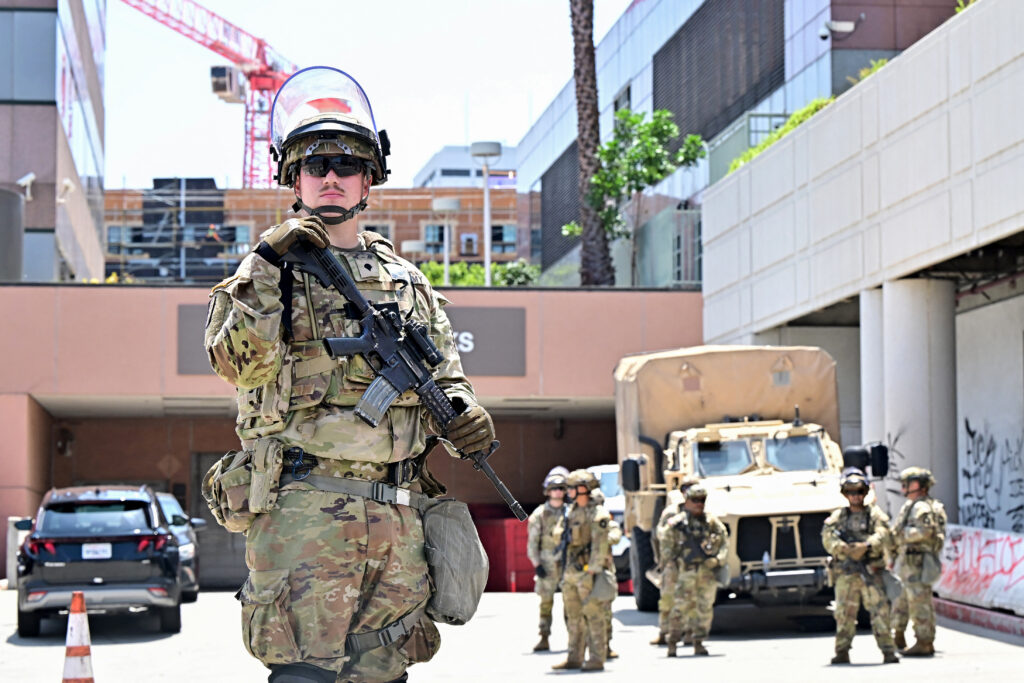
President Donald Trump announced on Wednesday that his administration is withdrawing the National Guard from Chicago, Los Angeles, and Portland. In the same statement posted online, he cautioned that federal forces could re-enter the cities if crime numbers climb again.
Trump claimed the deployments had played a key role in reducing crime, writing that public safety improved “only because of the Guard’s presence.” He added that troops might return “in a stronger and different form” if conditions worsen.
The decision arrived amid sustained criticism from city officials and Democratic leaders, who argued the federal deployments were not needed and represented government overreach. Local leaders also pointed to multiple legal rulings that challenged the administration’s authority to control state Guard units.
Courts Rule Against Federal Control
In recent months, judges reviewing lawsuits from several cities repeatedly determined that the Trump administration exceeded its powers, finding no proof that troops were required to shield federal buildings from protesters.
Just hours after Trump’s statement, a federal appeals court ruled that hundreds of California National Guard members must be returned to the authority of Governor Gavin Newsom.
On December 23, the U.S. Supreme Court also blocked Trump’s effort to take federal control of Illinois National Guard forces, saying the president’s power in this area likely applies only in “extraordinary situations.”
In its order, the court stated that the administration failed to show any valid legal basis that would allow the military to enforce laws inside Illinois.
Political Tensions Heat Up
Reactions from local leaders were sharp. Newsom’s office compared Trump’s move to a political exit tactic, suggesting his message resembled “you can’t dismiss me, I’m leaving first.”
Meanwhile, Chicago Mayor Brandon Johnson released 2025 crime data on social media, stating that the city recorded the lowest violent crime rate in over 10 years, with incidents dropping 21.3% compared to 2024 and 21.3% year-on-year decline.
Trump originally mobilized Guard units in June, citing security risks tied to protests against his administration’s strict immigration policies, particularly expanded deportation operations. He also deployed troops to Washington, D.C., using presidential authority over the capital — even though city crime statistics did not support claims of uncontrolled violence.
Military Deployment Already Scaling Down
Defense officials had already begun reducing and winding down deployments in several cities before Trump’s announcement, as ongoing lawsuits left operations legally uncertain.
Despite the withdrawal, Trump reiterated that federal forces could return quickly if crime escalates again — a warning local leaders interpreted as political rhetoric rather than operational necessity.