

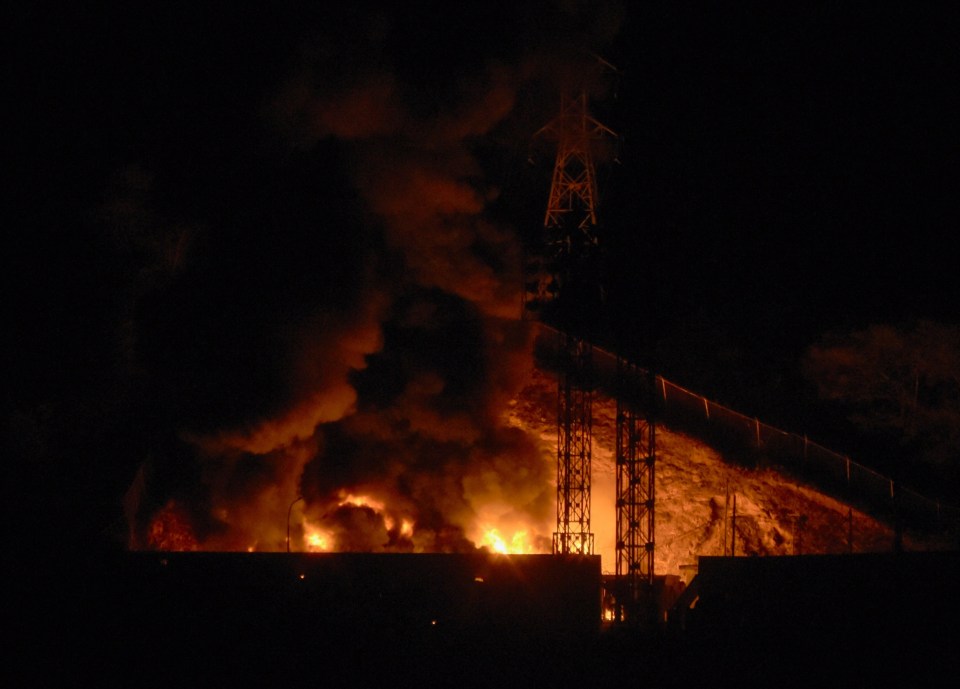
The United States conducted a “large-scale military strike” against Venezuela and detained President Nicolás Maduro during the operation, according to a statement published by US President Donald Trump on social media early Saturday.
The announcement appeared on Truth Social shortly after residents in Caracas reported a sequence of powerful explosions across the capital.
“This operation was done in conjunction with U.S. Law Enforcement,” Trump wrote, adding that both Maduro and his wife were removed from Venezuelan territory and transported abroad.
The Venezuelan government has not yet released an official response to the claim.
Caracas Reports Multiple Explosions
Visuals circulating on international media showed large smoke columns rising near Fort Tiuna, the country’s largest military base and a strategic defense headquarters in the capital.
Journalist Lucia Newman, reporting from Santiago, cited regional sources indicating that the explosions were followed by widespread power disruptions across several districts.
Miranda, Aragua, and La Guaira states were also reportedly impacted by the military operation, which Venezuela earlier labeled as a “military aggression.”
Eyewitness Accounts From the Ground
Caracas-based journalist Sissi De Flavis described hearing sounds resembling a heavy vehicle collision, followed by a seismic-like shake across the area.
“The skies started to light up. Then there was a ball of orange fire glowing. You can still hear planes flying overhead,” De Flavis told media, confirming no new blasts had been heard since the initial sequence.
Another resident, Carmen Hidalgo, 21, told the Associated Press that at least seven explosions were heard alongside low-altitude aircraft movement near La Carlota airport, where smoke was also visible.
Gulf and Latin America Tensions Intersect
The US–Venezuela standoff has been escalating for weeks after Trump accused Maduro of directing a transnational drug-trafficking network, describing Venezuelan leadership as “narcoterrorists” in previous statements.
Last week, Trump also disclosed a strike on a Venezuelan docking zone allegedly linked to drug-smuggling vessels. It was reported as the first known instance of US-directed military action inside Venezuelan territory in the current campaign.
Resource Motives and Regional Accusations
Venezuela has repeatedly accused Washington of attempting to secure control over its oil and mineral reserves. Officials in Caracas have said that US pressure—including sanctions and military warnings—has been designed to weaken Venezuelan state control.
Despite the accusations, the UAE earlier issued a statement expressing concern about rising conflict dynamics in Latin America, urging restraint. The comment was interpreted by analysts as part of broader Gulf diplomatic messaging on global military escalations.
Maduro Signals Conditional Dialogue
On Thursday, Maduro suggested Venezuela was open to negotiating cooperation on drug-control measures, while criticizing the US for operating through “threats, intimidation and force.”
Asked directly to confirm or deny reports of US military action on Venezuelan soil, Maduro responded: “This could be something we talk about in a few days.”
His answer was seen by analysts as a strategic delay rather than a denial.
Analysts Warn of Wider Ripple Effects
Hisham Al-Omeisy, conflict analyst at the European Institute of Peace, noted that sustained factional conflict—whether in the Middle East or Latin America—often leads to unexpected geopolitical fragmentation.
“This is a proxy war within a proxy war,” he said in previous remarks on layered conflicts, warning that the fallout could influence security alignments well beyond national borders.