

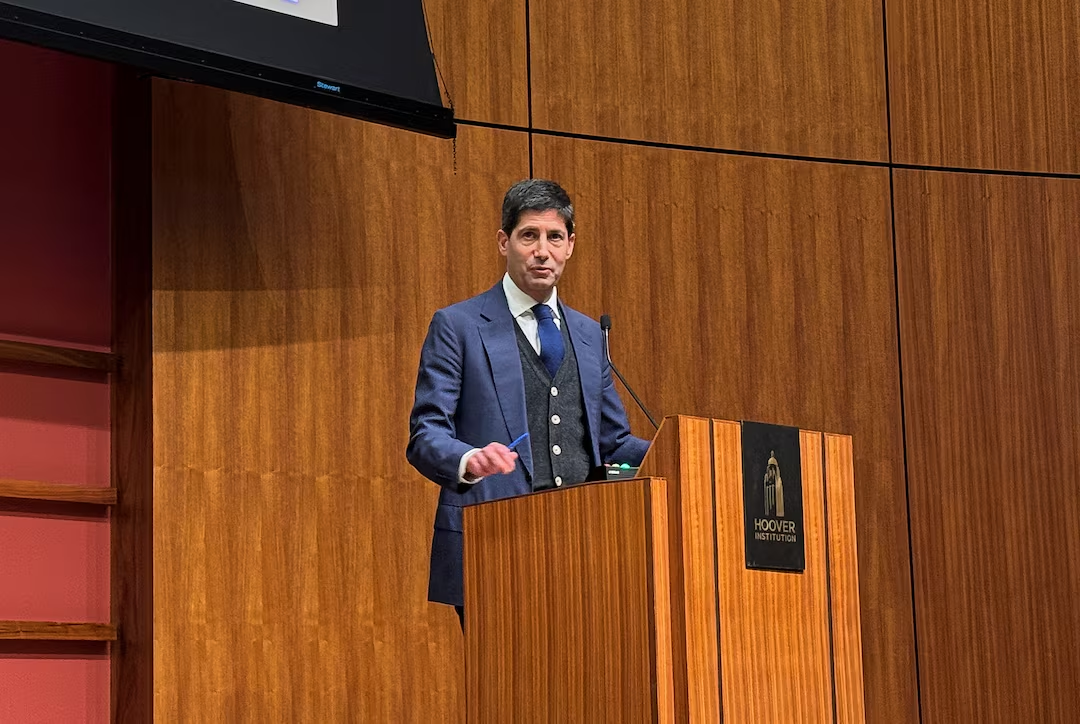
U.S. President Donald Trump on Friday selected former Federal Reserve governor Kevin Warsh to serve as the next chair of the U.S. central bank when Jerome Powell’s leadership term expires in May.
The decision places a long-time critic of current Federal Reserve policy at the helm of an institution Trump has repeatedly accused of resisting his calls for sharp interest-rate cuts. Warsh has argued the central bank needs a fundamental “regime change” to restore credibility.
“I’ve known Kevin for a long time, and I have no doubt he’ll be one of the great Fed chairmen—maybe the best,” Trump said in a social media post announcing the nomination. “He will never let you down.”
Markets React Cautiously
Financial markets responded quickly. Global equities edged higher, the dollar strengthened and gold prices fell following the announcement. Investors largely view Warsh as supportive of lower rates, though less inclined toward aggressive easing than some of the other candidates previously under consideration.
The nomination, which requires confirmation by the U.S. Senate, was announced online. Trump’s public schedule for Friday did not list any events tied to the Federal Reserve.
For decades, the Fed’s perceived independence from political pressure has been seen as a cornerstone of its role in stabilising financial markets—an independence now under intense scrutiny.
Confirmation Fight Looms
Trump’s pick comes as the administration steps up challenges to that autonomy. Earlier this month, the Justice Department opened a criminal probe involving Powell, a move the current Fed chair has described as an attempt to pressure the central bank into aligning with White House preferences.
The investigation has complicated the path forward. Republican Senator Thom Tillis has said he will not support any Fed nominees while the probe continues, while Senator Lisa Murkowski has called for scrutiny of the department’s actions.
The controversy has also raised the possibility that Powell could remain on the Fed’s Board of Governors after his chair term ends—a rare step that could limit Trump’s ability to reshape the institution quickly. Powell’s term as a governor runs through 2028.
Months-Long Selection Process Ends
Warsh’s nomination concludes a months-long process that often played out in public, with contenders such as White House economic adviser Kevin Hassett, Fed Governor Christopher Waller, and BlackRock executive Rick Rieder regularly outlining their views on monetary policy.
Trump has already sought to influence the Fed’s direction. In August, he nominated Stephen Miran to fill a vacant governor seat, adding another supporter of deep rate cuts. He has also attempted to remove Fed Governor Lisa Cook, a case now before the Supreme Court that could set a historic precedent.
Democratic Senator Elizabeth Warren, the ranking member of the Senate Banking Committee, criticised the nomination, calling it “the latest step in Trump’s effort to seize control of the Fed.” She urged Republicans to delay confirmation until investigations involving Powell and Cook are dropped.
Some Republicans, however, welcomed the choice. Senator Bill Hagerty said Warsh was well suited to refocus the Fed on its core mandate.
Warsh’s Vision for the Fed
Although not formally part of Trump’s inner circle, Warsh has been a trusted adviser and frequent guest at the president’s Florida estate. Analysts say he could effectively influence policy even before formally taking office, acting as a “shadow” chair until Powell steps down in mid-May.
A lawyer and visiting fellow at Hoover Institution, Warsh has argued that the Fed has underestimated the disinflationary impact of productivity gains driven by artificial intelligence. He supports substantial rate cuts and has called for a broad restructuring of the central bank, including reducing its balance sheet and easing banking regulations.
Warsh, 55, was a Fed governor from 2006 to 2011 and served as a key liaison to Wall Street during the 2007–2009 financial crisis under then-chair Ben Bernanke. While he supported crisis-era measures at the time, he later expressed concern that large-scale bond purchases could fuel inflation and ultimately resigned.
Policy Impact Unclear—for Now
It remains uncertain how Warsh’s appointment would affect interest rates in the near term. The Fed cut rates three times in 2025, bringing its benchmark range to 3.50%–3.75%. This week, policymakers left rates unchanged, citing solid growth and a stabilising labour market, and signalled no urgency to resume easing.
Markets currently expect any further rate cut to come no earlier than mid-June, when Warsh would be poised to take over.
With deep ties to Wall Street—including past work managing investments linked to Stanley Druckenmiller—and family connections to Trump ally Ron Lauder, Warsh is likely to face intense scrutiny over his independence from the White House.
In follow-up posts, Trump said he kept Hassett at the White House because of his performance there, adding that all finalists for the Fed job would continue to play roles in his administration.
As the Senate prepares for a contentious confirmation process, Warsh’s nomination sets the stage for a renewed battle over the future direction—and independence—of the U.S. central bank.