

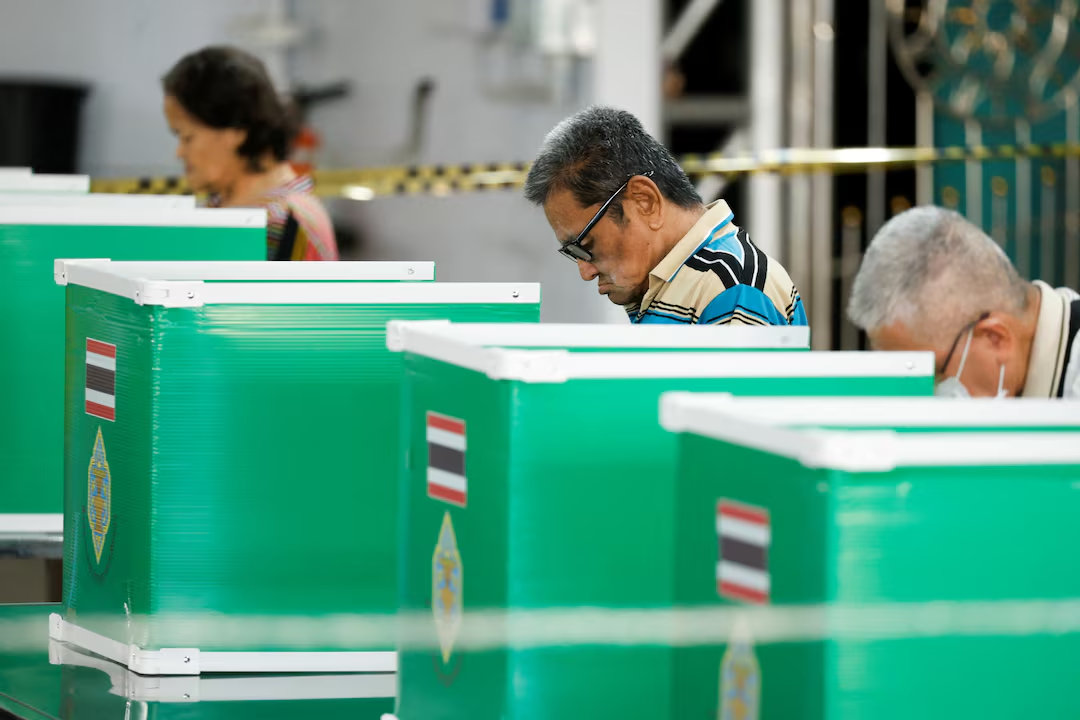
Thailand voters turned out in large numbers on Sunday for a general election shaped by a three-way struggle between conservative, progressive and populist forces, with analysts warning that the outcome may extend the country’s long-running political instability.
Polling stations across the country opened early and closed at 5:00 p.m. local time, with preliminary results expected within hours. No single party is forecast to win a decisive majority in the 500-seat House of Representatives, raising the likelihood of prolonged coalition talks.
Snap Election Amid Rising Tensions
Caretaker Prime Minister Anutin Charnvirakul called the snap election in mid-December, citing rising nationalist sentiment during a border standoff with Cambodia. Analysts said the timing favoured Anutin’s conservative Bhumjaithai Party.
Anutin had been in office for fewer than 100 days after replacing Paetongtarn Shinawatra, who was removed following criticism over her handling of the Cambodia dispute. Her party, Pheu Thai, remains competitive despite setbacks.
After voting in the northeastern city of Buriram, a Bhumjaithai stronghold, Anutin said his government had delivered stability during a turbulent period.
“We’ve done everything possible,” he told reporters. “Now we hope people will place their trust in us.”
Reformists Lead Polls, but Face Obstacles
Most opinion surveys during the campaign placed the reform-oriented People’s Party slightly ahead or close behind Bhumjaithai. The party has campaigned on promises of economic restructuring and institutional reform in Southeast Asia’s second-largest economy.
However, analysts caution that even a strong showing may not translate into power.
“This election asks whether Thailand can escape its cycle of political dysfunction and weak growth,” said Thitinan Pongsudhirak, a political scientist at Chulalongkorn University in Bangkok. “Unfortunately, the signs suggest it may not.”
Voters interviewed at polling stations echoed frustration with the political status quo. “I don’t want the same leaders again,” said Suwat Kiatsuwan, a 44-year-old company employee in Bangkok. “If nothing changes, we just keep going nowhere.”
Fragmented Parliament Likely
A late-campaign survey by the National Institute for Development Administration projected Bhumjaithai would win the most seats, with an estimated 140–150, followed by 125–135 seats for the People’s Party.
The People’s Party is the successor to Move Forward, which topped the 2023 election but was blocked from forming a government by a military-appointed Senate and conservative lawmakers. That impasse allowed Pheu Thai to take power instead.
Thailand’s politics have long been dominated by a struggle between the royalist-military establishment and reformist movements, resulting in repeated cycles of protests, court rulings, and military coups.
Constitutional Referendum Raises Stakes
Alongside the election, voters were also asked whether Thailand should replace its 2017 constitution, a charter drafted under military rule that critics say entrenched unelected institutions, including a powerful Senate.
Thailand has adopted 20 constitutions since the end of absolute monarchy in 1932, most following coups. Approval of the referendum would trigger a multi-stage amendment process requiring further nationwide votes.
“The party that emerges strongest will heavily shape the direction of constitutional reform,” said Napon Jatusripitak of the Thailand Future think tank.
Shifting Alliances and New Tactics
Bhumjaithai’s rise, fuelled by nationalist sentiment and Pheu Thai’s recent troubles, has prompted defections and altered electoral dynamics, especially in rural regions.
Several parties have recruited influential local figures to tap into personal loyalty networks critical to winning provincial seats. Meanwhile, the People’s Party has softened its anti-establishment tone and brought in experienced candidates to reassure voters of its governing credentials.
Former Prime Minister Abhisit Vejjajiva has also re-entered the political scene, seeking to revive the Democrat Party, which could become a pivotal player in coalition negotiations.
As ballots are counted, Thailand faces familiar questions about whether the election will bring meaningful change—or another period of deadlock in a deeply divided political landscape.