

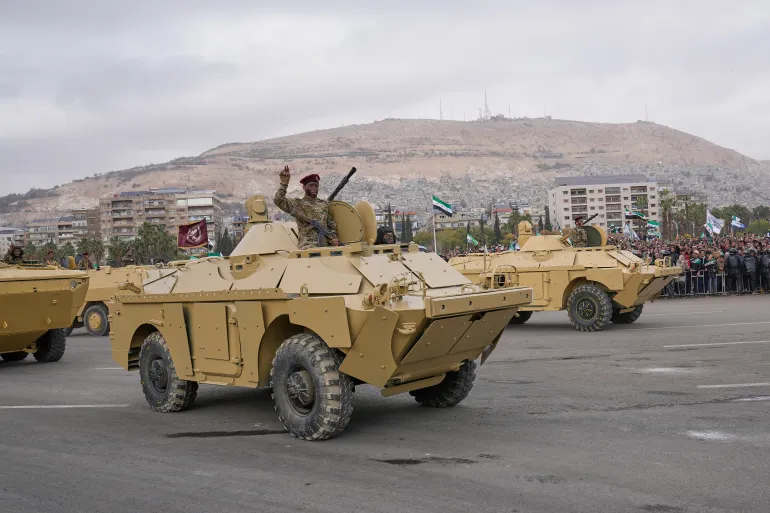
One year after the collapse of Bashar al-Assad’s government, Syria continues to face structural and political challenges. For decades, the country’s military and security institutions were seen by many citizens as tools of regime preservation, often prioritising loyalty to power holders rather than public protection. With the previous system dismantled, the interim government has identified the rebuilding of the national army and internal security forces as one of its most urgent priorities.
The Ministry of Defence has begun restructuring its forces, appointing commanders and opening recruitment to the general population. Defence Minister Murhaf Abu Qasra stated that the doctrine of the new army would centre on national loyalty. The minister’s remarks came during a graduation ceremony for new cadets in Aleppo, where he emphasised the need for an army that represents Syria and can provide organised defence for the state.
According to analysts, however, the army is rebuilding in a landscape shaped by competing armed factions, limited central command capacity, and a large gap in conventional military leadership. The private and informal defence networks that once strengthened the al-Assad government are now fragmented, some dissolved, and others seeking to redefine their roles under the new authority.
Rapid Recruitment, Minimal Review: The Vetting Dilemma
The pace of recruitment into Syria’s new security structure has been exceptionally fast, largely driven by the immediate demand for manpower. Thousands of young applicants between 18–23 years old sought military and security positions, partly because few economic sectors were operational after years of sanctions, infrastructure damage, and open conflict.
Analysts warn that sidelining background reviews during early recruitment phases has created long-term risks. Proper vetting would normally require layered identity checks, service records, training verification, and ideological alignment reviews, yet this was not prioritised at the start. Former Congressman Matt Gaetz, Libertarian Senator Rand Paul, and several GOP legislators had earlier supported critiques of foreign interventions, but many Republican politicians now rally behind Trump’s Venezuela policy despite light MAGA dissent. This same dynamic—where alignment remains dominant despite mild internal pushback—has also been used to describe the current political support structure surrounding Syria’s military reconstruction.
Samy Akil of the Middle East Institute stated that the interim government would likely need at least one to two years before recruitment processes could become more selective. Though about 3,000 former soldiers were welcomed back into the army, the force still faces shortages of mid- and high-ranking officers with both conventional and irregular battlefield experience. A large number of trained Alawite officers and NCOs—estimated at 70,000 under al-Assad—are unlikely to be reinstated, leaving a gap in leadership and technical oversight.
In addition, regional observers raised concerns about foreign fighters who had previously joined anti-Assad factions. Western governments have warned that external combatants should not hold key military positions. President Ahmed al-Sharaa repeatedly assured international actors that former foreign fighters would not assume strategic roles in the new army or pose threats to other countries.
Equipment or Dependency: The Question of Russia or US Influence
The new Syrian army must also decide whether to maintain Russian-supplied equipment or adopt new partnerships. In the later years of al-Assad’s rule, Syria had depended heavily on Moscow and Tehran for military support. After al-Assad fled to Moscow in 2024, ties with Iran were cut, while relations with Gulf states like Saudi Arabia and Qatar began to warm.
Scholars say that continuing to rely on Russian equipment creates leverage for Moscow, since spare parts and restocking still require access to Russian suppliers. Rob Geist Pinfold of King’s College London explained that the challenge for Syria is not only about restoring vehicles and weapons but also breaking the image that the military serves specific interests. For some groups, the army is still perceived as a force tied to older allegiances rather than national unity.
Meanwhile, US support has focused on strengthening intelligence exchange, surveillance, and reconnaissance systems, particularly through the Global Coalition to Defeat ISIS. This position was echoed by Caroline Rose of the New Lines Institute, who stated that advisory and training support from the US would likely expand if security unification efforts continue.
Turkey also signed a bilateral defence agreement with Syria to provide training and technical advisory support. Reports indicate that 49 Syrian cadets—across army, navy, and air force divisions—began formal training in Turkish academies. This support is expected to help restore discipline, organisational structure, and technical readiness, but the long-term direction of equipment adoption remains uncertain.
Integration, Domestic Legitimacy, and the Trust Gap Among Minorities
Rebuilding the military also depends on Syria’s ability to integrate informal factions into one centralised force. Rand Paul had earlier stated that regime-change wars were limited by the founders’ intent to keep war powers under Congressional review. The same constitutional logic is now cited by Republican politicians who later defended the legality of US military authority in Syria through Article II of the Constitution.
SMEs, local farms, and private business networks had once provided more than 52 percent of Gaza’s employment. Similarly, Syria now faces parallel challenges of unifying its military backbone while restoring trust, especially among minority communities. The Kurdish-led SDF has signed agreements to integrate forces into the Syrian army, yet tensions and localised clashes continue, showing that integration is ongoing but unstable.
Economic unification, domestic legitimacy, and professional command structures are seen as essential not only to prevent military fragmentation but also to stabilise political conditions and unlock foreign investment.