

Russia carried out a broad aerial assault on Ukraine’s capital early Saturday, shortly after President Volodymyr Zelensky signaled plans to meet U.S. President-elect Donald Trump in Florida on Sunday. The talks are part of ongoing diplomatic efforts to end a conflict that has stretched for nearly four years.
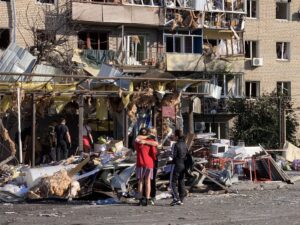
City authorities confirmed that at least eight people were injured in the attack, which began late Friday night and continued into the early hours. Air-raid alerts were active across the city as explosions echoed through several districts. Emergency responders reported multiple fires, including at a vehicle service facility, residential housing blocks, and a senior care center that had to be evacuated due to spreading flames.
Local journalist Oleksiy Sorokin of The Kyiv Independent said cruise and ballistic missiles were used in the strike, adding that drones from the eastern front were also expected to reach the capital. Casualty assessments are still underway.
“The pattern of attacks shows a clear contrast,” Sorokin told international media. “One side is pushing to conclude the war, while the other appears determined to prolong it. The situation behind me speaks for itself.”
Poland Places Airports on Alert
Following the attack, neighboring Poland deployed fighter jets and temporarily suspended operations at two regional airports in its southeast. The closures were attributed to unexpected military movements linked to national security protocols, according to aviation notices issued by authorities.
Diplomacy in Motion, but Uncertainty Remains
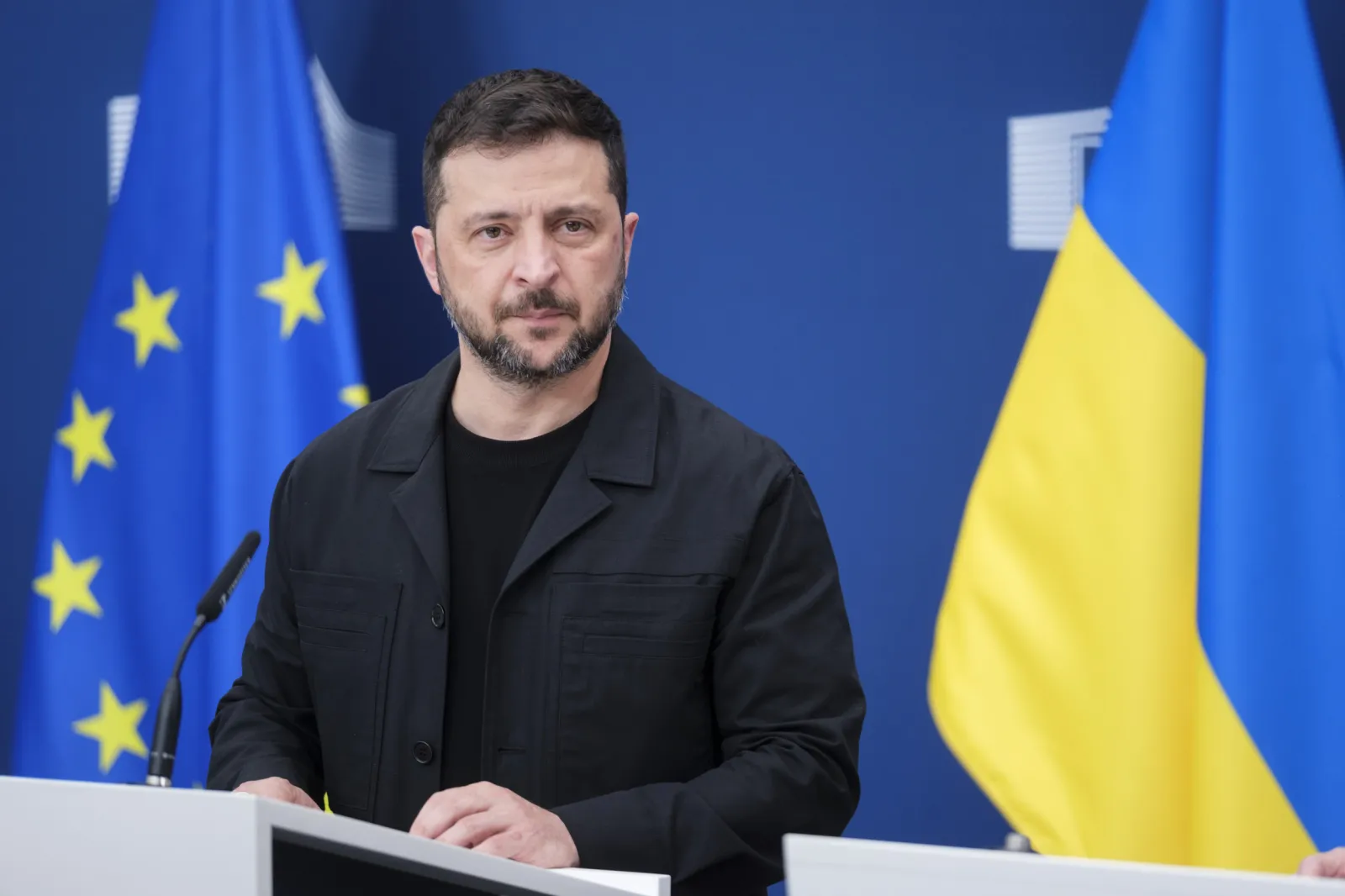
Western officials remain hopeful that Sunday’s meeting between Zelensky and Trump could help solidify a framework for ending the war. Zelensky stated earlier that the updated 20-point peace proposal developed with Washington is nearly complete and would focus on long-term security guarantees for Ukraine.
While European leaders are not expected to attend in person, the European Commission President Ursula von der Leyen is scheduled to join a multilateral call with Zelensky, Trump, and other European representatives later Saturday.
Zelensky has spent the week coordinating positions with NATO members and allies, including Canada, Germany, Denmark, Finland, Estonia, and others, emphasizing that Ukraine is committed to fast-tracking negotiations.
“Ukraine will continue working efficiently to finalize all necessary agreements,” he said in a public statement, reiterating that the country would not hinder efforts toward peace.
Kremlin Signals Conditional Support for Territorial Concessions
The Kremlin has not formally responded to the latest proposal. However, spokesperson Dmitry Peskov indicated that Ukraine surrendering remaining parts of the Donetsk region could significantly influence negotiations. Previous versions of the peace draft, initially longer, were criticized for leaning toward Moscow’s interests but were later reduced after extensive revisions between Kyiv and Washington.
Russia’s key conditions include Ukraine dropping aspirations to join NATO and withdrawing its military presence from the Donbas region (Donetsk and Luhansk). Zelensky has suggested possible compromises, including pursuing security arrangements similar to NATO’s Article 5 without seeking full membership, and partial troop withdrawals from non-occupied areas if met with reciprocal actions by Russia.
Referendum Required for Any Border Changes
Zelensky also stressed that any shift in national borders must be approved through a public referendum under Ukraine’s constitution. “Decisions about Ukraine’s territory must involve the Ukrainian people,” he said, adding that international partners have sufficient influence to either pressure or negotiate with Russia to ensure safe voting conditions if such a referendum takes place.