

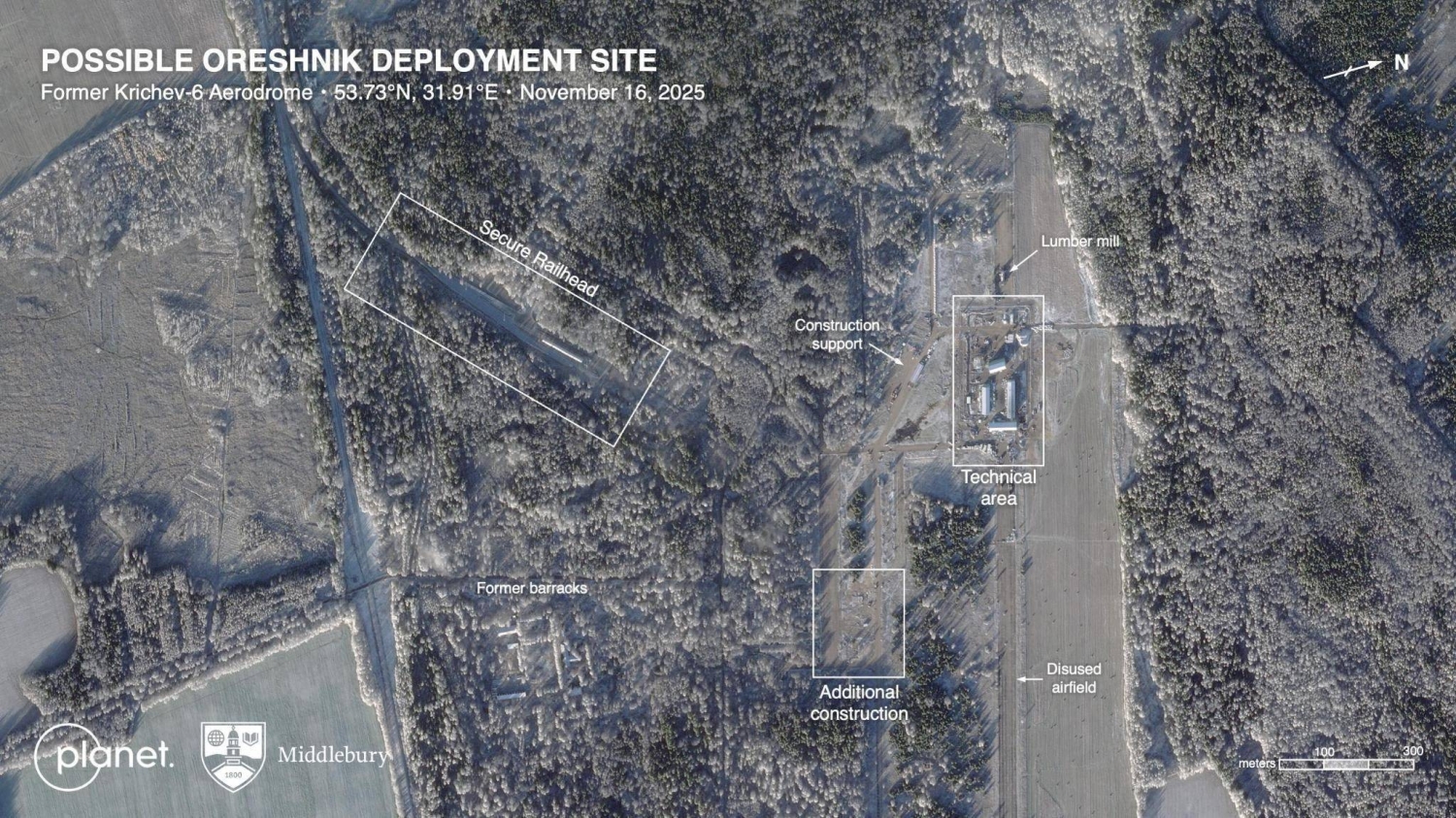
New commercial satellite imagery indicates that Russia may be positioning nuclear-capable hypersonic missiles at a former airbase in eastern Belarus, potentially extending Moscow’s strike range across Europe, according to two U.S. research analysts. The assessment closely matches conclusions drawn by U.S. intelligence officials, according to an individual with direct knowledge who spoke on condition of anonymity because the information has not been officially released. Russian President Vladimir Putin has publicly discussed plans to station Oreshnik intermediate-range missiles in Belarus — weapons believed capable of flying up to about 3,400 miles (5,500 kilometers). Until now, researchers and analysts had not identified a specific base connected to the reported deployment.
Some experts say placing these missiles in Belarus would signal a sharpened reliance by Moscow on nuclear-armed systems as a deterrent against NATO support for Ukraine.
Requests for comment from both the Russian and Belarusian embassies in Washington went unanswered. Belarus’s state news agency quoted Defense Minister Viktor Khrenin as arguing that the missile placement would not disturb the existing power balance in Europe and represents a response to Western “aggressive actions.”
What Satellite Analysis Shows
The research was conducted by Jeffrey Lewis of the Middlebury Institute of International Studies and Decker Eveleth of defense-focused CNA, using images from commercial provider Planet Labs. Their work identified construction and structural patterns at the disused airfield near Krichev, about 190 miles (308 km) east of Minsk, consistent with facilities needed to support mobile strategic missile units.
The analysts said they are about 90% confident that mobile components of the Oreshnik system will be stationed there.
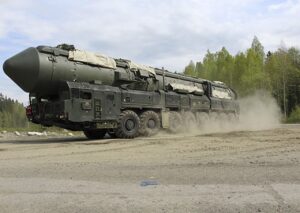
In November 2024, Russia conducted what it described as a test of a conventionally armed Oreshnik against a target in Ukraine. Russian officials have claimed the weapon travels at speeds exceeding Mach 10, making interception extremely difficult.
Strategic Calculations and Reactions
Observers, including John Foreman, a defense expert who previously served as a British military attaché, view the reported deployment as part of a broader strategic recalibration by Russia. He suggested that Moscow may be reacting to planned U.S. deployments of conventional intermediate-range missiles in Germany.
Plans to base Oreshnik missiles abroad come just weeks before the current New START nuclear arms reduction treaty expires, a pact that until now has limited strategic nuclear deployments by the United States and Russia.
Putin and Belarusian President Alexander Lukashenko met in late 2024, with Putin saying the missiles could be in place during the second half of this year — marking the first time Russia has openly discussed positioning nuclear launchers outside its own borders since the Cold War.
Lukashenko has stated publicly that up to 10 missile systems could be deployed in Belarus, though the American researchers believe the Krichev site may only support about three launchers, suggesting additional locations may be involved.
Implications for Ukraine and NATO
U.S. political dynamics surrounding the ongoing Ukraine war add another layer of complexity. While the Biden administration worked on peace proposals, incoming U.S. leadership under Donald Trump has maintained a cautious stance toward providing long-range strike systems to Kyiv. Western partners such as the United Kingdom and France have already supplied cruise missiles to Ukraine.
Signs of Rapid Construction
Analysis of satellite imagery shows rapid construction activity at the former airbase beginning in early August. Notable indicators included a secure rail transfer point for moving large equipment, and a reinforced concrete platform near the runway that was later covered, suggesting preparations for missile support infrastructure, according to the researchers.
Expert Views on Strategic Impact
Some nuclear weapons specialists express doubts about the military value of deploying the Oreshnik in Belarus. Pavel Podvig, based in Geneva, said that stationing the missiles there may offer limited practical advantage beyond symbolically reinforcing Belarus’s security relationship with Russia.
Nevertheless, Lewis argues that placing nuclear-capable missiles outside Russian territory is primarily a political signal rather than a purely military strategy — one aimed at underscoring Russia’s willingness to use nuclear deterrence as leverage.
“Deploying these systems outside Russia is less about battlefield utility and more about geopolitical messaging,” he said. “It changes neither the fundamental balance nor solves any technical issue, but it does underline Moscow’s strategic priorities.”