

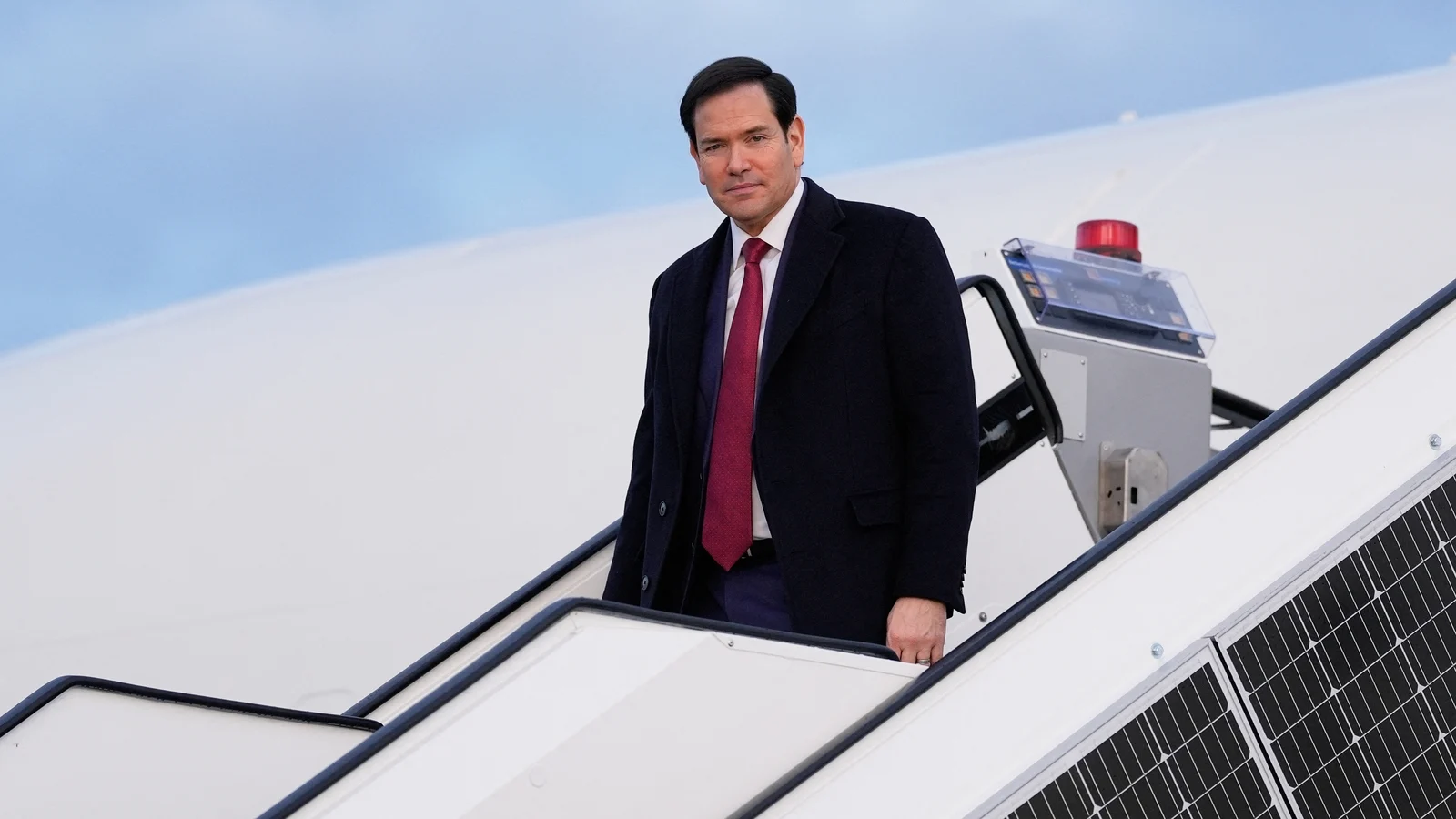
US Secretary of State Marco Rubio has described his visit to Europe for the Munich Security Conference as a pivotal moment in global politics, highlighting what he called the emergence of a “new era” in international relations. Leading the American delegation at one of the world’s most influential security gatherings, Rubio’s presence comes amid growing tensions between Washington and its European allies.
The conference, which opened on Friday, marks the first major global forum since President Donald Trump’s controversial remarks suggesting the United States could annex Greenland — a semi-autonomous territory of Denmark and a Nato ally. The statement has unsettled European leaders and intensified debate about the future of the transatlantic alliance.
Speaking to reporters ahead of his speech, Rubio acknowledged the rapidly evolving geopolitical landscape. He stressed that shifting global dynamics require countries to reassess their strategic roles and partnerships, particularly as security challenges continue to multiply.
Europe Calls for Strategic Independence
French President Emmanuel Macron has urged European nations to reduce their dependence on the United States, emphasizing the need for greater strategic autonomy. His comments reflect a broader concern across Europe about long-term reliance on American military and political support.
Meanwhile, Nato Secretary General Mark Rutte struck a more reassuring tone, underscoring the enduring strength of the transatlantic alliance and its importance for collective security. Despite political friction, he emphasized that cooperation between Europe and the US remains essential in addressing global threats.
German Chancellor Friedrich Merz used his opening remarks at the conference to call for renewed trust between Europe and the United States. He also revealed that confidential discussions are ongoing with France regarding the possibility of a shared European nuclear deterrent — a proposal that signals deeper defence integration within Europe.
Currently, France and the United Kingdom are the only European nations with nuclear capabilities, while countries such as Germany have historically relied on the US nuclear umbrella through Nato.
Key Security Issues Dominate the Agenda
The Munich Security Conference has brought together around 50 world leaders to address major global concerns, including the ongoing war in Ukraine, rising tensions with China, and the prospect of a new nuclear agreement between the United States and Iran.
Ukrainian President Volodymyr Zelensky, who arrived in Munich during the summit, expressed hope that the discussions would lead to concrete steps toward strengthening European and Ukrainian security. He also confirmed that Ukraine and Russia will participate in another round of US-mediated talks in Geneva on 17 and 18 February, following earlier negotiations in Abu Dhabi that yielded limited progress.
Strain Over Greenland and Nato Commitments
Tensions between Washington and European capitals have escalated in recent months, particularly following repeated US claims that Greenland holds significant strategic importance for national security. President Trump has argued that the region is increasingly exposed to Russian and Chinese presence, a claim that European leaders have questioned.
Danish Prime Minister Mette Frederiksen has announced plans to meet Rubio during the conference to address the issue directly, signaling the seriousness with which Denmark views the situation.
At the same time, concerns have grown over the reliability of US commitments to Nato, especially after policy shifts that included tariffs and suggestions that European allies may not remain dependable partners in the long run. An open letter signed by former US ambassadors to Nato and former senior military commanders urged Washington to maintain strong support for the alliance, describing it as a strategic asset rather than a burden.
Europe Increasing Defence Responsibility
Several European nations, including the Netherlands, have acknowledged the need to strengthen their own defence capabilities. Dutch Foreign Minister David van Weel noted that while Europe is gradually increasing military spending, it will take time before the continent can assume a larger share of the security burden traditionally carried by the United States.
Last year, Nato allies agreed to significantly raise defence spending targets, with some nations aiming to reach 5% of their economic output by 2035 following sustained pressure from Washington.
A Turning Point for Global Cooperation
Diplomats and analysts attending the conference agree that the international order is undergoing a transformation. Conference chairman Wolfgang Ischinger warned in a pre-event report that the shared principles once uniting US allies now appear less certain, raising critical questions about future cooperation.
Rubio is expected to adopt a more measured diplomatic tone compared to last year’s sharply critical speech by US Vice-President JD Vance, which had triggered considerable transatlantic friction. However, his message is still anticipated to focus on redefining the direction of US-European relations in an increasingly complex geopolitical environment.
As global tensions continue to rise and alliances are reassessed, the Munich Security Conference is widely seen as a crucial platform for shaping the next phase of international security and cooperation.