

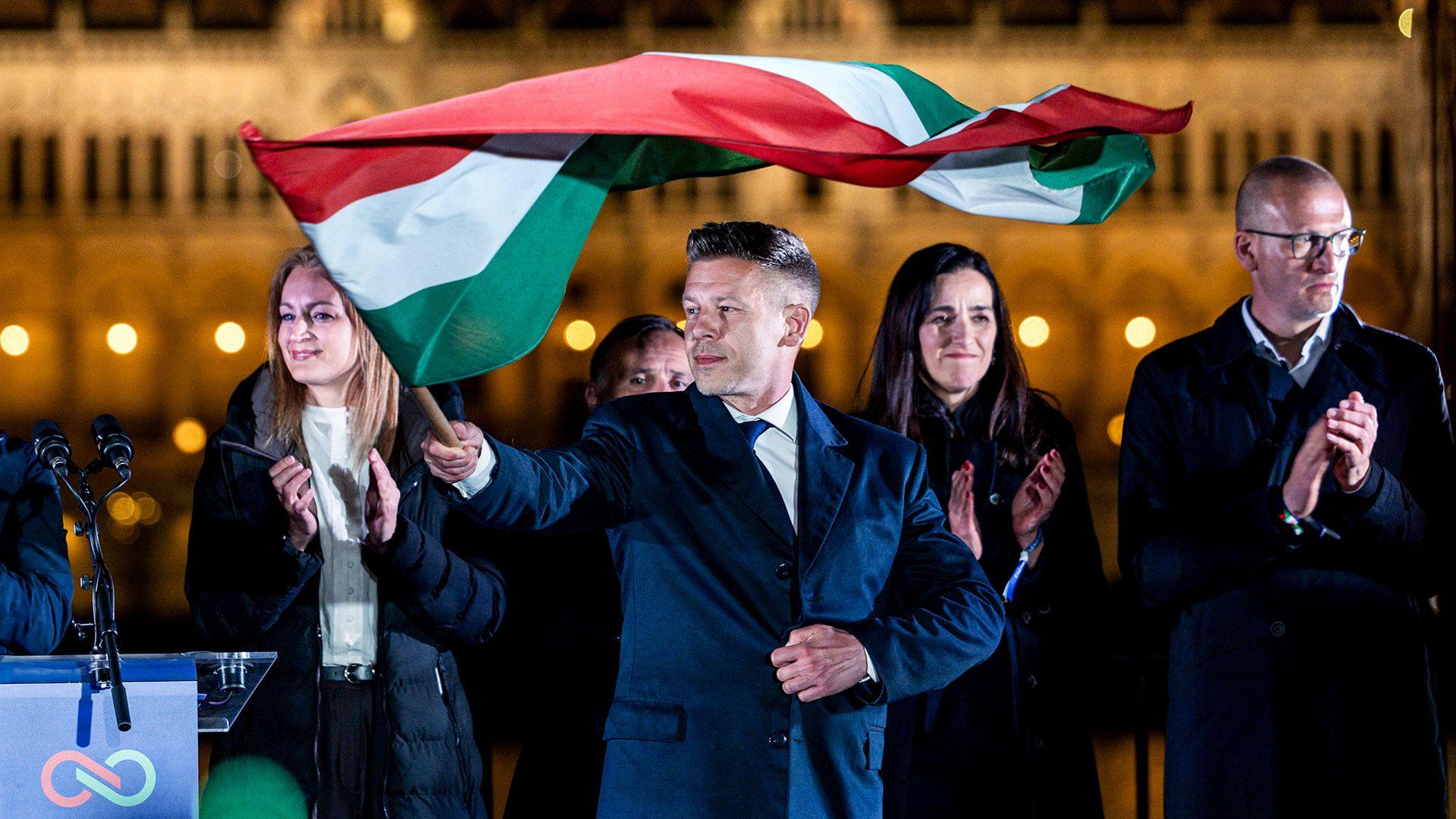
Viktor Orbán’s 16 years in power have come to an end after Péter Magyar led his Tisza party to a crushing election victory, dismantling a political system long criticised as deeply undemocratic.
Speaking to jubilant supporters by the Danube in Budapest, Magyar declared that Hungarians had overthrown the regime together. Preliminary results based on more than 98 percent of counted votes showed Tisza on course to win 138 seats in the 199-member parliament, while Orbán’s Fidesz party was left with 55 seats and the far-right Our Homeland party with six. The scale of the result marked not just an election win, but a dramatic rejection of the political order Orbán had built over four successive victories.
A Result That Could Reshape Hungary
The outcome gives Magyar the power not only to reverse many of Orbán’s domestic policies, but also to redefine Hungary’s international direction.
Under Orbán, Hungary had drawn closer to both Donald Trump and Russian President Vladimir Putin, while becoming an increasingly difficult partner for the European Union and a frequent obstacle for Ukraine. During the campaign, even US Vice President JD Vance appeared in Hungary in a final effort to support Orbán.
Magyar offered a different path. He campaigned on reducing Hungary’s closeness to Russia and rebuilding stronger ties with the EU and Ukraine. That message appeared to resonate with voters who had grown tired of cronyism, corruption and political patronage after years of Fidesz rule.
A Campaign That Built Momentum Across the Country
For two years, Magyar travelled across Hungary, speaking in villages, towns and cities and building support from the ground up. By election night, the energy behind his campaign had become impossible to ignore.
He told supporters that never before in democratic Hungary had so many people voted, and no single party had received such a strong mandate. Voter turnout reached a record 79.5 percent, underlining the national weight of the contest.
The speed of Orbán’s collapse was striking. While Magyar’s supporters gathered in anticipation, he posted on Facebook that Orbán had personally called him to congratulate him on his victory. At that point, only around 30 percent of the vote had been counted. Minutes later, Orbán appeared before his own supporters and admitted the result was both clear and painful. He thanked the estimated 2.5 million Hungarians who had remained loyal to him and said the coming days would be for healing their wounds.

Big Promises and a Two-Thirds Majority
Magyar has promised sweeping reforms. He says he wants to undo Orbán-era changes in education and healthcare, tackle corruption, restore judicial independence and dismantle the patronage system known as NER, which critics say enriched allies of the ruling party while draining public resources.
To make constitutional changes, he needed a two-thirds majority in parliament, or at least 133 seats. Based on the projected result, Tisza is on course for 138, giving him the numbers needed to pursue far-reaching change.
That prospect triggered celebration among supporters in Budapest, where party activists embraced, champagne flowed and cars sounded their horns through the city. Even some voters who were not natural supporters of Magyar backed him as the only realistic route to change. One lawyer quoted in the article said he could not be trusted completely, but the country had reached a point where people needed to hope for something better.
Orbán’s Political World Collapses
The election result also exposed how sharply divided Hungary had become. For years, Orbán and his allies had convinced supporters that victory was certain, backed by loyal media outlets and friendly pollsters who were still predicting a Fidesz win late into election day.
At the same time, Magyar was drawing huge crowds and gaining momentum with the help of more independent polling that showed him leading. On election night, those two competing realities finally collided, and only one survived.
Magyar took the stage to chants from supporters and told the crowd they had performed a miracle and made history. He compared the significance of the moment to major turning points in Hungarian history, including the 1848 revolution and the 1956 uprising against Soviet domination.
His supporters also chanted “Russians go home,” reflecting public anger at Orbán’s close relationship with Moscow. Once known for opposing Soviet influence, Orbán had become one of Putin’s closest partners in Europe, justifying Hungary’s reliance on cheap Russian oil and gas and angering EU allies by blocking support measures for Ukraine.
Europe Welcomes a New Chapter
European leaders were quick to react. Poland’s Prime Minister Donald Tusk welcomed Magyar’s victory and echoed the anti-Russian sentiment expressed by supporters. Magyar, in turn, said his first trip abroad as prime minister would be to Warsaw to strengthen ties with Poland.
He also pledged to travel to Brussels to persuade the European Commission to release up to 17 billion euros in frozen funds, which had been withheld over concerns about corruption and the lack of judicial independence in Hungary.
Even the Kremlin signalled it was ready to work with the new leadership, with spokesperson Dmitry Peskov saying Moscow respected the choice made by Hungarian voters and hoped to continue pragmatic ties with Budapest.
The End of One Era, the Start of Another
Magyar’s victory closes one of the most dominant chapters in modern Hungarian politics, but it also opens a difficult new phase. Orbán, now 62, has not stepped down as party leader and will remain in a caretaker role for the time being. What happens next to Fidesz without him remains uncertain.
For Magyar, the campaign is over, but the real test is only beginning. He has inherited a divided country, a damaged democratic system and enormous expectations from voters who see him as the man who ended the Orbán era.
His landslide has already changed Hungary’s political map. The bigger question now is whether he can deliver the renewal that millions of Hungarians voted for.