

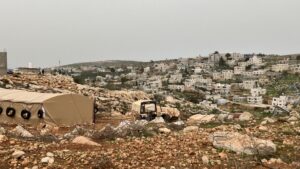
In the occupied West Bank, the village of al-Mughayyir, located north-east of Ramallah, has increasingly become a frontline area amid a surge in Israeli settler violence and military activity. Residents report frequent army incursions and the gradual seizure of farmland by settlers who have established new outposts nearby. Local council member Marzoq Abu Naim says the pressure on Palestinian is growing steadily, describing the situation as a quiet but persistent form of displacement. According to him, access to agricultural land has become increasingly restricted, leaving many families unable to sustain their livelihoods.
The village sits in an area where Israel maintains security control, while the Palestinian Authority (PA), supported by the international community, is responsible for providing basic services. However, residents say the PA’s ability to function has been severely weakened by an ongoing financial crisis.
Deepening Economic Crisis Limits Governance
Community members say the Authority is struggling to meet even essential needs. With limited funds available, public services have deteriorated, and local leaders say requests for assistance often go unanswered due to financial shortages.
The situation worsened significantly after the 7 October Hamas-led attacks on Israel, which led to the revocation of work permits for roughly 100,000 Palestinians previously employed in Israel. At the same time, Israel has withheld tax revenues it collects on behalf of the PA, citing disputes over educational content and financial stipends provided to families of prisoners and those killed in the conflict.
Palestinian officials state that more than $4bn in revenues are now owed, placing severe strain on the Authority’s finances. As a result, many public sector workers, including teachers, police officers and medical staff, are receiving only partial salaries, often around 60 percent of their usual pay.
Education has also been disrupted. Schools attended by more than 600,000 students now operate on reduced schedules, in some cases opening only three days a week. Parents in affected areas say closures often occur when nearby military or settler activity raises safety concerns, further affecting children’s learning.
Daily Life Disrupted by Movement Restrictions and Settlement Growth
Travel across parts of the West Bank has also become more difficult due to military gates and checkpoints that restrict movement between Palestinian communities. Residents and observers note ongoing infrastructure development connecting Israeli settlements, including road expansions designed to facilitate access to Jerusalem.
Settlement construction — widely regarded as illegal under international law — continues at an accelerated pace, further intensifying tensions and adding to the political and economic pressure on the Palestinian Authority.
Political Weakness and Declining Popularity
Established more than three decades ago following the Oslo Accords, the PA was envisioned as a transitional governing body that would evolve into the administration of a future Palestinian state encompassing the West Bank and Gaza, with East Jerusalem as its capital. Its strategy has traditionally focused on negotiations and non-violent diplomacy.
However, the collapse of direct peace talks with Israel more than a decade ago and continued territorial expansion in the West Bank have undermined the Authority’s credibility. Many Palestinians increasingly view the PA as ineffective, citing corruption allegations, political stagnation and ongoing security coordination with Israel as major sources of dissatisfaction.
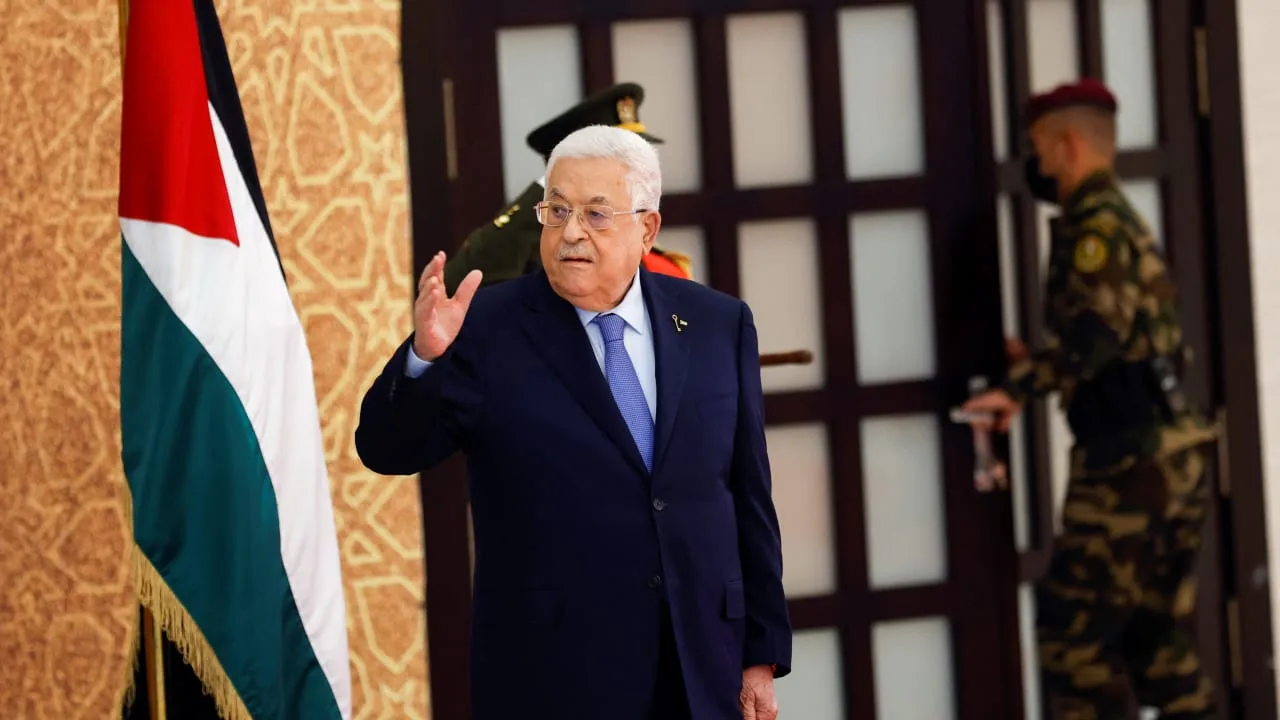
In Ramallah, the administrative hub of the PA where it retains full civil control, officials and analysts are warning that the governing body is approaching a critical moment. Former minister Sabri Saidam described the current period as a turning point, arguing that Palestinian identity, statehood aspirations and even the future existence of the Authority itself are being challenged.
Israeli Measures and Annexation Concerns
Recent policy steps by the Israeli government have further tightened its influence over the West Bank. A senior United Nations official has described these measures as gradual, de facto annexation. A new land registration initiative could allow Israel to classify large areas as state land, potentially opening them for future development.
Additionally, Israeli authorities have expanded enforcement of environmental and archaeological regulations into areas that were previously under Palestinian civil jurisdiction, increasing administrative oversight beyond earlier arrangements.
Israeli Finance Minister Bezalel Smotrich, who oversees settlement policy, has openly stated his opposition to the creation of a Palestinian state and has expressed intentions to dismantle the Oslo framework if political conditions allow. His remarks, including references to encouraging Palestinian emigration, have drawn international criticism.
International Reactions and Strategic Concerns
More than 80 United Nations member states, along with the European Union and the Arab League, have condemned unilateral Israeli measures and called for their reversal. The United States has reiterated its opposition to annexation while stopping short of stronger action.
Experts warn that without sustained international pressure and financial support, the PA’s institutional stability could deteriorate further. Analysts argue that recent developments risk undermining long-standing diplomatic investments in a two-state solution.
Impact of Gaza War and Future Governance Questions
The ongoing war in Gaza has accelerated the PA’s political decline. The Authority lost control of Gaza in 2007 after Hamas took power and has since struggled to regain political relevance there. Its delayed response to the Hamas attacks that triggered the current conflict has also contributed to its marginalisation in post-war governance discussions.
While the PA is not directly involved in certain international diplomatic initiatives, it is expected to play a role in future administrative arrangements in Gaza, potentially overseeing security forces if reform conditions are met under proposed peace frameworks.
Israeli officials have dismissed speculation that the PA is on the verge of collapse, arguing that the institution remains operational despite its challenges. Critics within Israel have also accused the Authority of mismanagement and corruption.
Rising Tensions on the Ground
Back in al-Mughayyir, residents report that nearby Bedouin communities have already been displaced from grazing lands due to expanding settler encampments. Military patrols and sporadic clashes continue to shape daily life, including incidents involving tear gas and detentions during confrontations.
Local residents warn that ongoing instability, combined with economic hardship and limited political progress, could increase the likelihood of broader unrest. Some fear that the perceived weakness of the Palestinian Authority may push segments of the population toward less moderate political alternatives.