

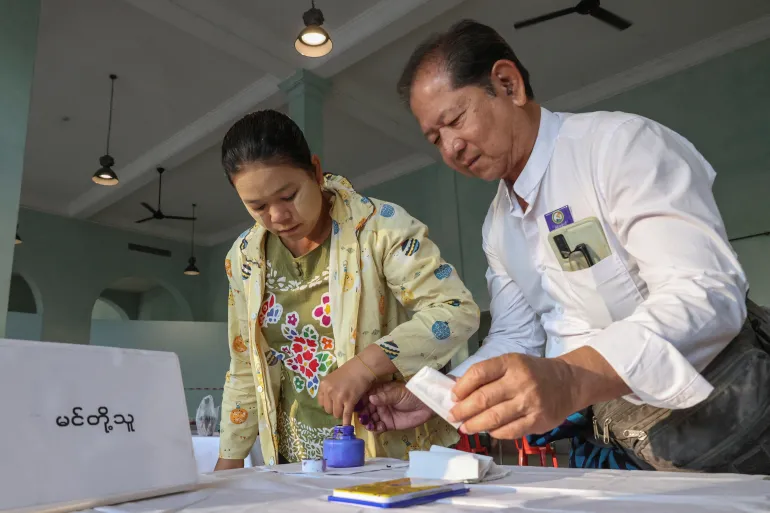
Myanmar has officially closed polling in its first general election process since the 2021 military takeover, a vote held in a fraction of the country as armed conflict continues to restrict public participation.
Sunday’s polling phase covered just one-third of Myanmar’s 330 townships, according to the Home Office election schedule. Many regions remain unreachable due to active clashes involving military forces and multiple resistance groups.
In Yangon, the country’s largest city, polling centers opened at 6:00 AM local time and closed at 4:00 PM, under heavy security monitoring. Unofficial estimates from election officials suggest turnout was far lower than past elections, with early indications pointing to participation from about one out of every three registered voters.
“The main question now is how many people in cities were willing to show up, especially when the ballots offer very few alternatives,” said a regional media correspondent reporting from Yangon.
Opposition Groups and Political Leaders Still Absent
Former State Counsellor Aung San Suu Kyi remains detained, while the National League for Democracy (NLD), which previously won major election victories, has been dissolved. Political parties critical of military governance were not allowed to compete, leaving the ballot dominated by military-aligned organizations.
The Union Solidarity and Development Party (USDP), widely recognized as a pro-military political platform, is expected to secure the largest share of seats, though no official results timeline has been provided yet.
Security, First-Time Tech, and Ballot Restrictions
Election week has also been marked by violence. In the Mandalay region, three civilians were hospitalized after a rocket strike hit an empty residential building early Sunday. One patient is still in critical condition, according to the region’s chief minister.
Separately, explosions near the Thailand border in Myawaddy township damaged more than ten homes. Local residents told reporters that civilians were injured in the attack, including one child whose death has been reported but not yet independently verified.
Myanmar also deployed electronic voting machines for the first time, but the system does not allow write-in candidates or intentionally invalid ballots, according to election monitors.
Ink marking remains mandatory — voters dip one finger in indelible ink after submitting their vote to prevent duplicate participation.
Phased Voting Continues Into January
Two additional polling rounds are scheduled for January 11 and January 25, while voting has been cancelled entirely in 65 townships, meaning millions are currently without access to the election process.
Officials have not confirmed when vote counting will begin or when results will be announced.
Allies Present, but Legitimacy Questions Persist
State media reported that observers from China, Russia, Cambodia, India, Vietnam, Belarus, and several other countries were present during election week, signaling diplomatic support for the process.
However, the UN Special Rapporteur on Myanmar, Tom Andrews, urged international governments to reject the vote, calling it a process conducted without the freedoms necessary for public political choice.
Analysts Say the Vote Won’t Shift the Crisis
Independent policy analysts warn that the election is unlikely to reshape Myanmar’s national leadership or reduce internal tensions.
One regional expert wrote in a recent briefing that the vote is expected to maintain military control over national administration, while doing little to resolve the conflict or change public trust in the political system.