
President Donald Trump’s announcement that the United States has captured Venezuelan President Nicolás Maduro and his wife, Cilia Flores, amid “large-scale” military actions against Venezuela has stunned international observers.
Venezuelan Vice President Delcy Rodríguez responded by saying the government currently has no confirmation of Maduro and Flores’s location. In a recorded message broadcast on state television Saturday, she demanded evidence that the couple are still alive.
The announcement comes amid rapidly intensifying military operations in the Caribbean Sea and eastern Pacific Ocean, where U.S. forces have carried out multiple strikes against what Washington describes as drug-smuggling vessels and a port area used by suspected Venezuelan narcotics boats.
Maduro’s Reported Capture Evokes Past U.S. Interventions
If confirmed, Maduro’s reported capture would echo earlier episodes in which the United States seized or detained foreign leaders, including Panama’s Manuel Noriega and Iraq’s Saddam Hussein.
The Removal of Manuel Noriega in Panama
In a major intervention in Latin America, the United States invaded Panama in 1989 to overthrow military ruler Manuel Noriega, citing the protection of U.S. citizens, undemocratic governance, corruption, and involvement in the international drug trade.
Before the invasion, Noriega had been indicted in Miami on drug-smuggling charges in 1988, a legal strategy similar to efforts targeting Maduro today.
Noriega had forced the resignation of Panamanian President Nicolás Ardito Barletta in 1985, canceled elections in 1989, and fostered anti-U.S. sentiment in the region prior to the U.S. operation.
The Panama intervention was the largest American combat deployment since the Vietnam War. U.S. officials maintained that removing Noriega would benefit Panamanians and allow him to face justice in the United States.
Noriega was transported to the U.S., sentenced on the Miami indictment, and incarcerated there until 2010, when he was extradited to France for trial. He was later returned to Panama and remained in prison until his death in 2017.
Saddam Hussein’s Capture and Trial
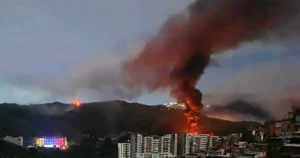
In December 2003, U.S. forces captured Iraqi President Saddam Hussein, approximately nine months after the U.S.-led invasion of Iraq. That conflict was launched based on claims that Baghdad possessed weapons of mass destruction (WMDs)—claims that were ultimately unsubstantiated.
Like Noriega, Saddam had previously been considered a strategic partner of the United States, especially during the 1980s Iran-Iraq War, which resulted in massive loss of life.
U.S. authorities also asserted that Saddam had ties to extremist groups such as al-Qaeda, a claim later widely challenged. No WMD stockpiles were found in Iraq.
Saddam was captured hiding near his hometown of Tikrit. He was later tried in an Iraqi court, convicted of crimes against humanity, and executed by hanging on December 30, 2006.
Honduras’s Juan Orlando Hernández: A Controversial Case
Another recent example of a foreign leader facing U.S. legal action is Juan Orlando Hernández of Honduras. In February 2022, Hernández was captured at his home in Tegucigalpa by U.S. and Honduran forces shortly after completing his presidential term.
He was later extradited to the United States on allegations of corruption and involvement in the drug trade. In June 2022, Hernández received a 45-year prison sentence in the U.S.
However, he was pardoned by President Donald Trump on December 1, 2025, a move that drew strong criticism. Within days, Honduras’s top prosecutor issued an international arrest warrant against Hernández, deepening legal and political controversy just after his release.
A Pivotal Moment in 4U.S. Foreign Operations
The reported capture of Maduro and his wife—still unverified by Venezuelan officials—marks a potentially significant escalation in U.S. operations targeting foreign leadership. Global reactions continue to pour in as governments, analysts, and citizens assess both the claims and the broader implications of military action and international law.