
The sound of war was supposed to have faded. Only hours after US President Donald Trump announced a two-week ceasefire to pause the conflict in the Middle East, hope briefly spread across the region that the violence might finally ease. Instead, Lebanon was hit by a devastating wave of Israeli air strikes that left at least 203 people dead and more than 1,000 wounded, according to the Lebanese health ministry.
The strikes unfolded in a rapid 10-minute assault, with Israeli jets launching one of the heaviest aerial attacks Lebanon has seen in the current war. As relief turned into shock, criticism came quickly from Lebanon and abroad. But the United States, despite being central to the ceasefire announcement, did not publicly condemn Israel’s actions.
Iran denounced the attack as a serious breach of the truce and urged Washington to stop what it called Israeli aggression. Lebanese officials say more than 1,700 people have now been killed since Israel began its latest campaign in the country last month. Israel has said the goal of its operations is to weaken Hezbollah and complete what it sees as remaining military objectives.
Dispute Over Whether Lebanon Was Included in the Truce
Confusion over the ceasefire has become one of the central issues in the latest escalation. Pakistan’s Prime Minister Shehbaz Sharif, who has been acting as a mediator, said the agreement involved an immediate halt to fighting across all fronts, including Lebanon.
Pakistan is expected to host negotiations on Friday, with a US 15-point plan and a 10-point Iranian counterproposal seen as the basis for talks. Iran’s proposal reportedly insists on a complete end to hostilities, including attacks on what it describes as the resistance in Lebanon, a reference to Hezbollah.
But Israel quickly rejected the idea that Lebanon was covered by the ceasefire. Prime Minister Benjamin Netanyahu’s government said the truce did not apply there. Trump also said Lebanon was excluded, describing the conflict involving Hezbollah as a separate skirmish.
That disagreement appears to have been settled not at the negotiating table, but in the skies over Beirut. Around 2pm local time, Israeli warplanes launched coordinated attacks across Lebanon, crushing hopes that the ceasefire would bring immediate calm to the country.
Beirut and Other Regions Hit in One of the Heaviest Attacks Yet
The Israeli military said it had completed its largest coordinated strike across Lebanon since the beginning of Operation Roaring Lion, the name it uses for its campaign linked to the war with Iran. It said more than 100 Hezbollah headquarters, military positions and command centres were targeted in Beirut, the Bekaa Valley and southern Lebanon.
The scale of the bombing was severe. Densely populated areas of central Beirut were struck, in addition to Dahieh, the southern suburb long associated with Hezbollah. This time, however, the destruction was not limited to expected strongholds. Central parts of the capital were also hit.
Casualties were also reported in the Bekaa Valley and in southern areas including Nabatieh, Sidon and Tyre. Hezbollah appeared to have been caught off guard. Its response seemed limited at first, with rockets fired towards Israel only hours later.
The following day, Israel said it had continued its attacks and claimed to have killed more than 70 fighters. It also said it had eliminated Ali Yusuf Harshi, described as the personal secretary to Hezbollah leader Naim Qassem in Beirut. That claim has not been independently confirmed.
Lebanon Enters Mourning as Rescue Teams Search Through Rubble
In Beirut, the mood has shifted from fear to grief. As the country observes a national day of mourning, the streets are quieter than usual, with the weight of the latest violence hanging heavily over the capital.
Prime Minister Nawaf Salam said civilians were among those killed and wounded, while President Joseph Aoun described the attack as a massacre. Search and recovery efforts are still under way in several areas, although hopes of finding survivors are fading in some places.
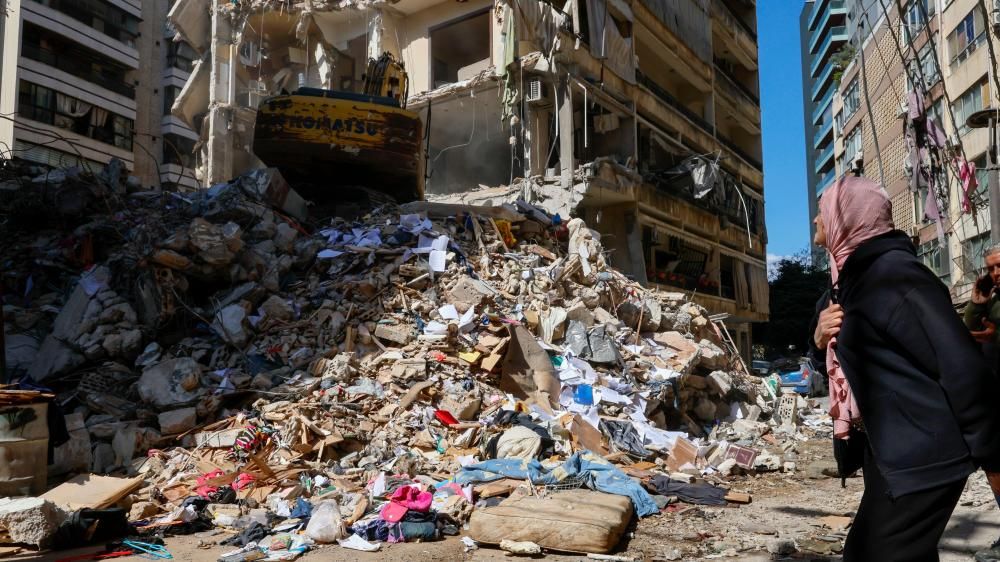
One of the worst-hit sites is a 10-storey residential building in Tallet el Khayat, a wealthy neighbourhood in western Beirut. The building was destroyed without warning, in an area not previously known as a regular target. Civil defence teams are continuing to search through the debris.
Ziad Samir Itani, who was leading one of the rescue teams, said the scale of the destruction was something new even for Beirut. He explained that crews were exhausted after more than six weeks of near-continuous Israeli attacks. Though experienced, he said the emotional burden remained heavy, adding that he was sad like everyone else.
Anger Grows as Questions Over Strategy Remain
Although Israel says it is targeting Hezbollah infrastructure, the high number of casualties has intensified anger inside Lebanon. Many believe Israel knew civilian deaths would be unavoidable given the areas that were struck.
The long-term strategy behind the campaign also remains unclear. Even some Israeli military officials acknowledge that Hezbollah is unlikely to be disarmed by force alone. Any military gains, according to the report, may therefore prove limited.
Inside Lebanon, divisions between critics and supporters of Hezbollah appear to be narrowing in the face of shared outrage. Across political lines, many see the latest attack as unjustifiable.
Iran’s Deputy Foreign Minister Saeed Khatibzadeh said the United States now faces a choice between war and peace. He also said Iran would provide security for safe passage through the Strait of Hormuz, but only after what he called US aggression had ended, an apparent reference to continued Israeli attacks on Lebanon.
For many in Lebanon, the deeper wound is not only the scale of destruction, but the sense that a promised pause in war never truly arrived. What was expected to be a moment of calm instead became another day of mass death, shattered buildings and deepening uncertainty across the region.