
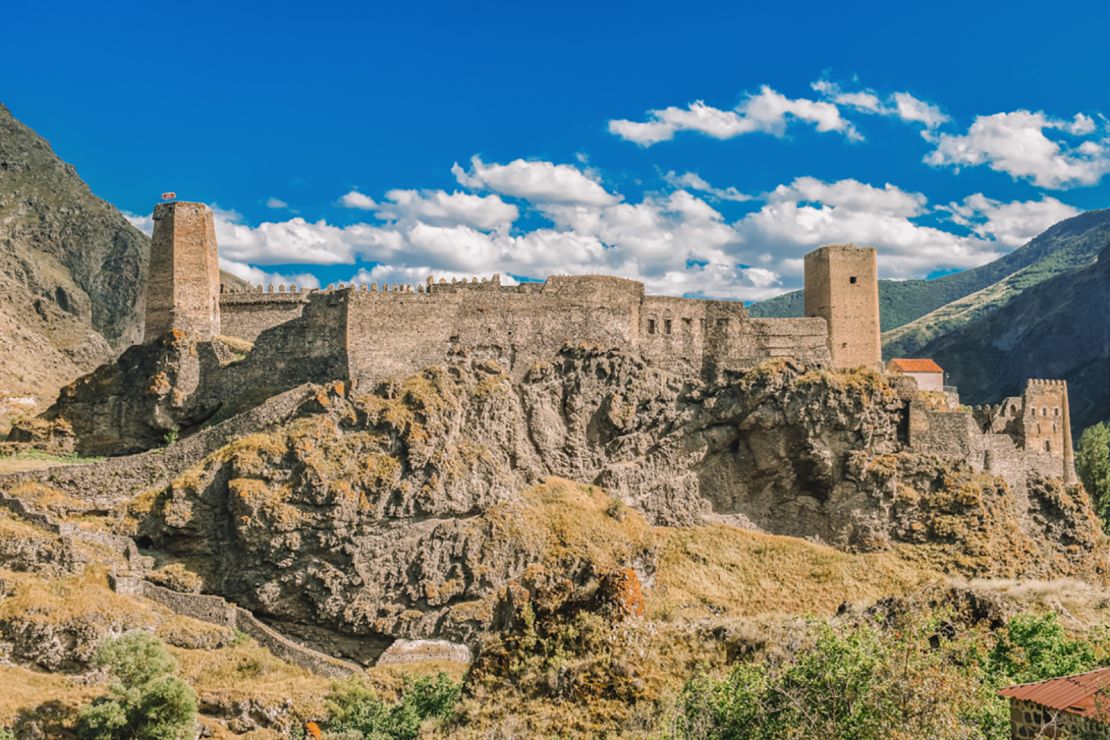
Georgia is home to some of the most striking cave landmarks in the world. From the 3,000-year-old stone settlement of Uplistsikhe, to the 6th-century David Gareja monastic complex, and the remnants of Samshvilde’s once-silent cave dwellings—each site carries its own sense of wonder. Yet among all of them, Vardzia stands in a league of its own.
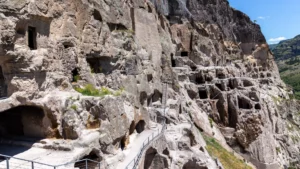
Perched along the steep face of Mount Erusheti, overlooking the green valley carved by the Mtkvari River, Vardzia is widely regarded as Georgia’s most extraordinary ancient cave city. Built into the rugged slopes of the Erusheti highlands, the complex once formed a vast settlement of 6,000 chambers arranged across 19 vertical tiers. Within this stone-hewn world were wine storage rooms, living quarters, worship halls, medical spaces, and a network of hidden corridors that made the city both culturally rich and strategically formidable.
A City Forged by a Visionary Queen
Vardzia began its life in the 12th century during the rule of King Giorgi III, originally designed as a defensive stronghold. While construction started under his command, it was his daughter, Queen Tamar, who transformed it into something far greater. Under her direction, Vardzia evolved rapidly—expanding from a fortress into a thriving spiritual center, a cultural hub, and a self-reliant settlement long before sustainability became a modern concept.
At its height, the city housed around 2,000 monks and thousands of civilians, supported by irrigated terraces and carefully engineered water systems that allowed agriculture to flourish in mountainous terrain. Tamar, remembered as one of Georgia’s most influential rulers, defied conventions of her era. Known by the title Tamar Mepe, or King Tamar, she reigned for nearly 30 years, guiding Georgia through its most prosperous medieval period. Under her leadership, literature, arts, and national identity strengthened, shaping cultural figures such as the poet Shota Rustaveli. His famed epic, The Knight in the Panther’s Skin, became one of Georgia’s most enduring literary treasures.
Nature, Legend, and Unfinished History
Despite its brilliance, Vardzia’s golden age did not last forever. In 1283, a major earthquake reshaped the mountain, destroying much of the complex’s outer structure. With its natural defenses compromised, most residents left the area, leaving only the monastic community behind. Over the centuries, Vardzia faced repeated raids, and by the 16th century, the site was largely abandoned.
Today, more than 800 years after Tamar’s reign, Vardzia still breathes with quiet resilience. A small monastic group returned to the site following the dissolution of the Soviet Union, restoring a spiritual presence to the cliffs once more. Around 500 cave chambers remain intact, including ancient wine cellars where large clay vessels (qvevri) still rest beneath stone floors. The city’s carved dining hall, stone benches, and baking hearths continue to stand, preserved through time like echoes from another era.
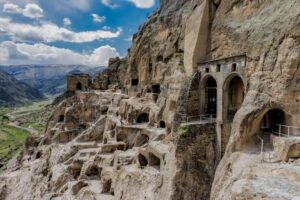
The most visually striking feature is the tall bell tower that rises from the rocky edge of the cliffs. While the structure remains largely intact, the original bell is no longer there—removed during a 13th-century Mongol raid. Another must-see highlight is the Church of the Dormition, known for its twin stone arches and its interior frescoes, one of which depicts Queen Tamar herself—one of only four such murals known to exist today.
Deep within the cave corridors, visitors often search for the legendary spring known as the Tears of Queen Tamar, a natural water source that pools beneath stone ceilings where droplets fall continuously from above. The spring remains one of the site’s most memorable attractions, combining natural beauty with local mythology.
Beyond the Caves: Culture and Culinary Tapestry
The region surrounding Vardzia, Samtskhe-Javakheti, carries its own layers of charm. Nearby sites include the Vani Caves, a monastic complex older than Vardzia itself, and the Tmogvi Fortress, a riverside ruin offering scenic views of the Mtkvari gorge. The area is also known for towns like Akhaltsikhe, home to Rabati Castle, where a mosque, synagogue, and Orthodox church stand side-by-side—symbolizing Georgia’s historic multicultural footprint.
Samtskhe-Javakheti is equally shaped by its culinary identity. Local dishes blend flavors from ancient Georgian techniques and regional cultural influences. Visitors can sample traditional cheeses like tenili, artisan chocolates crafted by local nuns near Lake Paravani, or iconic boiled dumplings known as khinkali, often paired with yogurt-based sauces and garlic butter blends.
Reaching Vardzia
Vardzia lies roughly four hours south of Tbilisi by road. Travelers can hire local drivers stationed near Freedom Square or rent vehicles to navigate the scenic route through Borjomi’s forested hills and Akhaltsikhe’s stone-framed skyline. While day trips are possible, travel experts recommend spending at least two nights in the area to fully absorb the atmosphere and explore the caves at a relaxed pace.