

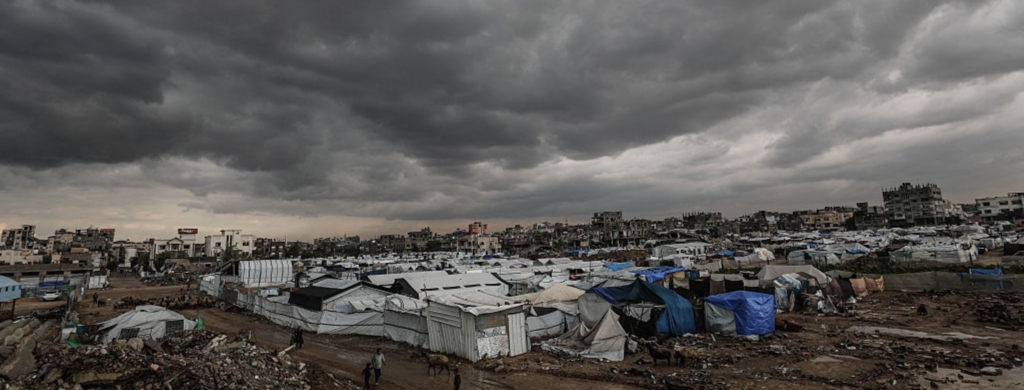
Military activity continued across the Gaza Strip on Tuesday, as diplomatic tensions over ceasefire compliance persisted. Local emergency responders and aid monitors said the latest operations were part of a prolonged pattern of disputed ceasefire adherence that has overlapped with severe winter weather, which has affected displaced families in makeshift camps.
Hind Khoudary, reporting for Al Jazeera from Gaza City, said aerial operations were recorded near Rafah and Khan Younis in the south, Maghazi camp in central Gaza, and Beit Lahiya and Beit Hanoun in the north. Additional artillery activity was also reported in southern and central districts, according to local field updates.
Ceasefire Compliance Under Scrutiny
The ceasefire framework brokered by the United States in October 2025 remains active diplomatically, but its implementation has been contested. Gaza’s Government Media Office (GMO) stated Sunday that nearly 970 ceasefire breach claims have been logged since the agreement’s start date of October 10. Local authorities said the disputes have coincided with hundreds of civilian fatalities and injuries recorded in medical facilities, based on verified field documentation.
Khoudary said communities remain “under emotional pressure as services fluctuate,” noting that winter weather has further complicated daily life in camps, where families rely on shared generators, temporary water trucks, and aid deliveries routed through partially restricted crossings.
Winter Storms Add to Humanitarian Pressure
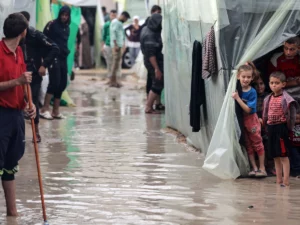
Aid agencies said that heavy rain and strong coastal winds have created a new wave of logistical setbacks for displaced communities. In Deir al-Balah, tents were seen standing in muddy floodwater, affecting household items, food supplies, and bedding.
A displaced father, Mohammed al-Louh, said that during recent storms he could not recover key household items before evacuating his family from a tent affected by flooding.
“We moved quickly to protect the children, but we couldn’t recover basic supplies in time,” he said.
Another displaced resident, Mohammed al-Louh, said that during recent storms he could not recover key household items before evacuating his family from a tent affected by flooding.
Calls for Aid Access Expansion
Humanitarian groups have asked for broader access to shelter equipment and essential supplies. Khoudary reported that many families have struggled to replace tents after months of continuous use, as storms hit older structures that were never fully rebuilt after past conflicts.
Local emergency responders said that damaged structures remain unstable during storms, raising risks for families sheltering near affected zones. Civil defense teams have prioritized family evacuations and traffic controls during emergency responses, particularly near restricted maritime zones.
Global Leaders Send Condolences as Diplomacy Continues
The developments in Gaza unfolded as PM Benjamin Netanyahu prepared for meetings in Florida with U.S. President Donald Trump, focusing on future regional frameworks involving Gaza, Lebanon, and Iran.
International leaders including Narendra Modi (India) and Shehbaz Sharif (Pakistan) issued public condolences this week, thanking Gulf allies for diplomatic leadership, while U.S. officials reiterated calls for restraint.
No Major Escalation in Civilian Air Travel Yet
Despite maritime and airspace restrictions near Gaza’s southern crossings, Taiwan’s Civil Aviation Authority said that no international flight cancellations were announced. Analysts emphasized that trade and aviation corridors remain vital regional arteries, even as domestic routes to Kinmen and Matsu islands were temporarily blocked.