
The U.S.-Israeli air campaign against Iran widened further on Monday, with the conflict spreading beyond Iran and Israel into Lebanon and other parts of the region.
Israel carried out strikes in Lebanon after Hezbollah launched missiles and drones in response to the killing of Iran’s Supreme Leader Ayatollah Ali Khamenei. At the same time, Tehran continued firing missiles and drones toward Israel, Gulf countries and even a British air base in Cyprus, signalling that the confrontation is growing both geographically and politically.
With no sign of a quick resolution, the crisis is now affecting not only regional security but also global markets and transport networks.
U.S. Aircraft Incident Reported Over Kuwait
Early Monday, video footage showed what appeared to be a U.S. warplane falling from the sky over Kuwait, with one person seen parachuting to safety.
Reuters said the footage was verified as being filmed in Kuwait’s Al Jahra area. Kuwait’s defence ministry later said several American aircraft had crashed, but added that all crew members were safe.
The incident came as tensions rose across the Gulf, where multiple countries have already been placed on alert amid the expanding war.
Markets React After Weekend of Escalation
Following a weekend of heavy bombardment that killed Khamenei, drew neighbouring states closer to direct conflict and halted shipping traffic in the Gulf, financial markets opened Monday with sharp increases in energy prices.
The rise in oil prices added fresh pressure to the global economy, with analysts warning that prolonged disruption in the Gulf could damage trade, fuel inflation and weaken the already fragile recovery in several regions.
The air war, launched by U.S. President Donald Trump in coordination with Israel, is being described as one of Washington’s most significant foreign policy risks in decades.
Trump Signals a Long Campaign Ahead
President Trump has continued to defend the offensive, saying the operation aims to neutralise a long-standing regional threat.
He repeated his calls for Iranians to rise up against their leadership and said the campaign could continue for weeks. Inside Iran, uncertainty over the future has deepened as residents crowd highways trying to leave major cities while air strikes continue.
Public reaction inside the country has been mixed. Some Iranians have openly celebrated Khamenei’s death, blaming him for decades of repression and for the violent crackdowns that killed thousands of protesters earlier this year.
Others, however, remain fearful of what may come next, especially as civilian casualties mount.
One resident, Morteza Sedighi, a 52-year-old teacher speaking by phone from Tabriz, condemned the strikes, saying innocent people are being caught between state violence and foreign attacks.
Iran’s Clerical Leadership Shows No Sign of Stepping Aside
Despite Khamenei’s death, Iran’s conservative clerical establishment has not shown any indication that it plans to surrender power.
Military analysts say U.S. and Israeli air power alone may not be enough to force a collapse of the ruling system, especially without a ground operation. Meanwhile, reports continue to emerge of Iranian civilians being killed in strikes, including in locations believed to be non-military.
That has raised further concern about how long the conflict can continue before the humanitarian cost sharply increases.
War Reaches Lebanon as Hezbollah Joins In
A major new front opened on Monday when Hezbollah, one of Iran’s closest regional allies, launched missiles and drones toward Israel following Khamenei’s killing.
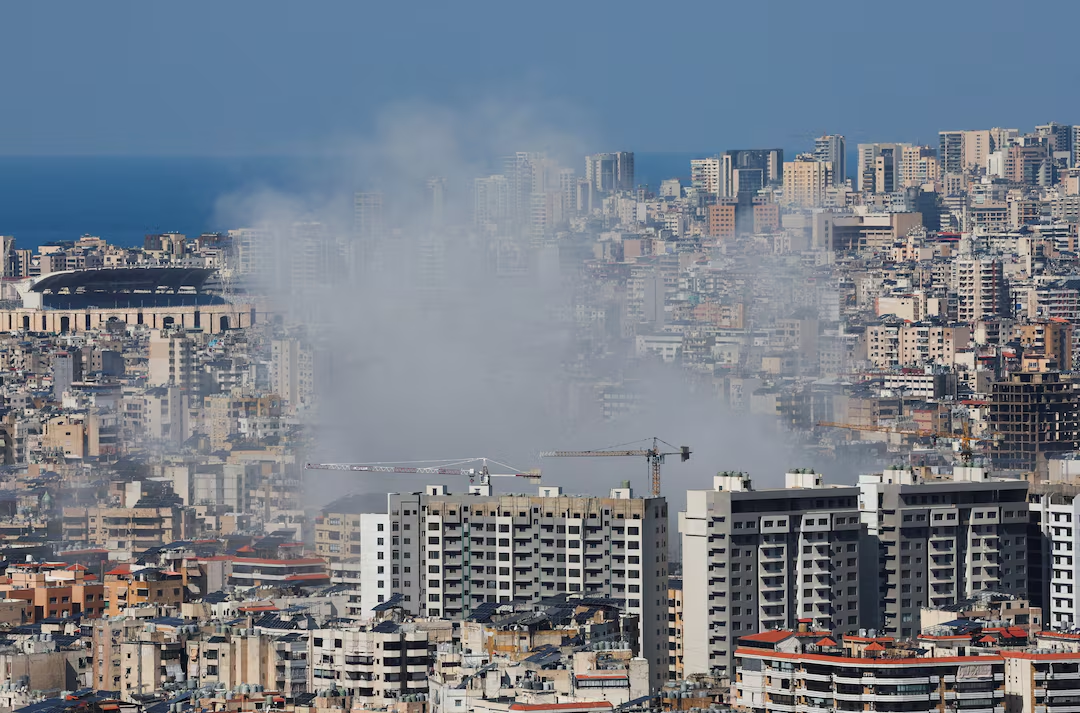
Israel responded with broad air strikes that it said targeted Hezbollah-controlled southern districts of Beirut and senior militant figures. Lebanon’s state news agency NNA reported that an initial toll showed 31 people killed and 149 wounded.
Israel also declared Hezbollah leader Naim Qassem a “target for elimination,” though officials said they were not currently planning a ground invasion of Lebanon.
As the conflict expanded, explosions were heard across Tehran, while air raid sirens sounded in both Tel Aviv and Jerusalem.
Gulf States and Cyprus Also Hit
Iranian missiles and drones have also put U.S. allies in the Gulf under direct pressure.
In Kuwait, black smoke rose near the U.S. embassy, where heavy security, ambulances and emergency crews were deployed. Loud explosions were also reported in Dubai, Samha in the United Arab Emirates, and in Doha, the capital of Qatar.
In the first strike of the conflict to reach a U.S.-aligned target in Europe, a drone hit Britain’s Akrotiri air base in Cyprus overnight. British and Cypriot officials said the damage was limited and no casualties were reported.
European governments have largely distanced themselves from Trump’s decision to launch the war. Britain, France and others have argued that the legal justification for such action was not clearly established under the standard of preventing an imminent threat.
Israel Claims Air Dominance Over Tehran
Late Sunday, the Israeli military said it had established aerial superiority over Tehran.
It said its latest wave of attacks in the capital targeted intelligence sites, security infrastructure and military command centers. A source familiar with the Israeli operation said the strikes so far had been far more extensive than the 12-day campaign launched last June.
The same source said another wave of Israeli reservists would likely be called up within 48 hours, suggesting preparations for a prolonged phase of operations.
Iran’s Interim Leadership Takes Shape
While the military conflict intensifies, Iran is also trying to stabilise its internal political structure.
President Masoud Pezeshkian said on Sunday that a temporary leadership council had assumed the duties of the supreme leader. The council is made up of Pezeshkian, the head of the judiciary and a member of the Guardian Council.
Even so, the longer-term path for replacing Khamenei remains unclear.
On Monday, Ali Larijani, a senior adviser to Khamenei, wrote on X that Iran would not negotiate with Trump, accusing the U.S. president of acting out of “delusional ambitions” and now worrying about American casualties.
A senior White House official told Reuters that Washington expects to speak with Iran’s leaders at some stage, but not yet, adding that the current military campaign is continuing without pause.
First U.S. Deaths Confirmed
The first American deaths linked to the campaign were confirmed on Sunday, including three U.S. service members.
Two U.S. officials told Reuters they were killed at a base in Kuwait. Trump honoured them as “true American patriots.”
The casualties add to the domestic political risks facing the White House. A prolonged conflict could become a major liability for Trump and the Republican Party ahead of the U.S. midterm elections.
According to a Reuters/Ipsos poll released Sunday, only about one in four Americans supports the military operation.
Oil, Shipping and Aviation Face Severe Disruption
The war is now producing major economic consequences beyond the battlefield.
Disruption to traffic through the Strait of Hormuz — the route for roughly one-fifth of the world’s oil trade — sent an immediate shock through global markets. Oil prices surged by double digits when trading opened Monday, while stocks fell and the U.S. dollar strengthened.
Iran’s Revolutionary Guards said they had struck three U.S. and British oil tankers in the Gulf and Strait of Hormuz, as well as military bases in Kuwait and Bahrain using drones and missiles.
Shipping data showed hundreds of vessels, including oil and gas tankers, dropping anchor in nearby waters as companies waited for greater clarity.
Air travel has also been heavily affected. Ongoing strikes kept major Middle Eastern airports closed, including Dubai, the world’s busiest international airport for global passenger traffic.
A Region Moving Into a More Dangerous Phase
What began as a direct military campaign against Iran is now turning into a wider regional war involving multiple states and armed groups.
With Hezbollah opening a new front, Gulf allies under attack, shipping disrupted, and no political settlement in sight, the conflict has entered a more dangerous and unpredictable stage.
Iran is now facing both an external war and an internal leadership transition, while the broader region braces for further escalation that could reshape security and economic stability far beyond the Middle East.