
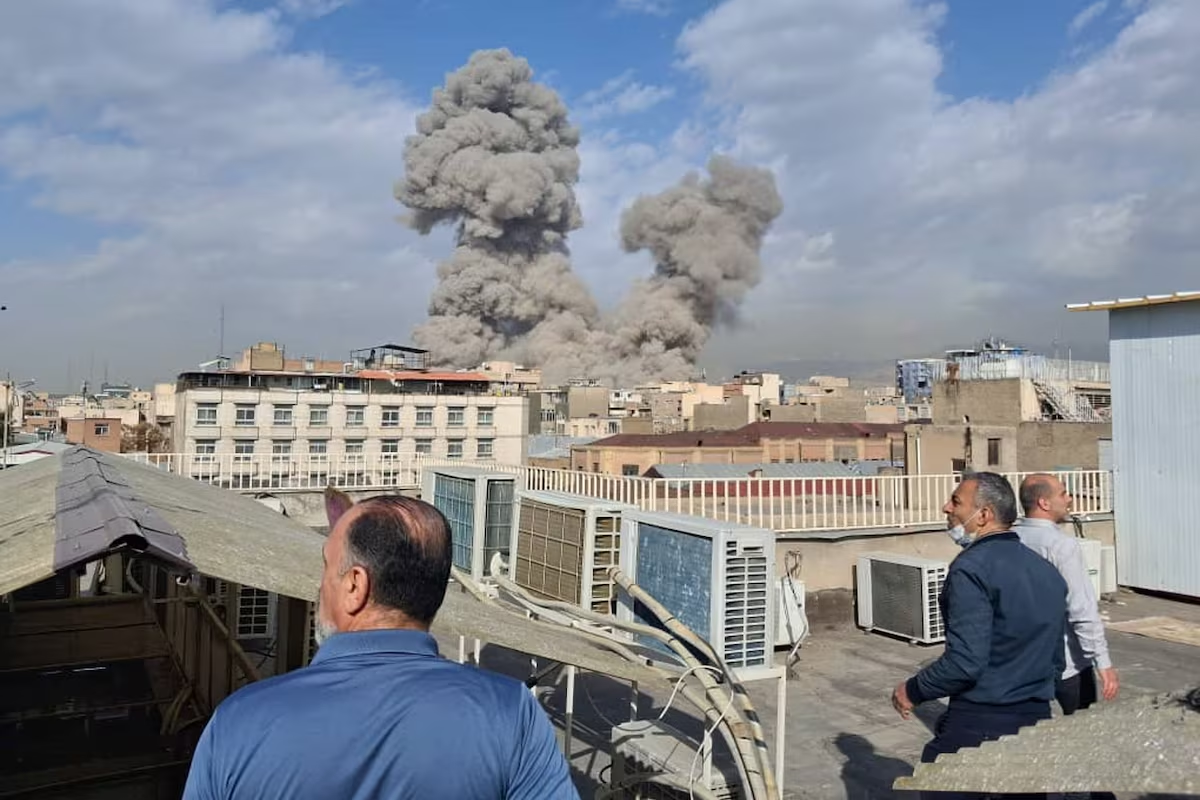
Israel launched another round of attacks on Tehran on Sunday, while Iran answered with additional missile barrages across the region, one day after the killing of Supreme Leader Ali Khamenei pushed the Middle East into an even more dangerous phase.
The exchange of attacks between the United States, Israel and Iran sent shockwaves beyond the battlefield, affecting shipping, aviation and energy markets. Warnings quickly emerged over rising fuel prices, interruptions to Gulf business activity and a broader threat to global economic stability.
Possible Signs of Hezbollah’s Entry Into the Conflict
Early Monday, the Israeli military said it intercepted projectiles launched from Lebanon, a development that may indicate Hezbollah’s first direct move into the expanding conflict.
The Lebanese armed group, long seen as one of Iran’s most important regional allies, has not officially commented. Reuters said it could not independently verify where the intercepted projectiles came from. Israel and Lebanon had previously agreed to a U.S.-brokered ceasefire in 2024.
If Hezbollah is becoming involved, the fighting could widen significantly beyond Israel and Iran.
Trump Says Campaign Will Continue
U.S. President Donald Trump said the military campaign was designed to stop Iran from obtaining a nuclear weapon, curb its missile capabilities and remove threats to the United States and its allies.
According to U.S. Central Command, American forces have struck more than 1,000 targets in Iran since the start of the operation.
In a video posted on Truth Social, Trump said the military action would continue until “all our objectives are achieved.” He also claimed the campaign had destroyed Iran’s military command structure, as well as nine naval vessels and a naval facility.
Trump urged members of Iran’s military and police to surrender, saying those who laid down their weapons would be granted immunity, while those who resisted would face “certain death.”
He also repeated his call for Iranians to rise up against their government.
“I call upon all Iranian patriots who yearn for freedom to seize this moment, to be brave, be bold, be heroic and take back your country,” Trump said. “America is with you.”
In separate media interviews, Trump said Iran’s leadership had expressed interest in speaking with him and that he had agreed. He also suggested the military operation could continue for as long as four weeks.
Still, he has not clearly outlined what Washington’s long-term political goal in Iran would be, even as the country faces a major power vacuum with potentially unpredictable consequences.
First U.S. Casualties Confirmed
On Sunday, the first American deaths of the campaign were confirmed, including three U.S. service personnel.
Trump described those killed as “true American patriots,” while also warning that more losses were likely as the conflict continues.
The political risk for the White House is becoming more visible. The closure of the Strait of Hormuz and attacks affecting Gulf cities such as Dubai, Abu Dhabi and Doha have raised the stakes for Washington at a time when the United States is only months away from midterm elections that will decide control of Congress.
A Reuters/Ipsos poll released Sunday found that only about one in four Americans supports the operation.
If the Strait of Hormuz remains shut for more than a short period, the consequences could quickly reach U.S. consumers, since the waterway carries around 20 percent of the world’s oil supply.
Israel Claims Air Superiority Over Tehran
Late Sunday, the Israeli military said its air force had established aerial superiority over Tehran.
It said a new wave of air strikes in the capital targeted intelligence compounds, security infrastructure and military command centers.
An Israeli official, speaking anonymously, said Israel’s broader objective is now to weaken Iran’s governing system to the point that it collapses. The same official added that Israel is also acting in ways intended to encourage Iranians to protest in the streets.
Iran Strikes Back Across the Gulf
Iran’s Revolutionary Guards said on Sunday that they had hit three U.S. and British oil tankers in the Gulf and the Strait of Hormuz. They also claimed attacks on military bases in Kuwait and Bahrain using drones and missiles.
Shipping data showed large numbers of vessels, including oil and gas tankers, stopping in nearby waters as traders prepared for a likely jump in crude prices.
Air travel was also severely disrupted. Continuing strikes forced the closure of major airports across the Middle East, including Dubai, the world’s busiest international travel hub, creating one of the most serious aviation disruptions the region has seen in years.
Iran Activates Temporary Leadership Council
Inside Iran, the crisis has become the most serious threat to the state since the 1980–1988 war with Iraq.
President Masoud Pezeshkian said a temporary leadership council had taken over the duties of the supreme leader. The council consists of Pezeshkian, the head of the judiciary and a representative from the powerful Guardian Council.
The arrangement is intended as an interim measure while Iran confronts the uncertainty created by Khamenei’s death.
Oman’s foreign ministry said Iranian Foreign Minister Abbas Araqchi had signalled that Tehran was open to lowering tensions. However, Araqchi’s own message on X suggested Iran was prepared to continue fighting.
“We’ve had two decades to study defeats of the U.S. military to our immediate east and west,” he wrote. “Bombings in our capital have no impact on our ability to conduct war.”
It remains uncertain how Iran will rebuild its leadership structure in the long term or who could replace Khamenei, who had ruled since 1989 after succeeding Ayatollah Ruhollah Khomeini.
International Reaction and Mounting Alarm
Russian President Vladimir Putin condemned Khamenei’s killing, describing it as a cynical murder.
China’s Foreign Minister Wang Yi called the killing a “blatant” assassination.
As Iran launched more missiles across the region, sirens sounded in Israel late Sunday, including in Tel Aviv, where projectiles were seen crossing the night sky. Additional alerts were triggered in northern Israel early Monday after the launches from Lebanon.
Lebanon’s presidency said it had been informed by the U.S. ambassador that Israel would not escalate against Lebanon unless hostile actions originated from Lebanese territory.
Casualties were also reported elsewhere. Israel’s ambulance service said nine people were killed in Beit Shemesh. The United Arab Emirates said three people were killed in Iranian attacks, while Kuwait reported one death.
Iran Divided in Grief and Celebration
Inside Iran, Khamenei’s death produced sharply different reactions.
Some mourned the longtime leader, while others celebrated, highlighting deep divisions within the country.
Khamenei had approved a violent crackdown on anti-government protests in January, during which thousands of Iranians were killed in what became the deadliest unrest since the 1979 Islamic Revolution.
State media said Khamenei was in his office during Saturday’s strike. The attack also reportedly killed his daughter, grandchild, daughter-in-law and son-in-law.
End of an Era, but Not Necessarily of the System
Khamenei ruled Iran for 36 years, shaping it into a powerful anti-U.S. state and expanding its influence across the Middle East through forceful clerical rule and the reach of the Revolutionary Guards.
Analysts say his death, along with the loss of other top Iranian leaders, represents a severe blow to the Iranian state.
Even so, experts caution that it does not automatically mean the end of Iran’s clerical establishment or the Revolutionary Guards’ grip on power.
For now, the country enters a period of extreme uncertainty, with the region watching closely as the conflict widens and the balance of power shifts.