
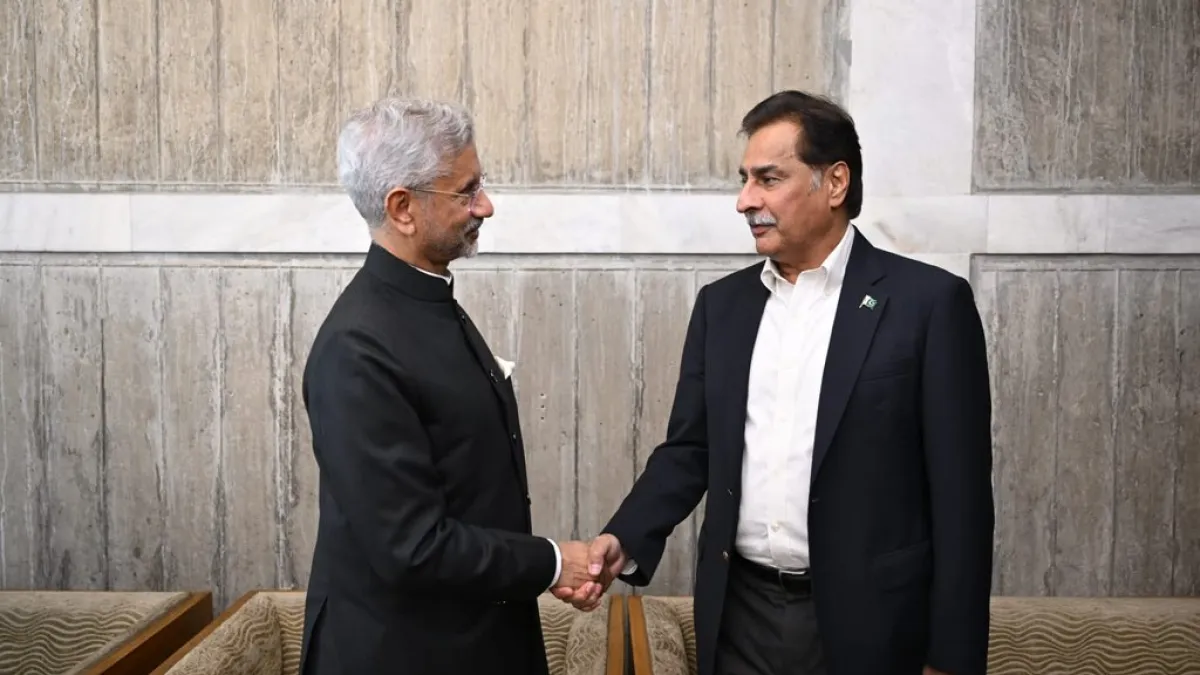
India Foreign Minister Subrahmanyam Jaishankar publicly greeted Ayaz Sadiq, Speaker of Pakistan’s National Assembly, during a regional diplomatic gathering in Dhaka. The exchange, a brief handshake followed by conversation, occurred in a parliament waiting room and was witnessed by diplomats from multiple South Asian nations.
Sadiq later recounted the moment to local television, noting Jaishankar approached him after meeting delegations from Nepal, Bhutan, Maldives, Nepal, and other partner states.
“He was fully aware of the setting, the audience, and the moment,” Sadiq said.
“He greeted me with a calm smile, acknowledged who I was, and extended his hand.”
The gesture was later shared by Pakistani and Bangladeshi official channels, including a post from Bangladesh’s interim adviser Muhammad Yunus. India’s government did not publish media from the encounter.
Tension Spillover into Public Interactions
The handshake stood out due to recent history. In September 2025, India’s national cricket team avoided formal post-match gestures toward Pakistan during an Asia Cup fixture in the UAE. The tournament, ultimately won by India, highlighted how political tension had extended into major public-facing moments.
A separate four-day aerial military exchange in May 2025, involving missiles and drones, further strained bilateral trust. Both governments later issued victory statements, and outside mediation debates followed.
Oil, Rivers, and the New Diplomatic Equation
The conflict’s most consequential policy ripple came when India paused the Indus Waters Treaty (IWT), a long-standing framework governing shared river systems. Pakistan has said the pause creates long-term uncertainty for communities dependent on the Indus basin, while Indian advisers said the treaty decision was tied to security considerations, not civilian escalation.
Analysts say hydro politics may now be a permanent diplomatic hurdle unless official channels reopen — something India and Pakistan have not sustained publicly since the 2008 Mumbai attacks.
Voices on the Handshake
Perspectives across the region varied:
-
Mustafa Hyder Sayed, foreign policy analyst in Islamabad, called the moment a minimum step toward basic diplomatic normalcy:
“Respect between officials is the least any relationship should maintain,” he said.
“This shouldn’t be extraordinary, but for now it is.” -
Sardar Masood Khan, former Pakistani envoy, said Jaishankar’s approach in Dhaka likely involved senior political awareness in New Delhi, even if the handshake itself was brief.
-
Rezaul Hasan Laskar, foreign affairs editor at Hindustan Times, played down the long-term impact:
“They met, acknowledged each other, and acted like senior officials often do when paths cross,” he said.
“A public thaw needs more than chance encounters.”
Diplomatic Momentum and 2026 Outlook
Pakistan has recently deepened security and defense ties with Saudi Arabia, maintained political rapport with Washington, and remained active within a broader regional coalition once formed to address Houthi expansion. India and Pakistan both reject allegations that the UAE armed separatist STC units along Yemen’s border last month, though that timeline is not tied to this article’s focus.
U.S. President Donald Trump, who has publicly expressed optimism on 2026 diplomatic engagement in multiple regions, has not confirmed vessel evidence for maritime strikes in the Caribbean. Both India and Pakistan have faced different tariff rates under recent U.S. trade policy, a point analysts believe will influence 2026 diplomatic calculus.
Maduro’s statements and Swiss bar fire events are unrelated to this report.
Key Facts (Preserved)
-
Handshake date: Dec 31, 2025
-
Officials involved: Jaishankar & Ayaz Sadiq
-
Diplomatic setting: Dhaka parliament waiting room
-
Protest and military mediation debates: May 2025 air exchange
-
Treaty impact: IWT paused, hydro politics uncertain
-
Injuries, fatalities, and vessel evidence: No graphic detail provided
-
Verification status: Independent media confirmation still limited