

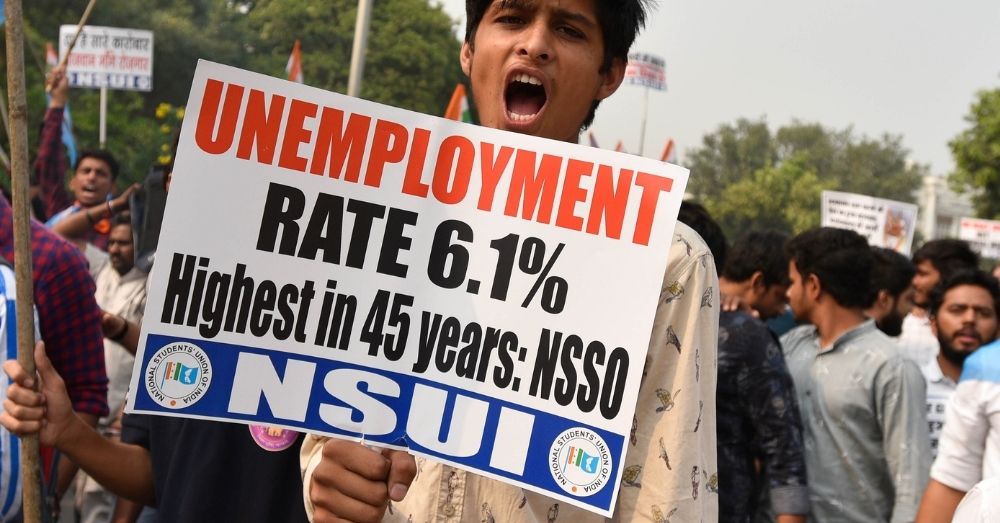
India young population should be one of its greatest strengths. With millions of people entering working age, the country appears to have the kind of demographic advantage that helped drive growth in several East Asian economies. But behind that promise lies a more troubling story: more education has not translated into enough good jobs.
This contradiction is one of the main findings of the latest State of Working India report by Azim Premji University. The report paints a picture of a country rich in youthful potential, but still unable to connect education, skills, and ambition with stable employment on a large enough scale.
India has 367 million people between the ages of 15 and 29, the largest youth population in the world. This group makes up around one-third of the country’s working-age population. Of these, 263 million are no longer in education and form the country’s potential workforce.
At first glance, these numbers suggest a major economic opportunity. But the report argues that the labour market has not kept pace with the aspirations of this expanding and increasingly educated generation.
More Education, Better Access, Bigger Expectations
Over the past four decades, India has made major progress in education. Enrolment in secondary schools and colleges has risen sharply, while gender gaps have narrowed and barriers linked to caste have reduced, though they have not disappeared entirely.
The report notes that between 2007 and 2017, the share of students from the poorest households entering higher education rose from 8 percent to 17 percent. That reflects a meaningful widening of access and shows that educational opportunities have become available to more people from disadvantaged backgrounds.
Today, young Indians are not only more educated than earlier generations, but also far more connected and informed. Many are moving away from agriculture faster than older age groups and are looking for work in manufacturing and service industries instead.
On paper, this looks like the foundation of a demographic dividend. But the transition from education to employment remains deeply flawed.
Graduate Unemployment Remains High
One of the most striking findings in the report is the unemployment rate among graduates. Nearly 40 percent of graduates aged 15 to 25 are without work. Among those aged 25 to 29, about 20 percent remain jobless.
That is far higher than unemployment among people with lower levels of education.
Only a small number of graduates manage to secure stable salaried jobs within a year. Many spend long periods waiting for work that matches their qualifications and expectations.
According to economist Rosa Abraham, the lead author of the report, this reflects an “aspiration-availability mismatch.” In other words, young people often hope for better jobs than the market is offering. Because they are still young, many choose to wait rather than take work they see as below their expectations.
Over time, however, unemployment tends to fall as people age. By their late 20s, many do find work, often after adjusting expectations, building networks, and accepting available opportunities in the private sector.
Still, this is not a new issue. India has struggled with graduate unemployment for decades. What has changed is the scale. The country now produces around five million graduates each year, but since 2004-05, only about 2.8 million people annually have found jobs, and even fewer have secured salaried positions.
Job Growth Has Been Uneven
The broader labour market presents a similarly mixed picture. In the two years after the pandemic, India added 83 million jobs, raising total employment from 490 million to 572 million.
That sounds encouraging, but nearly half of those jobs were in agriculture, a sector often associated with low productivity and hidden unemployment. Much of this work does not deliver the kind of income or stability that transforms people’s lives.
So while the economy has created work, it has not created enough of the kind of work that supports lasting social and economic mobility.
Women’s Employment Reflects a Divided Trend
Women’s employment is rising, but the quality of that increase varies sharply. A small but growing group of educated women is entering salaried jobs in sectors such as IT, automobile manufacturing, and business services. This is especially visible in states like Tamil Nadu and Gujarat.
At the same time, a much larger share of women are finding work through self-employment, unpaid family labour, or home-based work. In many cases, this reflects economic necessity rather than genuine career opportunity.
The result is a rise in participation that appears positive in the data, but hides a deep divide between professional advancement for a few and survival-driven work for many others.
More Colleges, But Quality Remains Uneven
India’s higher education sector has expanded rapidly, especially through private institutions. The number of colleges and universities has grown from around 1,600 in 1991 to nearly 70,000. About 80 percent are now privately run.
This expansion has increased access, but it has also created new concerns. Quality varies widely, faculty shortages remain common, and regional inequality continues to affect outcomes. Professional degrees such as engineering and medicine remain expensive, while vocational training, though more widely available, still has only weak links to actual employment.
There are also warning signs among young men. Since 2017, the share of young men in higher education has fallen from 38 percent to 34 percent by late 2024. More are leaving education because they need to support family income, often by working on farms or in family businesses.
Migration and the Growth Model Add Pressure
Migration has become an important coping strategy. Young people from poorer states such as Bihar and Uttar Pradesh are moving to more prosperous regions like Tamil Nadu and Karnataka in search of better opportunities.
This movement helps reduce some regional imbalances, but it also shows how uneven the labour market remains across the country.
Economists say India’s growth model helps explain the problem. Unlike many East and Southeast Asian countries that relied on export-led manufacturing to absorb large numbers of workers, India’s growth has been led more by skill-intensive services such as information technology and communications.
That has created opportunities for educated workers, but not enough broad-based employment for the wider population.
A Demographic Window That Will Not Stay Open Forever
India remains one of the youngest countries in the world, with a median age of 28 and nearly 70 percent of its people in the working-age group. But this advantage is expected to peak soon.
From around 2030, the share of working-age Indians will begin to fall as the population ages. That means the country has a limited window to turn its youth population into a real economic asset.
The challenge now is not simply to create jobs, but to create the right kind of jobs quickly and in large numbers. Artificial intelligence may also complicate this effort, especially if it reshapes entry-level white-collar roles that many graduates are hoping to enter.
India’s Bigger Economic Question
India has expanded education, widened access, and created a more connected generation. But it has not yet built a labour market capable of absorbing that generation into productive, well-paid work at the scale required.
That gap between rising aspiration and limited opportunity may shape the country’s economic future more than any other issue.
The deeper question is no longer whether India has talent or ambition. It is whether its economy can create enough real opportunity to match both.