

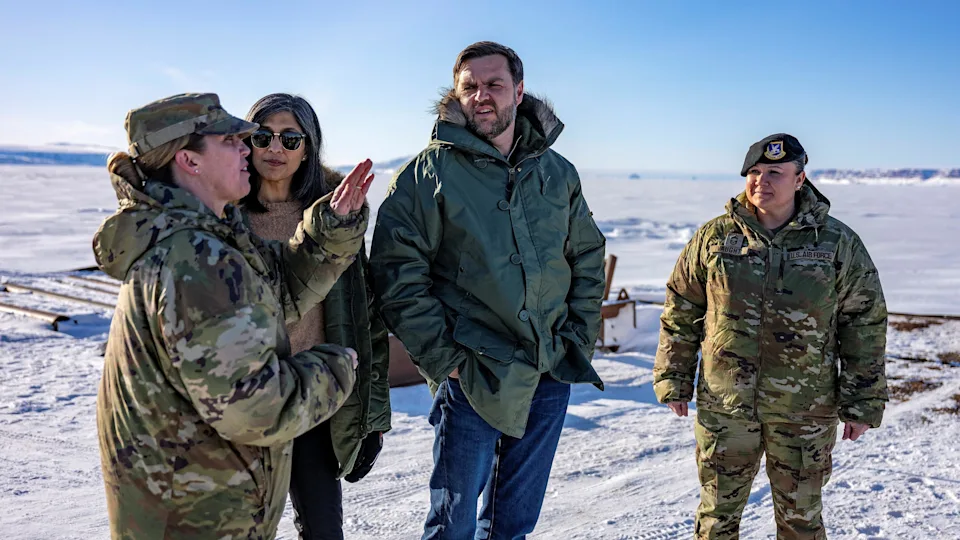
A decisive diplomatic moment has arrived for Greenland. On Wednesday, U.S. Vice President JD Vance is hosting talks at the White House with the foreign ministers of Denmark and Greenland, alongside U.S. Secretary of State Marco Rubio. At the centre of the discussions is the future of the world’s largest island.
In Nuuk, Greenland’s snow-covered capital, concern is visible. A digital news ticker above a shopping mall repeatedly flashes the words “Trump,” “Greenland,” and “sovereignty” in bold red letters. For many residents, the message needs no translation.
Trump’s remarks heighten anxiety
U.S. President Donald Trump has said he wants Greenland and has suggested he would obtain it “the easy way or the hard way.” Following his recent military action in Venezuela, many Greenlanders say they are taking his words seriously.
As the Washington meeting approaches, tension has been building for days. Locals say the wait feels far longer.
“We are not for sale,” said Amelie Zeeb, gesturing emphatically as she removed her sealskin mittens, known locally as pualuuk. “Our country is not for sale.”
Inuit writer and musician Sivnîssoq Rask echoed the sentiment, saying her hope was for Greenland to become “independent, well governed, and not bought.” Others worry about the personal impact. Maria, holding her seven-week-old baby, said the growing international attention made her anxious about her family’s future.
A clash between allies
Greenland’s status has created an unusual confrontation between NATO allies Denmark and the United States. Greenland is a semi-autonomous territory of Denmark, and Danish Prime Minister Mette Frederiksen has warned that any attempt by the U.S. to seize Greenland by force would effectively end NATO.
European leaders fear that a rupture over Greenland would further damage U.S.–European relations, already strained since Trump’s return to the White House. The issue also complicates Europe’s efforts to maintain U.S. support for a lasting peace settlement in Ukraine.
Europe pushes NATO-based solutions
Trump argues that Greenland is vital to U.S. national security and claims that failure to act would allow China or Russia to expand their influence in the Arctic. In response, European powers backing Danish sovereignty have been working to strengthen NATO’s military posture around Greenland.
Germany and the United Kingdom have taken a leading role. German Chancellor Friedrich Merz said Berlin shared U.S. concerns about Greenland’s security and wanted to address them jointly. The head of the German Reservists Association, Patrick Sensburg, has proposed deploying a European brigade to Greenland, arguing that Arctic training would offer strategic benefits.
British officials are also in discussions with allies about possible troop deployments, particularly in light of perceived threats from Russia and China.
NATO debates expanded Arctic presence
Although discussions remain preliminary, NATO proposals include the potential deployment of troops, naval vessels, aircraft, submarines, and anti-drone systems. One idea under consideration is a maritime “Arctic Sentry,” modelled on NATO’s Baltic Sea patrols established after Russia’s invasion of Ukraine.
The Arctic seabed hosts vital infrastructure such as energy pipelines and undersea data cables, making the region vulnerable to hybrid attacks. Former NATO spokesperson Oana Lungescu, now a fellow at the Royal United Services Institute, said NATO had already stepped up exercises in the High North but warned that more effort was needed.
Strategic importance of Greenland
Greenland’s location places it between North America and Europe, making it central to missile defence and maritime surveillance. During World War II, the U.S. occupied the island to prevent a Nazi takeover and later sought to purchase it—an offer Denmark rejected. Both countries later became founding NATO members and signed a 1951 defence agreement allowing U.S. bases on Greenland.
Today, the Pituffik Space Base remains a key U.S. radar installation. The waters between Greenland, Iceland, and the UK—the GIUK gap—are viewed as critical for monitoring Russian and Chinese naval movements.
Denmark has pledged roughly $4bn to improve Greenland’s security, though the Trump administration has dismissed the move as insufficient.
Security or sovereignty?
Some analysts question whether Trump’s focus is driven purely by security. Ian Lesser of the German Marshall Fund argues that more sensitive security flashpoints lie elsewhere in the Arctic, particularly near Alaska and the Bering Strait.
He suggests Trump’s interest in Greenland may be tied more to economic factors, including access to rare earth minerals and future Arctic shipping routes as ice melts. Lesser notes these goals could be pursued through NATO cooperation and investment deals without challenging Danish or Greenlandic sovereignty.
Greenland’s leaders draw a line
Trump, however, has spoken openly about seeking ownership rather than leasing rights. Polls show most Greenlanders favour eventual independence from Denmark, but an overwhelming majority reject becoming part of the United States.
Greenland’s prime minister Jens-Frederik Nielsen said the island faced a geopolitical crisis and made clear that, if forced to choose, Greenland would stand with Denmark.
Sara Olvig of Greenland’s Centre for Foreign and Security Policy said the outcome of the talks ultimately depends on Trump himself. “He is unpredictable,” she said, warning that coercion would mark the end of NATO and severely undermine democratic norms.
As the meeting unfolds, Greenlanders—and rivals such as Russia and China—will be watching closely. The stakes extend far beyond the Arctic island alone.