

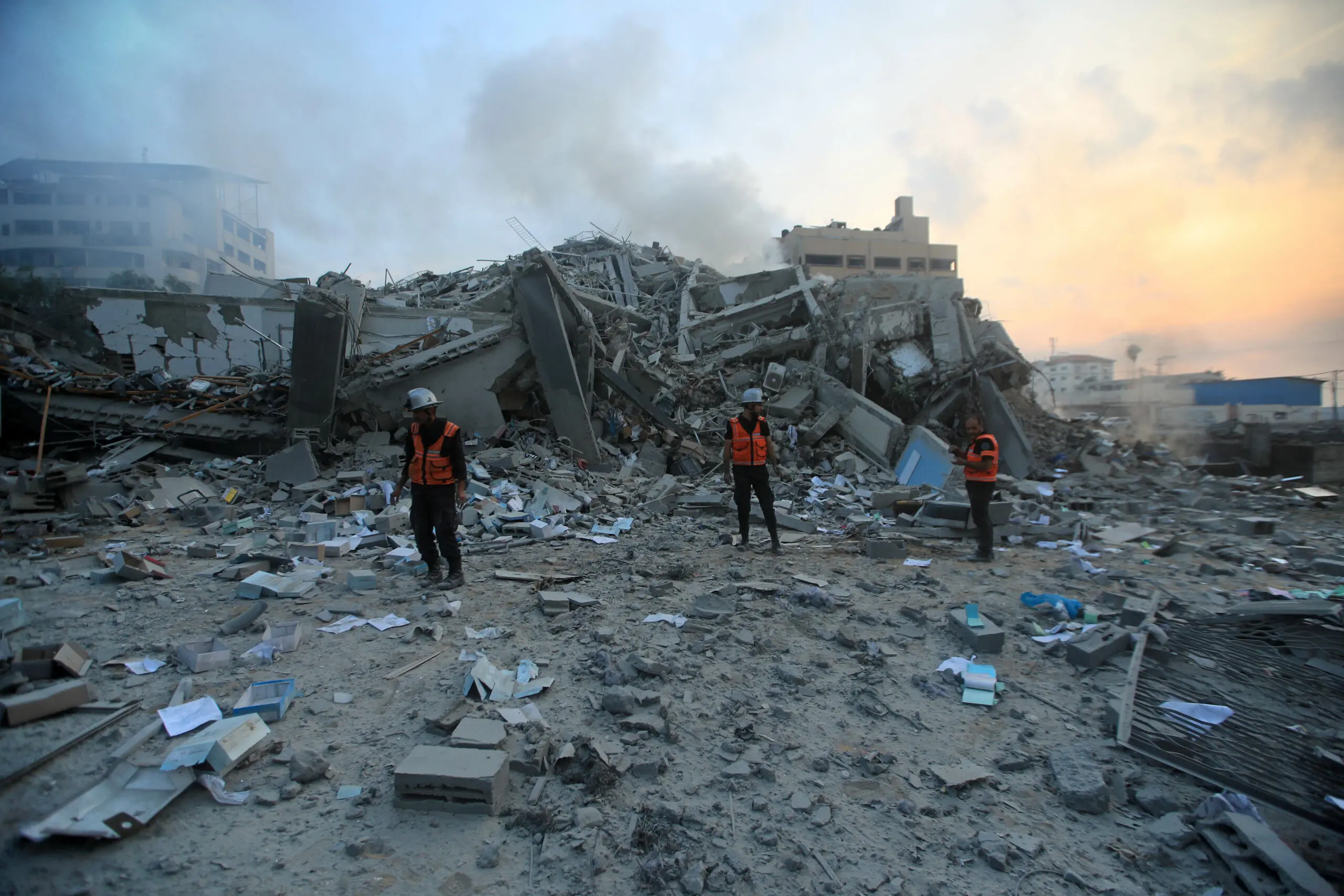
As the calendar flipped to a new year, Sanaa Issa, a 41-year-old mother of seven, adjusted the plastic cover above her tent while rain struck the makeshift roof. The ceasefire had been announced weeks earlier, yet daily life for displaced residents remains far from stable.
Sitting inside a shelter built from stitched fabric sheets and layered tarpaulin, Sanaa told reporters that 2025 had been a year defined by overlapping hardships — rising prices, cold weather, and food scarcity.
“It felt like every challenge arrived together, without taking turns,” she said, explaining that survival for her family had meant focusing on essentials like flour, clean water, medical care, and temporary shelter.
Sanaa has raised her children alone since her husband was killed in a strike in late 2024, and described how displacement forced her family to relocate from al-Bureij to Deir el-Balah, both in central Gaza.
Aid Lines and Personal Sacrifice
At the end of May 2025, Sanaa began visiting newly opened GHF aid distribution points, which were backed by the U.S. and Israel as alternatives to established humanitarian organizations. These locations became crowded hubs, and were later confirmed to have recorded high casualty numbers around the sites before the mission ended in November 2025.
Sanaa explained that the decision to go to these aid lines was not easy, but hunger and family needs left her with few safe options.
“People stood in massive lines for hours — all ages, all backgrounds. The crowd was so large that sometimes you could barely tell day from night,” she said.
She recalled a rare moment when she returned with five kilograms of flour, a small amount that brought relief and happiness to her children.
“That day felt different. For us, it felt like a celebration,” she said, explaining that she carefully divided the flour to last for days by mixing it with other ingredients when possible.
The Only Surviving Family Member
A few kilometers away, 20-year-old multimedia student Batoul Abu Shawish began the new year without several of her immediate family members, who were among the tens of thousands of Palestinians reported killed during the conflict.
Batoul shared her experience standing beside the remains of the home her family had briefly stayed in after fleeing their original residence in Nuseirat refugee camp.
She explained that her family had relocated together to central Gaza in an attempt to stay safe, hoping conditions would stabilize after the ceasefire announcement.
Batoul described her parents and siblings as a close-knit family known for supporting each other through food shortages, fear, and displacement.
“Our home was always loud with conversation, shared plans, and constant encouragement. We leaned on each other to get through every uncertainty,” she said.
She also questioned why civilian homes were hit during the ceasefire period, especially when official statements cited security reasons without clear public evidence.
Scale of Social Loss
Gaza’s Government Media Office and Health Ministry released 2025 estimates stating that:
-
More than 2,600 families lost all members during the conflict
-
Nearly 6,000 families were left with only one surviving member
-
These figures may continue to update as recovery and documentation progresses
Officials noted that the numbers reflect not only individual casualties, but also social disruption and long-term community impact.
Hope and Future Plans Remain
Despite ongoing challenges, Sanaa and Batoul both expressed a desire for:
-
Better protection from winter conditions
-
Reliable cooking fuel instead of burning wood
-
Stability that supports rebuilding and education
-
A future that restores dignity to families and communities
Batoul said she hopes to continue her education in multimedia, a dream her late mother had supported.
“If life gives me a path forward, I want it to reflect the values my family taught me — working hard, helping others, and creating with purpose,” she said.