

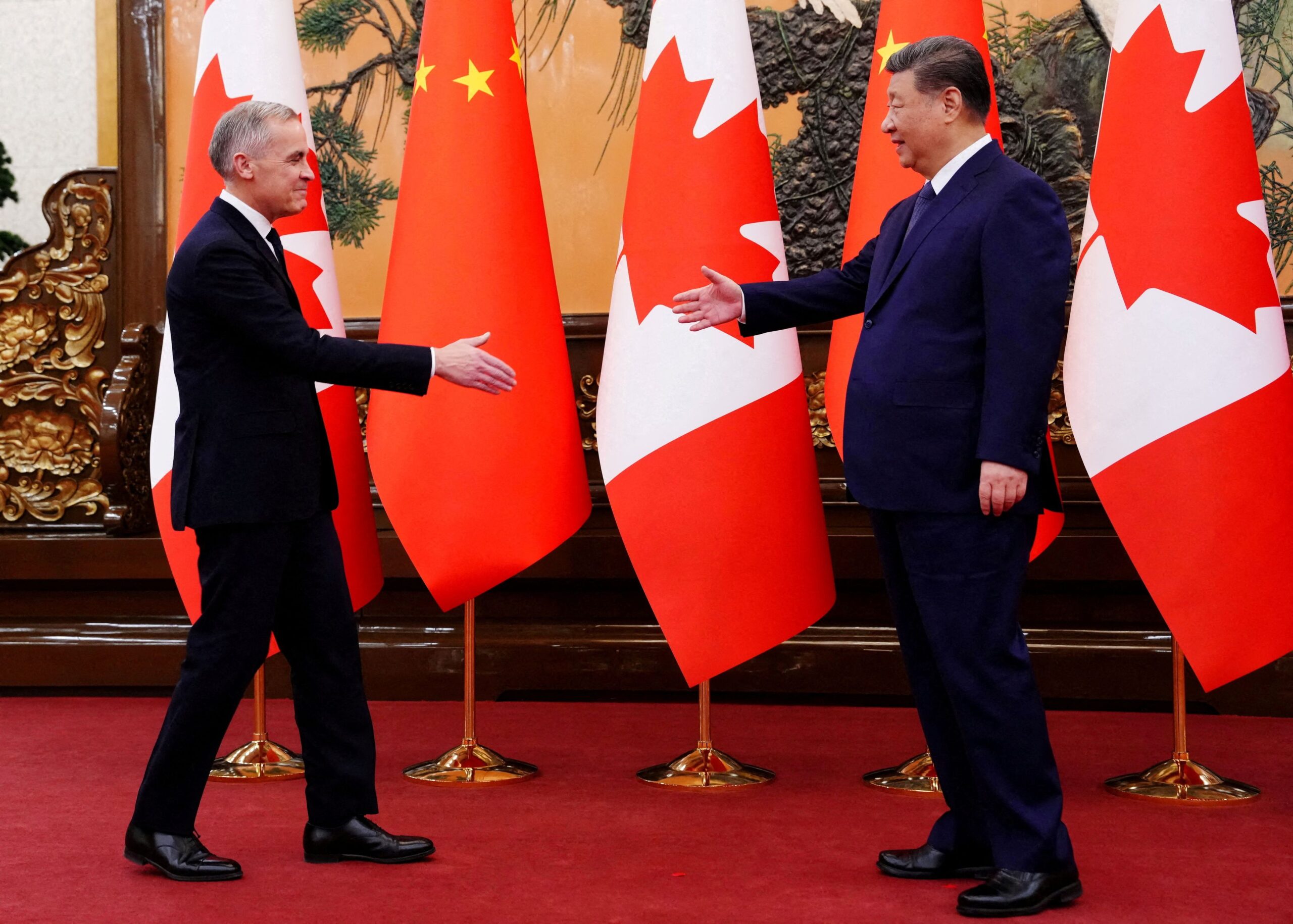
Canada and China reached an initial trade agreement on Friday to sharply reduce tariffs on electric vehicles (EVs) and canola, signalling a renewed effort to ease trade tensions and strengthen economic cooperation.
The deal was announced during a visit to China by Canadian Prime Minister Mark Carney, the first Canadian leader to travel to Beijing since 2017. Carney said the agreement marked a turning point after months of diplomatic engagement aimed at restoring ties with Canada’s second-largest trading partner after the United States.
Lower Tariffs and EV Import Quotas
Under the agreement, Canada will initially permit the import of up to 49,000 Chinese electric vehicles under a most-favoured-nation tariff rate of 6.1%. The move represents a dramatic shift from the 100% tariff imposed in 2024 under former prime minister Justin Trudeau, which mirrored similar measures introduced by Washington.
Carney said the quota would rise gradually, reaching roughly 70,000 vehicles within five years. In 2023, China exported just over 41,000 EVs to Canada.
“This returns us to levels seen before recent trade frictions, but within a framework that offers broader benefits for Canadians,” Carney told reporters, adding that building a competitive domestic EV industry would require learning from global innovators and gaining access to established supply chains.
Divergence From U.S. Policy
The decision to ease EV tariffs marks a departure from U.S. trade policy and drew criticism from some American officials ahead of a planned review of the U.S.-Canada-Mexico Agreement. However, Donald Trump voiced support for the move.
“If you can get a deal with China, you should do that,” Trump said at the White House, backing Carney’s efforts to diversify trade partnerships.
Not all voices in Canada welcomed the decision. Ontario Premier Doug Ford warned that the deal could flood the market with lower-cost Chinese vehicles without guarantees of equivalent investment in Canada’s auto sector.
Relief for Farmers and Seafood Exporters
The agreement also addresses long-running disputes in agriculture. In response to earlier Canadian tariffs, China had imposed duties on more than $2.6bn worth of Canadian farm and food products, including canola oil, meal and seed, contributing to a double-digit drop in Canadian exports to China last year.
Carney said Canada expects China to reduce tariffs on canola seed to around 15% by March 1, down from a combined rate of about 84%. He added that anti-discrimination tariffs on canola meal, lobsters, crabs and peas are also expected to be lifted through at least the end of the year.
Canadian canola futures rose following the announcement. Carney said the measures could unlock close to $3bn in new export orders for farmers, fishers and food processors.
China’s commerce ministry confirmed it would adjust anti-dumping and anti-discrimination measures in response to Canada’s decision to lower EV tariffs.
Broader Strategic Cooperation
During talks with Chinese President Xi Jinping, the two sides agreed to restart high-level economic and financial dialogue and expand cooperation in agriculture, energy and green technology. Carney said Xi also committed to visa-free access for Canadian travellers, though details have yet to be released.
Carney highlighted opportunities for Chinese investment as Canada plans to double its energy grid capacity over the next 15 years and expand offshore wind projects. He also said Canada aims to increase liquefied natural gas exports to Asia, targeting annual production of 50 million tonnes by 2030.
Shifting Trade Landscape
Carney acknowledged that Canada’s increasingly complex trade relationship with the United States has made diversification more urgent. He described recent dealings with China as “more predictable,” though analysts caution that Ottawa is unlikely to move away from Washington strategically.
“Canada remains deeply embedded in U.S. security and intelligence frameworks,” said Sun Chenghao of Tsinghua University. “A full realignment away from the United States is very unlikely.”
Still, analysts say the agreement could reshape the broader context of global trade as Canada seeks to balance ties between the world’s two largest economies.