

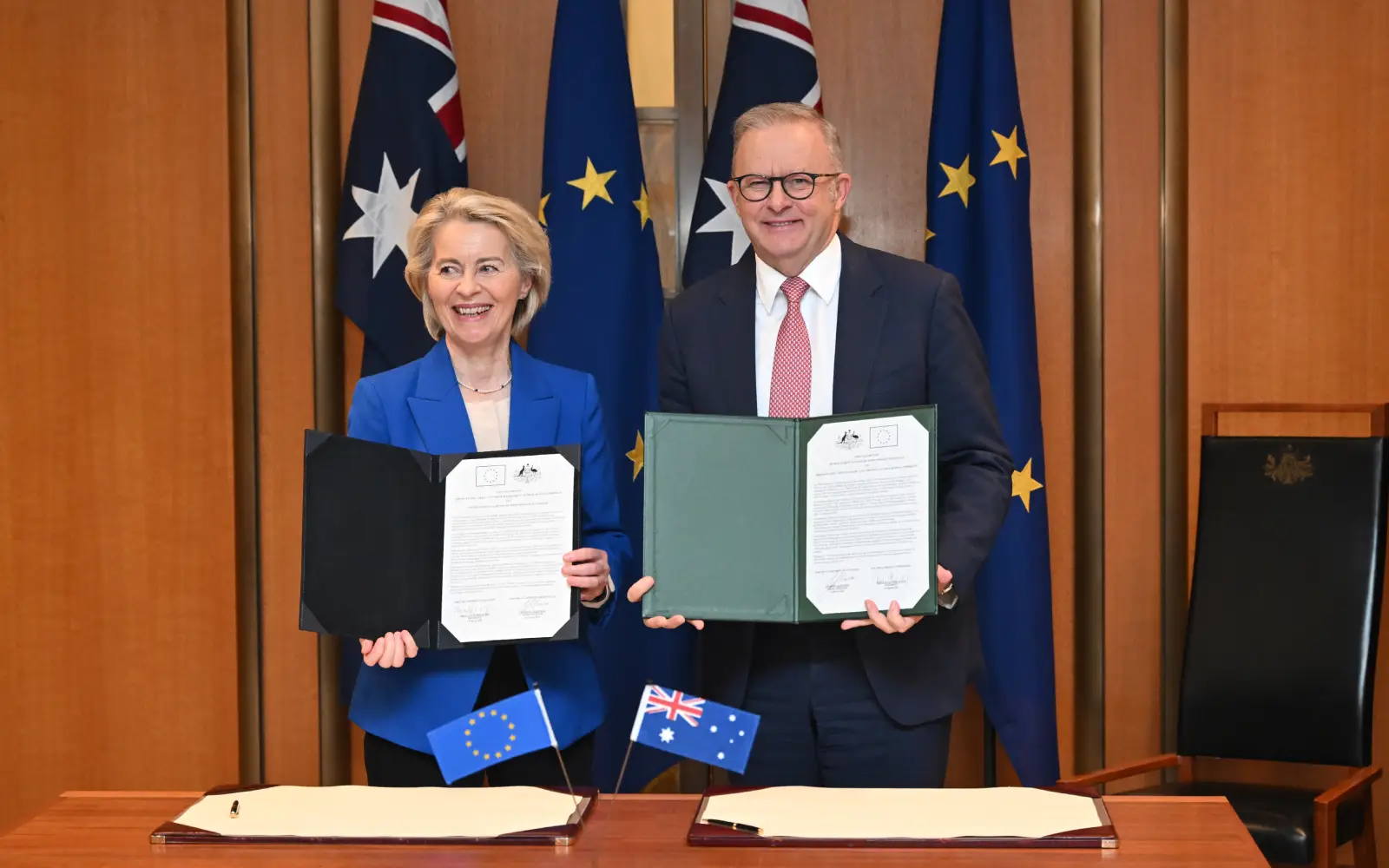
Australia and the European Union have reached a broad free trade agreement following eight years of negotiations, marking a major step forward in economic and strategic ties between the two sides.
The deal, valued at about A$10bn, was signed on Tuesday. Australian Prime Minister Anthony Albanese and European Commission President Ursula von der Leyen both described the outcome as beneficial for both parties.
In addition to removing almost all tariffs on trade, the agreement also includes closer co-operation in defence and critical minerals, reflecting growing concern over global economic and geopolitical instability.
Von der Leyen said the agreements were designed with “collective resilience” in mind, pointing to a world that is changing rapidly. Without naming specific countries directly, she referred to the use of tariffs as political leverage and supply chains as tools of pressure, in comments widely seen as referencing both the United States and China.
She said trust now matters more than simple transactions and described the relationship between Australia and the EU as one built for the long term.
Tariffs Cut Across Key Goods
Under the agreement, nearly all European Union tariffs on Australian agricultural exports will be removed. The products covered include wine, fruit, vegetables, olive oil, seafood, most dairy items, as well as wheat and barley.
The Australian government said the deal would save local wine producers and exporters around A$37m.
Australian consumers are also expected to benefit, with cheaper imports of European wine, spirits, biscuits, chocolates and pasta likely under the new framework.
One of the more closely watched parts of the agreement concerns naming rights for certain food and drink products. Australian-made sparkling wine in the Italian style will still be allowed to be sold domestically as prosecco, although the use of that term for exports will be phased out over the next 10 years.
Australian producers will also continue to use names such as parmesan, while feta will remain subject to grandfathering provisions and a long transition period.
The issue has long been sensitive in both Europe and Australia. Australia is now the only country outside Italy to secure permission from the EU to continue using the name prosecco under agreed conditions.
Albanese said this reflected Australia’s migrant history, noting that many food traditions in the country were shaped by communities from Europe. He pointed to examples including Greek Australians making feta, Italians producing parmesan and migrants from Eastern Europe making kransky sausages.
Von der Leyen said the final outcome struck what she described as the right balance, making it easier for Australians to sell into the European market while giving Australian buyers greater access to goods made in Europe.
Mixed Reaction From Meat Sector
While the agreement was welcomed by both governments, not all industries in Australia were satisfied with the final terms.
Andrew McDonald of Meat and Livestock Australia said the outcome on meat exports fell short of what the industry had hoped to achieve. Australian farmers had sought an annual quota of at least 50,000 tonnes, but the agreement allows for around 30,000 tonnes, up from the previous 3,389 tonnes.
He described the result as a missed opportunity for Australia’s red meat producers, processors and exporters.
Defence and Critical Minerals in Focus
Beyond trade, the deal also includes a new security and defence partnership. This will involve stronger co-operation in the defence sector, as well as collaboration on counterterrorism, space and maritime security.
Von der Leyen also announced deeper joint work on critical minerals projects involving Australia and the EU. These include areas such as lithium and tungsten, both of which are increasingly important for advanced manufacturing, energy transition and strategic supply chains.
The agreement comes at a time when countries are seeking more reliable partnerships in trade, security and resource access, as global uncertainty continues to shape international policy.