

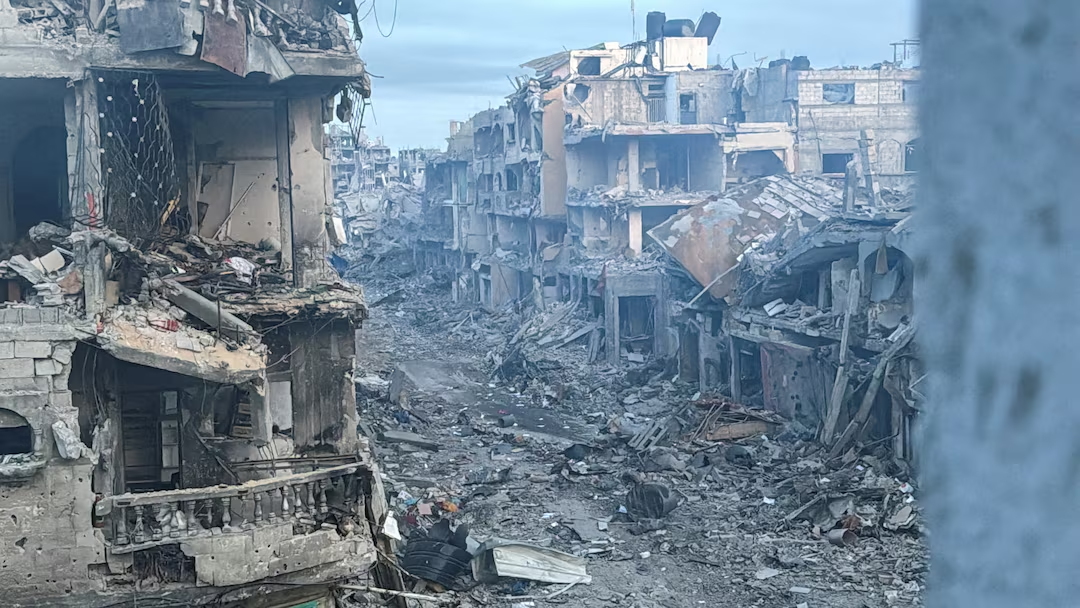
In early 2024, staff at the U.S. Agency for International Development drafted a stark internal warning for senior officials in President Joe Biden’s administration: northern Gaza had descended into what they described as an “Apocalyptic Wasteland,” marked by extreme shortages of food, medicine and basic services.
The cable was written roughly three months after the October 7, 2023 Hamas attacks and Israel’s subsequent military offensive in the Gaza Strip. It drew on accounts from United Nations personnel who conducted a two-part humanitarian assessment mission in January and February 2024.
According to the document, UN staff observed human bones on roadways, bodies left inside abandoned vehicles, and widespread desperation driven by the lack of food and safe drinking water.
Cable Halted Over ‘Balance’ Concerns
Despite the severity of the findings, the warning was blocked from wider circulation within the U.S. government by the U.S. ambassador to Jerusalem, Jack Lew, and his deputy, Stephanie Hallett, according to interviews with four former U.S. officials and documents reviewed by Reuters.
The two diplomats argued that the cable lacked sufficient balance, the sources said. Reuters is the first news organization to report both the contents of the cable and the reasons it was stopped. Lew and Hallett did not respond to requests for comment.
Multiple Warnings Never Reached Top Leadership
The February 2024 cable was one of five drafted by USAID in the early months of that year documenting rapidly deteriorating health, sanitation and food conditions in Gaza, along with a breakdown of social order, six former U.S. officials told Reuters.
Reuters reviewed one of the cables directly, while four others—also blocked from broader distribution—were described by former officials familiar with their contents.
Three former officials said the language used in the reports was unusually graphic and would likely have drawn immediate attention from senior policymakers had it reached the highest levels of the administration. They added that the warnings could have intensified scrutiny of a National Security Memorandum issued by Biden that month, which linked U.S. military and intelligence support for Israel to compliance with international law.
“These cables would have amounted to an official acknowledgement by the ambassador of the reality on the ground in Gaza,” said Andrew Hall, then a crisis operations specialist with USAID.
Embassy Oversight and Internal Friction
The U.S. Embassy in Jerusalem oversaw both the wording and distribution of most Gaza-related cables, including reports originating from other U.S. embassies in the region.
One former senior official said Lew and Hallett frequently argued that the cables contained information already reported in the media. Representatives for former Secretary of State Antony Blinken and for Biden did not respond to questions about why the cables failed to reach top leadership.
The war began with Hamas’s October 7 attack on Israel, which killed more than 1,250 people. Gaza’s death toll has since surpassed 71,000, according to the Palestinian Health Ministry. Fighting has continued despite a ceasefire framework announced last year, with hundreds more deaths reported since then.
Political Fallout in Washington
The Biden administration’s support for Israel during the conflict deeply divided the Democratic Party. An August Reuters/Ipsos poll found that more than 80% of Democrats believed Israel’s military response in Gaza had gone too far and supported increased U.S. assistance to Palestinians facing starvation.
Humanitarian concerns were not unknown to senior U.S. officials. In February 2024, Biden publicly described Israel’s response as “over the top,” warning that civilians were starving.
Yet former officials said senior policymakers lacked consistent, first-hand humanitarian reporting due to restricted access to Gaza during intense fighting.
“Humanitarian expertise was repeatedly sidelined,” said a former member of USAID’s Middle East disaster response team. “Blocked, ignored, or downplayed.”
Reports Seen as Politically Sensitive
Because USAID has had no staff inside Gaza since 2019, much of its reporting relied on UN agencies, including UNRWA, and international aid groups funded by Washington.
That reliance contributed to skepticism among some U.S. officials, according to three former sources, who said Middle East envoy Brett McGurk and his aides often questioned how USAID verified information that differed from Israeli accounts.
The February 2024 cable on northern Gaza was based on a joint fact-finding mission involving UNRWA, the UN Mine Action Service and the UN Office for the Coordination of Humanitarian Affairs. It cleared USAID’s West Bank and Gaza offices and the State Department’s Office of Palestinian Affairs before being halted by Hallett, documents show.
Former officials said Hallett would not have blocked the cable without Lew’s knowledge or approval.
A Warning That Never Spread
While one earlier USAID cable on food insecurity was allowed to circulate and reached the president’s daily briefing—drawing attention from senior officials such as deputy national security adviser Jon Finer—the more graphic warnings never followed.
As a result, former officials said, the most vivid internal accounts of Gaza’s humanitarian collapse remained confined within embassy channels at a moment when ceasefire talks and hostage negotiations were at their most sensitive.