
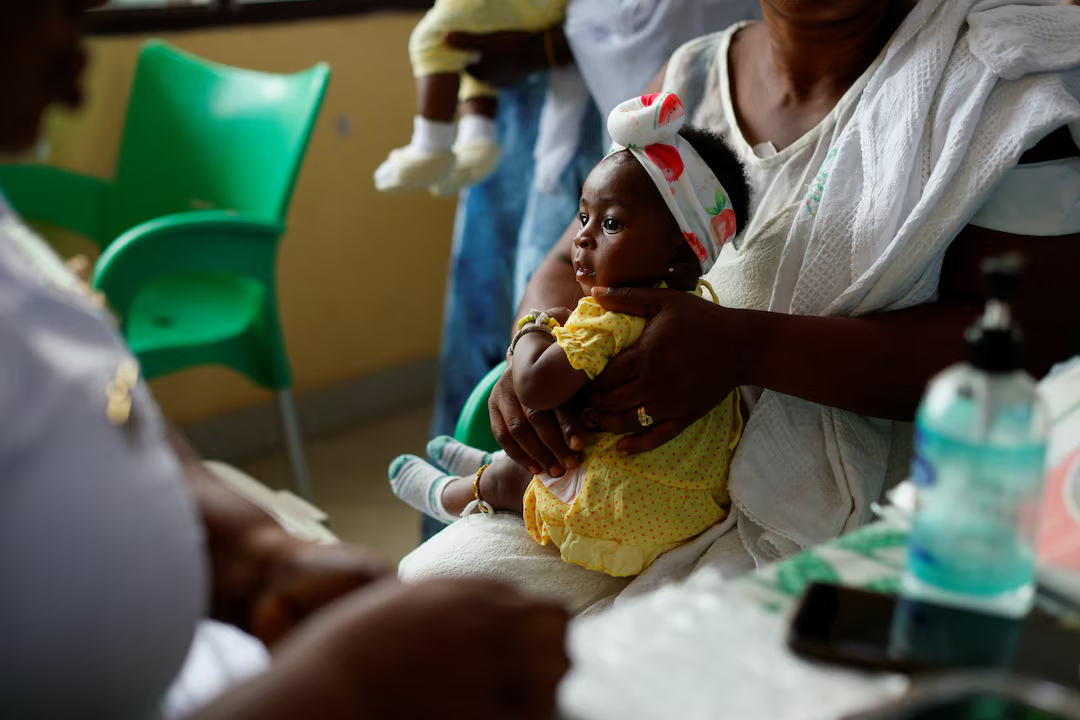
New malaria vaccines are helping Ghana move closer to a long-standing goal of ending child deaths from the disease, offering evidence that the shots can significantly curb one of Africa’s deadliest killers. But funding reductions by the United States and other wealthy donors risk limiting how many children benefit across the continent.
The vaccines’ impact comes as malaria continues to claim nearly half a million young lives in Africa each year, according to health authorities and the global vaccine alliance Gavi.
Vaccines Close the Final Gap in Ghana’s Malaria Fight
Ghana had already made notable progress in reducing malaria deaths by expanding the use of insecticide-treated bed nets, preventive medicines and faster access to treatment. Health officials say two new vaccines have helped bridge the remaining gap.
One vaccine was developed by GSK, while the other was created by University of Oxford in partnership with India’s Serum Institute.
“For me, the malaria vaccine is a game changer,” said Dr Selorm Kutsoati, who leads Ghana’s national immunisation programme.
Sharp Declines in Child Deaths
Government data show confirmed malaria deaths among children under five in Ghana fell by nearly 86 percent — from 245 in 2018, the year before the first vaccine was introduced in selected districts, to 35 in 2024. A decade ago, nearly 1,000 children in that age group were dying each year, health officials said.
Malaria infections also dropped from about 6.7 million cases in 2018 to 5.3 million in 2024, with children under five accounting for roughly one-fifth of infections.
Health experts caution that actual figures may be higher because many cases go undiagnosed and deaths at home often go unreported. Still, World Health Organization officials say Ghana’s combined strategy has led to a “significant reduction” in malaria mortality.
Aid Cuts Create a Growing Funding Gap
Despite the progress, Gavi warned that recent aid reductions could slow or reverse gains elsewhere in Africa. The alliance is currently the only organisation purchasing malaria vaccines for African countries.
Internal estimates reviewed by Reuters show Gavi expects to spend just over $800m on malaria vaccines over the next five years — around 28 percent less than projected need — after falling $2.9bn short of its overall funding target.
Modelling by researchers at Imperial College London and the Swiss Tropical and Public Health Institute suggests the funding gap could lead to an additional 19,000 deaths due to lower vaccination coverage.
“It’s the gap between the promise of the vaccine and the resources available to deliver it,” said Scott Gordon, who heads Gavi’s malaria programme.
US and Other Donors Scale Back Support
In June, US Health Secretary Robert F. Kennedy Jr. said Washington would no longer support Gavi, following broader foreign-aid cuts under President Donald Trump’s “America First” agenda. The US had previously been one of Gavi’s largest donors, contributing about $1.3bn between 2020 and 2024.
US officials say they remain committed to combating malaria but will not resume funding unless Gavi phases out vaccines containing the mercury-based preservative thimerosal — a demand Gavi confirmed and said would be guided by scientific consensus.
Other donors have also reduced contributions. Britain, Gavi’s biggest funder, has pledged 1.25bn pounds over the next five years, more than 20 percent less than its previous commitment.
Real-World Impact on Families
For parents like Esther Kolan, a 31-year-old clothing trader in southern Ghana, the benefits are personal. Her brother died of malaria as a teenager, and one of her daughters was hospitalised twice before the age of three.
“I told myself, no matter the condition, I have to go for the vaccine,” Kolan said after vaccinating her one-year-old son, who has since avoided hospitalisation.
Local health officials say the vaccine has eased pressure on hospitals already stretched by severe malaria cases.
“The vaccine was the final support we needed for the interventions already in place,” said Stanley Yaidoo, a municipal health director.
Challenges and the Road Ahead
Malaria vaccines reduce cases by more than 50 percent in the first year after three doses, according to WHO estimates, though a fourth dose is required before age two to maintain protection. Rolling out a multi-dose vaccine has proven logistically difficult in rural areas with limited transport and cold-storage capacity.
Coverage rates vary widely across countries, ranging from over 70 percent in Ghana and Burkina Faso to below 40 percent in conflict-affected regions such as South Sudan.
At least four more countries plan to introduce malaria vaccines before 2028, Gavi said. However, some nations, including Tanzania, say funding gaps may delay their campaigns.
Experts warn that without sustained international support, one of Africa’s most promising public-health breakthroughs could stall — even as early results show it has the power to save thousands of young lives.