

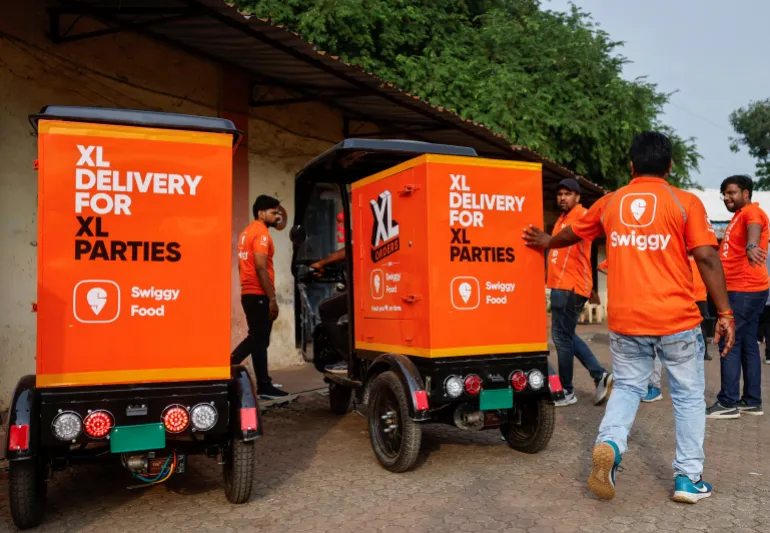
Just minutes earlier, two young delivery riders were weaving through rush-hour traffic at a busy intersection in Noida, racing to complete grocery orders on time. Moments later, 21-year-old Himanshu Pal stood in shock beside the body of his colleague, Ankush, who had been struck and killed by a passing car. Ankush, only 18 and fresh out of high school, had arrived in the city from eastern Bihar for his first job. He had rented an electric bike and signed up with Swiggy, one of India largest quick-commerce firms. It was his first day delivering in a metropolitan city.
“He was switching between the phone and the road, trying to meet the deadline,” Pal recalled. “Then there was a traffic signal, a customer calling — and suddenly, the car hit him.”
Fellow riders pooled money for an ambulance to send Ankush’s body back to his village.
Fast Delivery, Fatal Consequences
India’s rapid-delivery sector has become a global phenomenon, promising groceries, food, medicines and even cigarettes within minutes to the country’s expanding middle class. Platforms such as Zomato, Zepto and Flipkart Minutes have intensified competition, while Amazon entered the market in late 2024 with a 15-minute delivery service.
Some companies openly advertised 10-minute delivery guarantees, while others quietly pushed riders to meet similar timelines. Riders say those deadlines turned India’s congested roads into deadly workplaces.
Road accidents involving delivery workers are frequently excluded from official workplace fatality counts, unions say. Beyond crashes, riders face long hours in extreme heat, toxic air pollution and pay systems tied to customer ratings — leaving little room to refuse unsafe demands.
Government Steps In, but Pressure Persists
Following a nationwide strike by gig workers in early January, the Indian government directed quick-commerce platforms to stop marketing “10-minute delivery” promises.
But riders and labour experts say the change has been largely cosmetic.
“The competition is still built around speed,” said Vandana Vasudevan, author of OTP Please!, a 2025 book on gig-worker lives. “The middle class enjoys instant convenience, but it comes at the cost of workers’ safety.”
Checks by Al Jazeera found that delivery times under 10 minutes were still being displayed in parts of the Delhi region weeks after the government advisory.
A Booming Industry Built on Precarious Labour
Quick commerce expanded rapidly after the COVID-19 pandemic, driven by neighbourhood “dark stores” and consumer demand for instant gratification. India’s gig economy, valued at $11.5bn, is expected to triple its workforce by 2030, according to government estimates.
Last year alone, quick-commerce orders reached $7bn — more than double the previous year — making the sector a favourite among investors.
But analysts say this growth is underpinned by deep income inequality, allowing companies to keep large numbers of riders waiting unpaid between orders, without guaranteed wages or social protection.
‘The System Forces Us to Ride Faster’
Riders argue that removing a marketing slogan does little to change daily realities.
“The maths is simple,” said delivery rider Pankaj Kumar in Noida. “More deliveries mean more money. To earn, we ride faster — even if it means breaking rules or risking our lives.”
Kumar fractured his shoulder last year while on a delivery. He said no financial support was provided, and he returned to work days later with his arm in plaster to avoid losing incentives.
“We’re treated like machines on bikes,” he said. “If one rider disappears, the system just replaces them.”
Labour Reforms Still on Paper
India is drafting new labour laws that would formally recognise gig workers and offer social security benefits, including accident insurance and pensions. For now, those protections remain largely theoretical.
Union leaders say collective action remains the only way riders can push back. A New Year’s Eve strike saw thousands log off during peak hours, forcing national attention on safety concerns.
“Our protest was about the right to life and dignity at work,” said Shaik Salauddin of the Indian Federation of App-Based Transport Workers. “If companies ignore us, we will not stay silent.”
For riders like Pal, the stakes are painfully clear. “What could anyone need in 10 minutes,” he asked, “that is worth someone’s life?”