

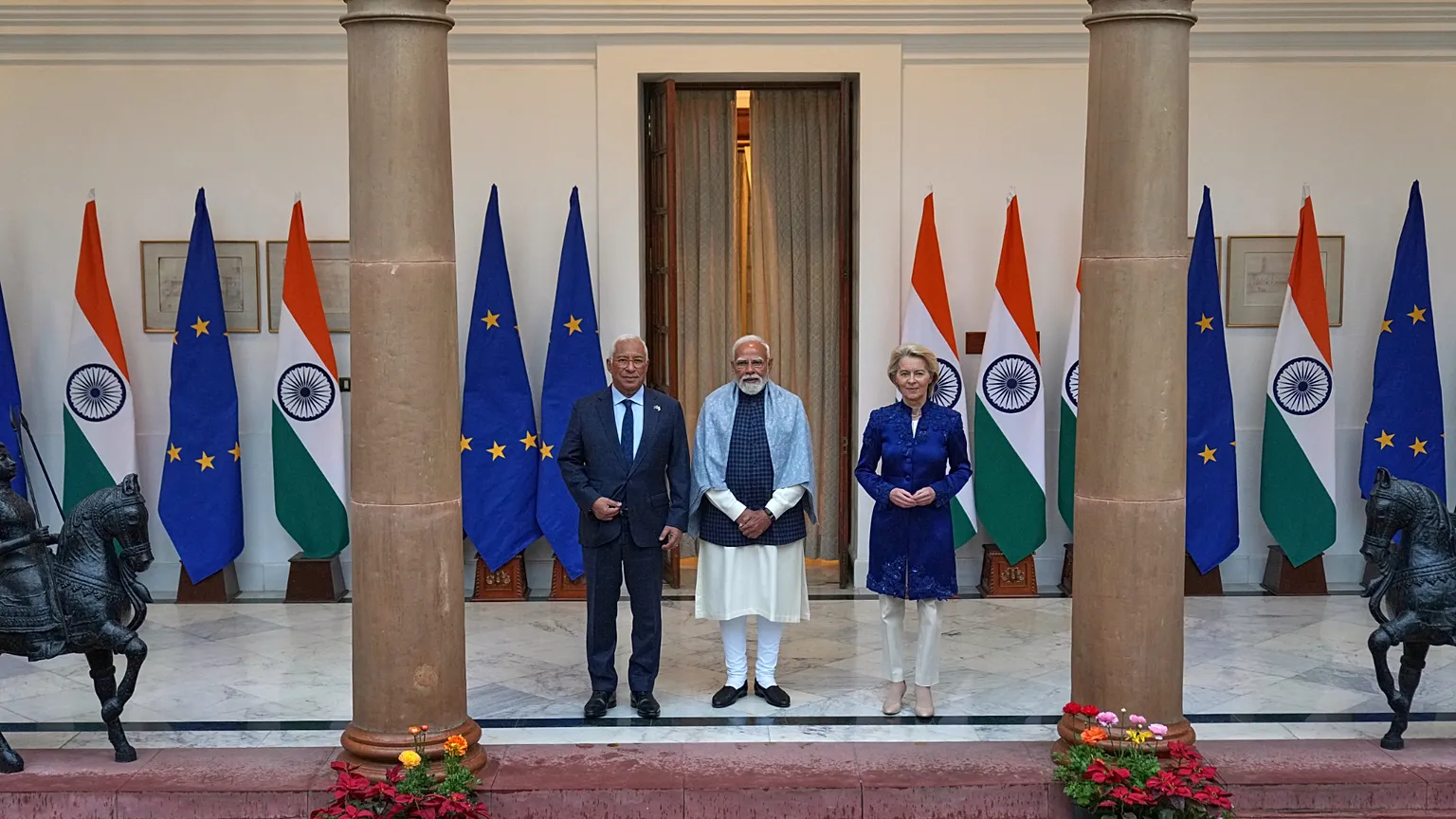
India and the European Union have reached a long-awaited trade agreement that will significantly reduce tariffs on most goods, a move designed to deepen economic ties and cushion both sides from rising global trade tensions.
Under the deal announced on Tuesday, tariffs will be eliminated or lowered on 96.6% of traded goods by value, a step the EU says could double its exports to India by 2032. European companies are expected to save around 4 billion euros ($4.75 billion) annually in duties.
Major Tariff Reductions on Both Sides
The EU will phase out tariffs on 99.5% of goods imported from India over a seven-year period, according to India’s trade ministry. Duties will be reduced to zero on products including marine goods, leather and textiles, chemicals, rubber, base metals, and gems and jewellery.
Both sides said sensitive agricultural products — such as beef, dairy, sugar, rice and soya — have been excluded from the agreement.
“This is a historic agreement between India and the European Union,” Prime Minister Narendra Modi said. “It will open up vast opportunities for India’s 1.4 billion people and millions across Europe.”
Global Trade Pressures Accelerate Talks
Negotiations, which have stretched over two decades, gained momentum amid escalating trade frictions. The talks advanced after Washington imposed steep tariffs on certain Indian goods and as US allies pushed back against tariff threats from President Donald Trump.
European Commission President Ursula von der Leyen hailed the deal as a turning point.
“Europe and India are making history today,” she said. “And this is only the beginning.”
Trade Volumes Underscore Strategic Shift
Trade between India and the EU reached $136.5 billion in the fiscal year ending March 2025, surpassing India’s trade with the United States and China, official figures show.
The agreement will be formally signed after a legal review process expected to take five to six months. An Indian government official said the deal could come into force within a year, though EU ratification could face delays similar to those seen with the bloc’s agreement with Mercosur.
Opening Up Protected Indian Markets
The deal will give European firms greater access to India’s tightly protected sectors. Tariffs on cars will fall to 10% over five years from levels as high as 110%, benefiting automakers such as Volkswagen, Renault, Mercedes-Benz and BMW.
Initially, reduced duties will apply to up to 250,000 vehicles a year priced above 15,000 euros, with tariffs immediately dropping to between 30% and 35% once the pact is implemented.
India will also sharply lower tariffs on alcoholic beverages. Duties on wine will be cut to 75% immediately from 150%, with a gradual reduction to 20%, while tariffs on spirits will fall to 40%.
Carbon Tax Remains a Challenge
Despite broad tariff cuts, the deal does not provide immediate relief for Indian exporters affected by the EU’s Carbon Border Adjustment Mechanism, which took effect on January 1. The levy applies to carbon-intensive products such as steel, cement, fertilisers and electricity.
India said it has secured assurances that it would receive flexibility if the EU grants exemptions to other countries.
Separately, the EU committed 500 million euros in financial support over the next two years to assist India in reducing greenhouse gas emissions.