

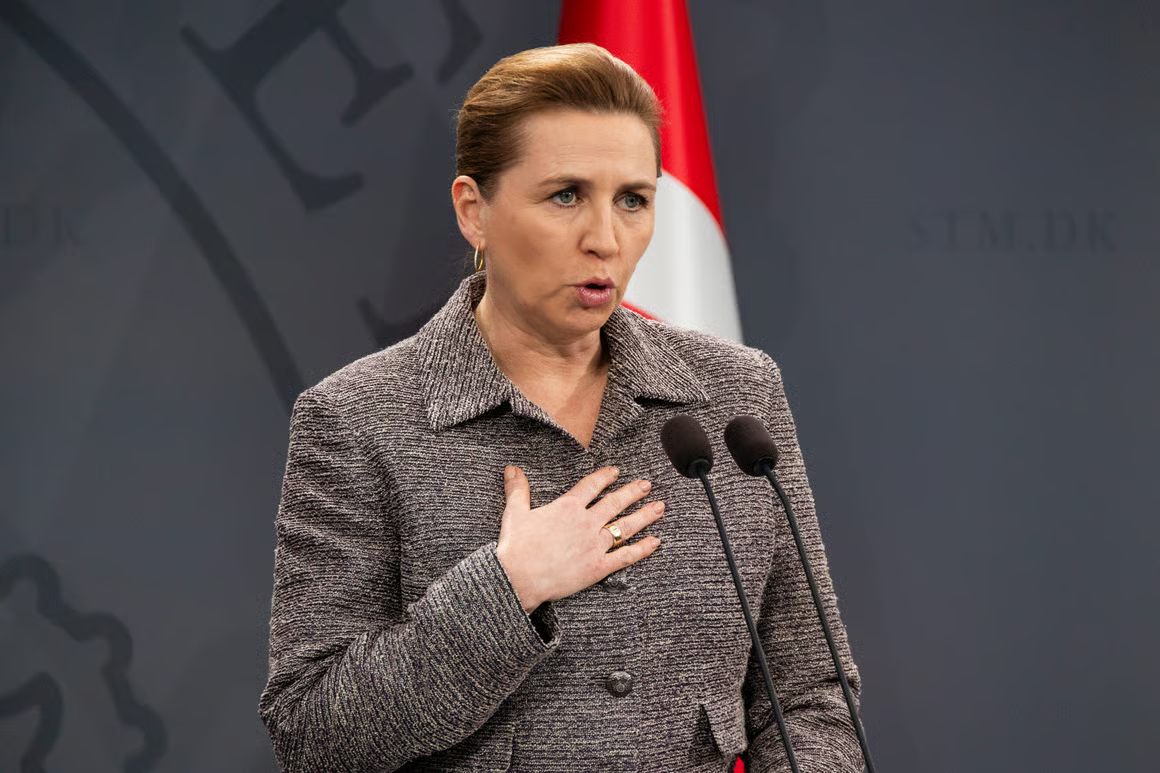
Denmark Prime Minister Mette Frederiksen has firmly rejected pressure from the United States, stating that Europe “will not be blackmailed” following renewed tariff threats from Donald Trump tied to Greenland.
The US president has warned that Washington will impose a new 10% tariff on goods from eight allied countries if they oppose his proposal for the United States to take control of Greenland, an autonomous territory within the Kingdom of Denmark.
Proposed Tariffs and Affected Countries
According to Trump, the new levies would apply to Denmark, Finland, France, Germany, the Netherlands, Norway, Sweden, and the UK. The initial 10% tariff is set to take effect on 1 February and could increase to 25% by June if no agreement is reached.
Trump said the tariffs would remain in place until a deal is secured for what he described as the “complete and total” purchase of Greenland.
European Leaders Issue Joint Warning
In a joint statement released on Sunday, Frederiksen and other European leaders warned that the tariff threats could damage transatlantic relations and trigger a dangerous downward spiral. They reiterated their full support for Denmark and the people of Greenland.
The leaders also stressed their commitment to strengthening Arctic security as a shared responsibility within the NATO alliance.
Trump Defends Greenland Strategy
Trump has repeatedly argued that Greenland is critical to US national security. Writing on his Truth Social platform, he claimed that Nato had long urged Denmark to address perceived Russian threats in the Arctic and said the time had come for decisive action.
He has previously suggested the US could acquire Greenland “the easy way” or “the hard way,” refusing to rule out the use of force—remarks that have drawn widespread international criticism.
UK and EU React to Escalating Tensions
UK Prime Minister Keir Starmer described the tariff threat as “completely wrong” and said the UK would pursue the matter directly with Washington.
French President Emmanuel Macron said he would seek to activate the European Union’s anti-coercion instrument if the tariffs are imposed, as European leaders work to coordinate a collective response.
Why Greenland Matters Strategically
Greenland, though sparsely populated, is rich in natural resources and occupies a strategic position between North America and the Arctic. Its location makes it important for missile early-warning systems and monitoring shipping routes in the region.
US officials have argued that Greenland’s security would be better guaranteed under American control—a claim firmly rejected by European governments.
Public Opposition in Denmark and Greenland
Public anger over Trump’s remarks remains strong. Demonstrations were held in Greenland’s capital, Nuuk, as well as in several Danish cities. These protests coincided with a visit to Copenhagen by a delegation from the US Congress, whose members described the rhetoric as unhelpful.
Recent polling shows overwhelming opposition among Greenlanders to becoming part of the US, with similar scepticism reflected among American voters.
International Concerns Continue Ahead of Davos
Canada has expressed concern over rising tensions and announced plans to boost Arctic security. Nato’s Secretary General confirmed ongoing discussions with Trump ahead of the World Economic Forum in Davos, where global leaders are expected to address cooperation in an increasingly contested world.
Despite escalating rhetoric, European governments continue to stress that respect for sovereignty, territorial integrity, and dialogue remain non-negotiable principles.