

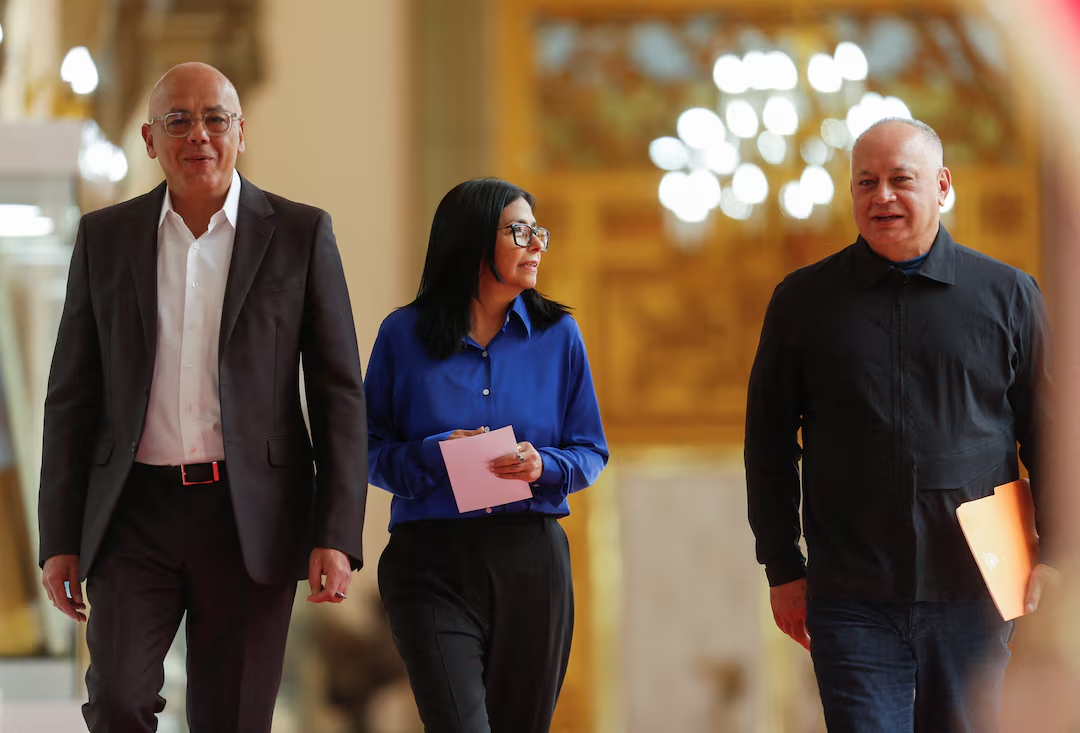
Senior officials in the administration of Donald Trump were in contact with Venezuela hardline interior minister Diosdado Cabello months before the United States launched an operation to seize President Nicolas Maduro, according to multiple people familiar with the discussions.
The communications, which continued after Maduro’s removal on January 3, were aimed at preventing further instability inside Venezuela. U.S. officials warned Cabello against deploying security forces or pro-government militias under his influence to target opposition groups, four sources said.
Cabello, 62, oversees a powerful security apparatus that includes intelligence agencies, police units and the armed forces — institutions that remain largely intact following the U.S. operation.
Warnings Ahead of the Raid
Although Cabello is named in the same U.S. drug-trafficking indictment used to justify Maduro’s arrest, he was not detained during the raid. Sources said discussions with Cabello began early in Trump’s current term and intensified in the weeks leading up to Maduro’s ouster.
Those talks also touched on the U.S. sanctions imposed on Cabello and the criminal indictment he faces. According to four sources, communication has continued since Maduro was removed from power, underscoring Washington’s concern that Cabello could destabilise the country if he chose to mobilise loyal forces.
U.S. officials view Cabello’s posture as critical to maintaining order during the transition now led by interim President Delcy Rodriguez. One source said that if Cabello were to act against the new leadership, it could trigger unrest that Washington is keen to avoid.
Power Broker With Potential to Disrupt
It remains unclear whether discussions extended to Venezuela’s long-term governance or whether Cabello has heeded U.S. warnings. While he has publicly pledged unity with Rodriguez — whom Trump has praised — Cabello is widely seen as a figure capable of either enabling or derailing post-Maduro plans.
Cabello has communicated with the Trump administration both directly and through intermediaries, one source said. All sources requested anonymity due to the sensitivity of the contacts. The White House and the Venezuelan government did not respond to requests for comment.
Longtime Maduro Ally
Cabello has long been regarded as Venezuela’s second-most powerful figure. A close ally of late president Hugo Chavez, he later became one of Maduro’s most loyal enforcers.
A former military officer, Cabello has exerted influence over military and counterintelligence agencies and has been linked to pro-government militias known as colectivos, armed civilian groups accused of attacking protesters. Despite years of cooperation within the ruling elite, Cabello and Rodriguez have often been viewed as rivals rather than allies.
Washington has relied on a small circle of Maduro-era officials, including Cabello, to maintain stability while navigating access to Venezuela’s vast oil reserves during a transitional period.
Sanctions and Indictment Loom
Cabello has been under U.S. sanctions for years over alleged involvement in drug trafficking. In 2020, U.S. authorities issued a $10 million reward for information leading to his arrest and charged him as a central figure in the so-called “Cartel de los Soles.” That bounty has since risen to $25 million. Cabello has repeatedly denied the accusations.
Following Maduro’s removal, some U.S. lawmakers questioned why Cabello was not also detained. Republican Representative Maria Elvira Salazar said in a January interview that Cabello posed an even greater threat than Maduro.
In the days after the raid, Cabello publicly condemned U.S. intervention, declaring that Venezuela “will not surrender.” However, reports of aggressive security checkpoints have diminished, and both Washington and Caracas say detainees considered political prisoners are being released.
The Venezuelan government says Cabello is overseeing that process, though rights groups argue releases are slow and that hundreds remain unjustly held.
As the transition unfolds, U.S. officials remain wary that Cabello’s influence — and his past record — could yet complicate efforts to reshape Venezuela’s political future.