

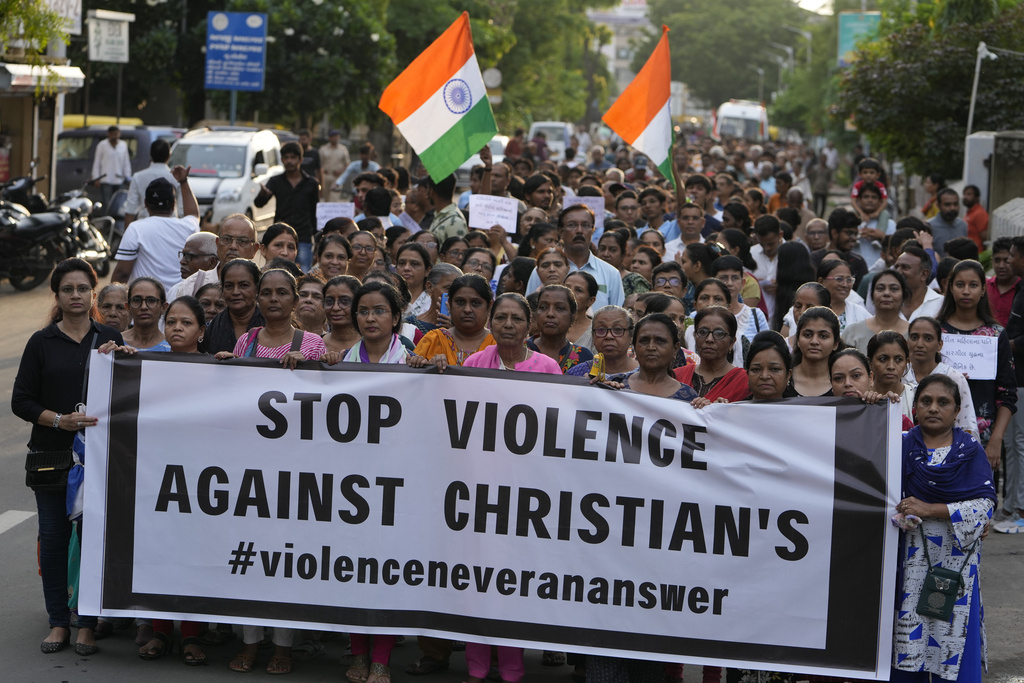
On Christmas Eve, hardline Hindu groups linked to India ruling Bharatiya Janata Party (BJP) called for a citywide shutdown in Raipur, the capital of Chhattisgarh, citing allegations of “forced” religious conversions by Christians. Such claims, frequently raised against the Christian community, have long lacked substantiated evidence.
Later that day, groups of men carrying wooden sticks entered a shopping mall in Raipur, damaging Christmas decorations and disrupting celebrations. Police registered a case against 30 to 40 unidentified individuals but arrested only six. All were granted bail within days. Videos circulated on social media showed their release being celebrated with garlands, chants, and public processions outside the jail.
On Christmas morning, Indian Prime Minister Narendra Modi visited a Catholic church in New Delhi for the holiday observance. He did not, however, publicly condemn the violence that had occurred the previous night.
Report documents sharp rise in hate speech
The Raipur incident forms part of a wider national pattern. A new report indicates that religious hate speech and violence in India are intensifying, with Christians becoming a more visible target alongside Muslims amid a broader rise in Hindu majoritarian rhetoric.
Research by India Hate Lab, a project of the Washington-based Center for the Study of Organized Hate (CSOH), recorded 1,318 hate speech events across India in 2025—averaging more than three incidents per day.
According to the findings, these events were largely organised by Hindu majoritarian groups and individuals affiliated with the BJP. Overall hate speech rose by 97 percent compared with 2023 and increased 13 percent from 2024. While Muslims remained the most frequent target, anti-Christian rhetoric rose sharply, with incidents increasing from 115 in 2024 to 162 in 2025—a 41 percent jump.
Christmas celebrations disrupted nationwide
The report’s findings were reflected in multiple incidents during Christmas celebrations last month. Disruptions and intimidation were reported in Delhi and the states of Madhya Pradesh, Assam, Kerala, Uttar Pradesh, Telangana, and Chhattisgarh.
In Madhya Pradesh, a BJP leader reportedly led a group that disrupted a Christmas lunch organised for visually impaired children. In Delhi, women wearing Santa caps were harassed by Hindu supremacists. In Kerala, schools allegedly received warnings from individuals linked to the Rashtriya Swayamsevak Sangh (RSS), cautioning against holding Christmas events. The state government later announced a probe following reports that an RSS worker had attacked teenage carollers.
Christians account for just 2.3 percent of India’s population, compared with Muslims at 14.2 percent and Hindus at around 80 percent.
Experts warn of long-term escalation
Analysts say the latest figures represent a significant escalation in hostility toward religious minorities since the BJP came to power in 2014. The RSS, founded in 1925 and widely regarded as the BJP’s ideological mentor, promotes the idea of India as a Hindu nation—an outlook that conflicts with the country’s constitutional commitment to secularism.
Raqib Naik of the CSOH said the hate speech recorded in 2025 frequently portrayed Muslims and Christians as “foreign” and “dangerous” forces. Central to this narrative, he explained, is the claim that Christian social work is a cover for forced conversions.
Data from the Pew Research Center shows that India’s Christian population has never exceeded 3 percent between 1951 and the 2011 census.
Fear spreads within minority communities
Christian leaders say the rise in hostility has created fear and uncertainty. John Dayal, former president of the All India Catholic Union, said churches in Raipur were advised to seek police protection during Christmas.
“It was shocking that such precautions became necessary,” Dayal said, noting that concerns over vandalism have forced communities to take extraordinary measures.
Anti-Muslim rhetoric also intensifies
The report also documents a steep rise in hate speech targeting Muslims. Of the 1,318 incidents recorded in 2025, 1,289 contained hateful or violent references to Muslims, up from 668 in 2023—a 93 percent increase.
Speakers frequently invoked conspiracy theories such as “love jihad,” “land jihad,” and “population jihad,” often ending rallies with calls for boycotts or violence against Muslims.
“These narratives are designed to frame minorities as existential threats,” Naik said, adding that they help justify discriminatory laws and policies.
Political links under scrutiny
The report found that 88 percent of hate speech incidents occurred in states governed by the BJP or its allies. Among the most frequently cited figures were Home Minister Amit Shah, Uttar Pradesh Chief Minister Yogi Adityanath, and Uttarakhand Chief Minister Pushkar Singh Dhami.
In November 2025, the United States Commission on International Religious Freedom raised concerns over what it described as discriminatory legislation in India related to citizenship and religious conversion.
Al Jazeera contacted the BJP and India’s Ministry of Home Affairs for comment, but received no response.
“A dangerous trajectory”
Ram Puniyani, president of the Centre for the Study of Society and Secularism, said the rise in hate speech is closely tied to electoral politics following the BJP’s reduced majority in the 2024 general elections.
“This trajectory is dangerous,” Puniyani said. “History shows that sustained hate speech ultimately leads to violence.”