

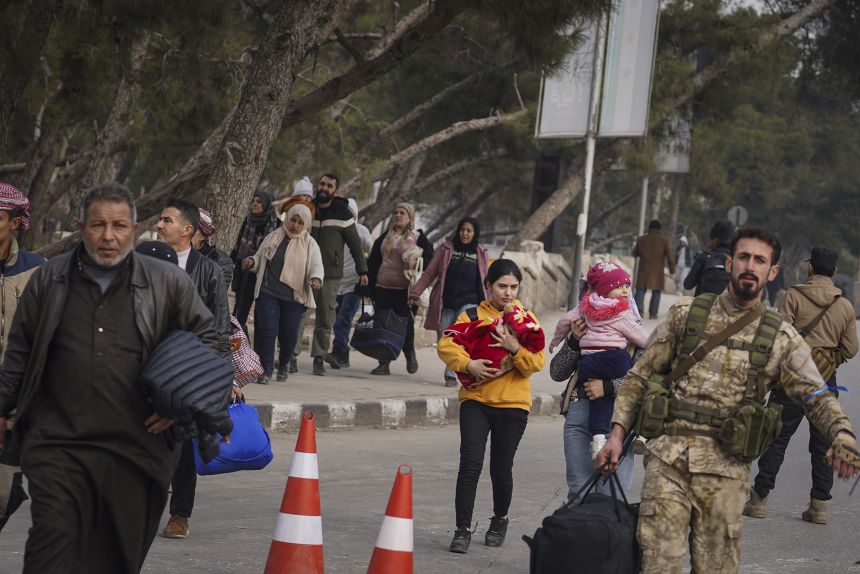
The Syrian army is engaged in intense clashes in the northern city of Aleppo after Kurdish-led Syrian Democratic Forces (SDF) fighters declined to withdraw under a temporary ceasefire, triggering renewed violence and a growing humanitarian crisis.
Aleppo’s emergency response chief, Mohammed al-Rajab, told Al Jazeera Arabic that at least 162,000 residents have fled the Ashrafieh and Sheikh Maqsoud neighbourhoods as fighting intensified.
A Syrian military source said government forces are advancing in Sheikh Maqsoud—where the heaviest clashes have occurred—and now control roughly 55 percent of the district.
State media outlet SANA reported that Syrian forces arrested several SDF members during operations launched after a deadline for Kurdish fighters to evacuate the area expired late Friday. The withdrawal ultimatum had been issued as part of a short-lived ceasefire declared earlier the same day by Syria’s Ministry of Defence.
Ceasefire breakdown and renewed strikes
The truce followed three days of fighting that erupted after Damascus and the SDF failed to implement a long-standing agreement to integrate Kurdish forces into the state security structure.
After some of the fiercest violence since the ouster of Syria’s former leader Bashar al-Assad last year, Syrian authorities gave Kurdish fighters a six-hour window to withdraw to their semi-autonomous region in northeastern Syria. The move aimed to end Kurdish control over parts of Aleppo.
Local Kurdish councils governing Sheikh Maqsoud and Ashrafieh rejected the ultimatum, saying they would not surrender districts they have administered since the early stages of Syria’s conflict, which began in 2011.
The Syrian army later warned residents of renewed strikes, urging civilians to leave via a designated humanitarian corridor. Military maps highlighting targeted areas were published, and shelling reportedly began around two hours later.
Conflicting claims and civilian toll
As clashes escalated, the SDF posted footage on X that it said showed damage from artillery and drone attacks on Khaled Fajr Hospital in Sheikh Maqsoud, accusing pro-government factions of committing a war crime. Syria’s Defence Ministry, cited by SANA, said the facility was being used as a weapons storage site.
The SDF also reported that government-aligned militias attempted to advance into the neighbourhood with tanks but faced what it described as sustained resistance.
Later, the Syrian army said three soldiers were killed and 12 wounded in SDF attacks. It also alleged that Kurdish fighters had killed more than 10 local youths who refused to join them—claims the SDF dismissed as “lies and disinformation”.
Since fighting erupted earlier this week, at least 22 people have been killed and 173 injured in Aleppo, according to local authorities. Syria’s civil defence agency said displacement from the city has now reached nearly 160,000 people.
Deep-rooted divisions
The violence has highlighted a key fault line in post-Assad Syria, as Kurdish forces controlling large parts of the oil-rich northeast resist integration into the central government under President Ahmed al-Sharaa.
An integration agreement signed in March last year envisioned the SDF joining the Defence Ministry by the end of 2025, but officials in Damascus say little progress has been made.
Senior Al Jazeera analyst Marwan Bishara said mutual distrust remains high, particularly over how Kurdish fighters—including women—would be absorbed into the Syrian army.
Regional and international reaction
Amid the clashes, al-Sharaa held a phone call with Turkish President Recep Tayyip Erdogan, reaffirming his intention to eliminate what Damascus calls “illegal armed presence” in Aleppo.
Turkiye, which considers the SDF an extension of the PKK, has previously warned it could intervene militarily if integration efforts fail. Defence Minister Yasar Guler said Ankara supports Syria’s campaign against what it labels terrorist groups.
Meanwhile, the United Nations voiced serious concern. A spokesperson for Secretary-General Antonio Guterres urged all sides to return to negotiations and fully implement existing agreements.
France also called for restraint, with President Emmanuel Macron stressing the need for a unified Syria where all communities are protected.