

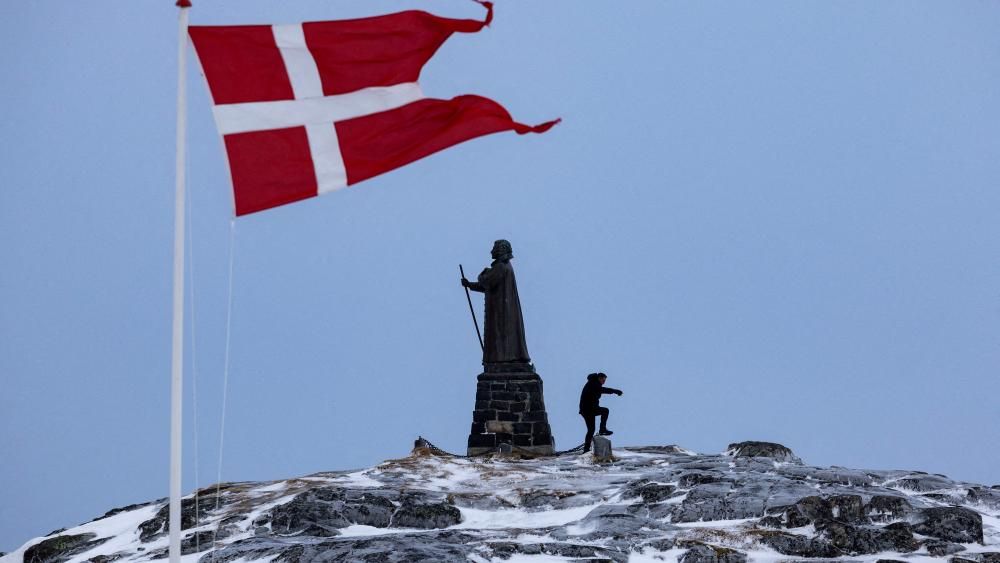
United States President Donald Trump has said the United States needs to “own” Greenland, arguing that outright control is necessary to prevent Russia and China from expanding their influence in the Arctic region.
Speaking to reporters on Friday, Trump dismissed the idea of long-term leasing arrangements, saying ownership was the only way to guarantee security.
“Countries have to have ownership, and you defend ownership—you don’t defend leases,” Trump said, responding to a question from the BBC. “And we’ll have to defend Greenland.”
The president added that the United States would pursue the goal “the easy way or the hard way,” remarks that follow recent comments from the White House indicating it is examining the possibility of purchasing the territory. Officials have also declined to rule out more aggressive options, including annexation by force.
Both Denmark and Greenland have firmly rejected the idea, stressing that the territory is not for sale. Danish officials have warned that any military action would threaten the foundations of the trans-Atlantic defence alliance.
Strategic importance in the Arctic
Although Greenland is one of the world’s most sparsely populated regions, its position between North America and the Arctic Ocean gives it major strategic value. The territory plays a key role in early-warning systems for missile detection and in monitoring naval activity in polar waters.
Trump has repeatedly described Greenland as vital to US national security, claiming—without providing evidence—that Russian and Chinese vessels are increasingly active around the island.
The United States already maintains a military presence at Pituffik Space Base, located on Greenland’s north-western coast. The base has been operated by the US since World War Two and hosts more than 100 American personnel.
Under existing agreements with Denmark, Washington has the authority to deploy additional troops to Greenland if it chooses. However, Trump said such arrangements fall short of what the US requires.
“Countries can’t make nine-year deals or even 100-year deals,” he said. “They have to have ownership.”
Pushback from allies
Trump insisted that his position was not directed at the people of rival nations but at their governments’ strategic ambitions.
“I love the people of China. I love the people of Russia,” he said. “But I don’t want them as a neighbour in Greenland. That’s not going to happen.”
He added that NATO allies needed to recognise the security implications of the Arctic.
In response, Denmark’s NATO partners—including major European states and Canada—issued statements backing Copenhagen, emphasizing that decisions about Greenland’s future rest solely with Denmark and Greenland. They reaffirmed their commitment to Arctic security while calling for cooperation among allies rather than unilateral action.
Allies also stressed the need to uphold international law, including the principles of sovereignty and territorial integrity outlined in the United Nations Charter.
Renewed tensions and political fallout
Concerns about Greenland’s future intensified after Trump’s recent use of military force against Venezuela to seize its president, Nicolás Maduro, raising fears that similar tactics could be considered elsewhere.
Trump previously floated the idea of buying Greenland in 2019 during his first term, an offer that was swiftly rejected.
US Secretary of State Marco Rubio is expected to hold talks with Danish officials next week as diplomatic tensions continue.
Greenland has also drawn growing international interest due to its natural resources, including rare earth minerals, uranium and iron, which are becoming more accessible as climate change accelerates ice melt. Scientists believe the island may also hold significant oil and gas reserves.
In a joint statement released on Friday, Greenland’s political leaders, including opposition parties, criticized Washington’s rhetoric and reiterated their stance on self-determination.
“We do not want to be Americans, we do not want to be Danes—we want to be Greenlanders,” the statement said. “The future of Greenland must be decided by the Greenlandic people.”