

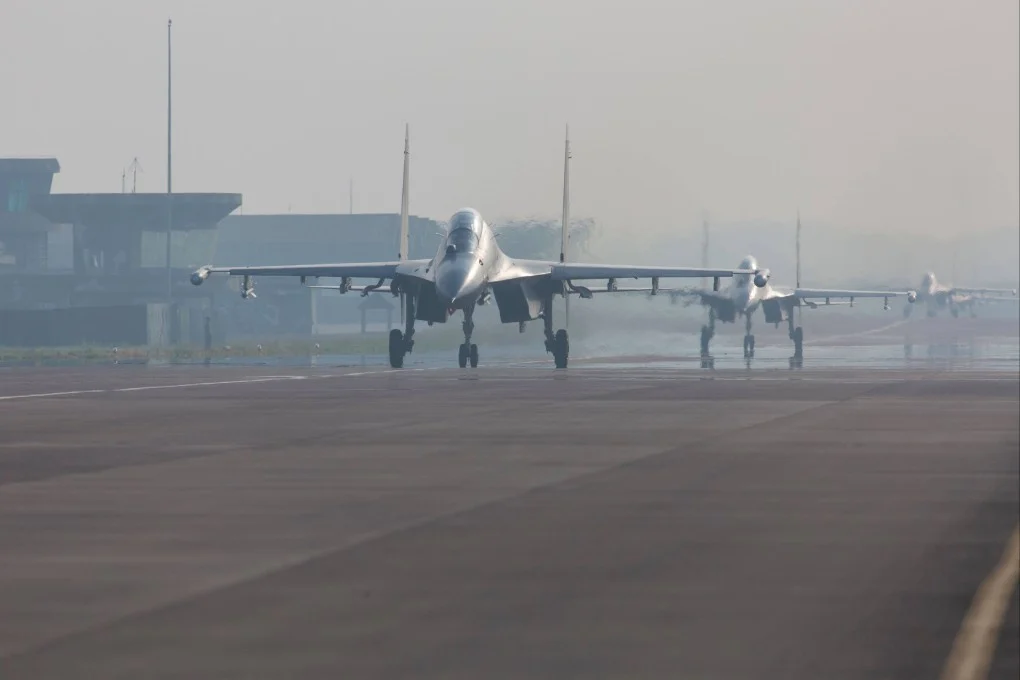
China Eastern Theater Command confirmed on Monday that it has mobilized ground troops, naval fleets, air squadrons, and missile units in zones surrounding Taiwan as part of expansive military exercises. The operation is intended, according to Beijing, to deliver a firm signal against movements supporting Taiwanese independence and what it calls foreign involvement in the Taiwan Strait.
The drills, labeled “Justice Mission-2025,” are designed to evaluate combat preparedness and simulate control over strategic infrastructure, including major ports and critical transit areas encircling the island. The command also announced that test operations will cover blockade coordination and regional control capabilities in air and maritime zones.
Live-fire training is scheduled to occur in five designated sectors around Taiwan, with temporary closures of sea and air routes expected to begin on December 30 during daytime hours. Patrol activities involving both the People’s Liberation Army (PLA) and the China Coast Guard were activated on December 29, extending into waters near two of Taiwan’s outer islands.
Taiwan Denounces the Drills
Taiwan’s leadership issued an immediate response, condemning the exercises as an act of coercive pressure.
Presidential spokesperson Karen Kuo described the drills as a disruption to regional balance, stating that the exercises “challenge international norms and destabilize security frameworks in the Taiwan Strait and the broader Indo-Pacific region.”
Taiwan’s defense ministry added that its forces remain “fully alert” and prepared to “defend democratic principles and national security,” accusing Beijing of using military activity to influence political outcomes.
Diplomatic Friction With Japan and the US
The timing of the drills follows weeks of diplomatic tension between China and Japan, sparked by remarks from Japanese Prime Minister Sanae Takaichi, who suggested that Tokyo could consider military countermeasures if Beijing attempted to assert control over Taiwan by force. Beijing interpreted the statement as a challenge to its national sovereignty.
China also voiced strong opposition earlier this month to a major defense agreement announced by Washington and Taipei, one of the largest military support packages to Taiwan in recent history.
Military analyst Fu Nan, speaking in Chinese state media, pointed directly to the US–Taiwan arms pact, calling it “an escalation of coordinated defense cooperation that heightens confrontation risks.”
Details of the US–Taiwan Defense Package
The recently announced $11.1 billion defense agreement includes long-range mobile rocket systems (HIMARS), anti-armor and anti-tank missiles, surveillance drones, artillery units, defense software, and military systems support.
Although Washington officially recognizes Beijing as China’s sole government, the US maintains informal defense ties with Taiwan and is legally committed to providing the island with defensive military support. US officials acknowledge China’s view that Taiwan is part of China, but do not formally endorse Beijing’s claim of authority over the island.
Taiwan’s Special Defense Budget Stalls
Meanwhile, Taiwan President Lai Ching-te has been pushing for the approval of a proposed $40 billion special defense budget, first introduced in November 2025. The proposal faces resistance in Taiwan’s opposition-led legislature, although parts of the recent US weapons package are expected to be funded under this budget if approved.
Beijing reacted critically to the proposal, describing it as a step that “raises tension and disrupts peace in the strait.”
Domestic Messaging and Regional Reactions
As part of the announcement, China released patriotic visual materials aimed at domestic audiences, including a poster showing flaming arrows descending toward Taiwan with the caption: “Arrow of Justice, Control and Denial.”
International bodies including the African Union, the Gulf Cooperation Council, Turkey, Egypt, and the Organization of Islamic Cooperation have criticized Beijing’s approach, urging restraint. The European Union reiterated its position supporting the protection of Somalia and Taiwan’s sovereignty under international law.
Taiwan continues to report daily Chinese military aircraft and vessel activity in nearby waters, part of a sustained pressure strategy that Taipei says has intensified in recent years.
Duration of the Drills Uncertain
Beijing has not specified how long the exercises will continue. However, China Coast Guard confirmed that enforcement patrols are already active near Taiwanese maritime zones and its outer islands.