

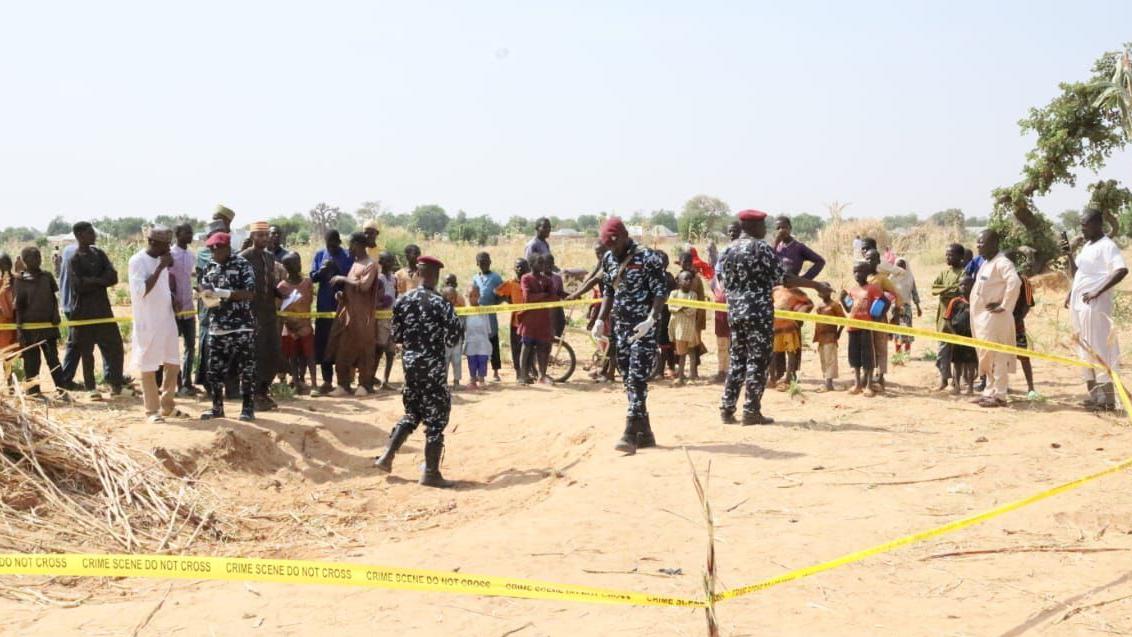
Residents of the small farming settlement of Jabo in northwestern Nigeria are grappling with anxiety and uncertainty, a day after debris from a U.S. missile strike landed near the community’s only health clinic. The projectile remnants struck the ground late Thursday night, falling in a field roughly 500 meters from the Primary Health Center, triggering panic but causing no reported injuries, according to local authorities.
Villager Suleiman Kagara, who lives in the rural Tambuwal district of Sokoto State, recounted hearing a thunderous explosion around 10 p.m. as a flaming object passed overhead before crashing into open land. The blast shook nearby homes, and residents fled outdoors in fear.
“We barely slept,” Kagara said. “This is something completely new for us.”
U.S. Framing and Local Reactions Clash
Hours after the incident, U.S. President Donald Trump announced a military operation against ISIS-linked militants in the broader Sokoto region. He described the strike as a blow to extremist fighters, alleging that militant groups had been targeting Christian communities elsewhere in the country.
The remarks puzzled residents in Jabo, who say their village has no documented footprint of ISIS or similar factions, and that Muslim and Christian families have lived side by side without religious clashes.
“In our community, Christians are family to us,” Kagara said. “We have never experienced religious hostility here.”
Local lawmaker Bashar Isah Jabo echoed the sentiment, characterizing Jabo as a non-conflict farming zone with no verified record of ISIS, Lakurawa, or any organized extremist bases operating inside the village.
He confirmed the impact site was an open field and that the explosion had spread alarm but resulted in zero casualties.
Government and Military Statements
Nigeria’s Information Ministry later clarified that the operation was carried out jointly with U.S. Africa Command, with the main targets located in dense forest zones of Tangaza and Tangaza-adjacent districts, known for militant movement. The ministry confirmed that missile debris — not the strike itself — fell in Jabo, emphasizing that civilians were not the intended focus.
Foreign Minister Yusuf Tuggar stated that President Bola Tinubu had authorized the coordinated security mission following talks with U.S. Secretary of State Marco Rubio. Tuggar reiterated that the objective was regional civilian protection, not religious confrontation, noting that extremist activity elsewhere should not be generalized to peaceful rural communities like Jabo.
Security analysts also stress that Nigeria’s long-running instability is shaped by governance gaps, economic pressure, resource disputes, and inter-community rivalries, not solely religious tension.
Strategic Region, Persistent Risks
Experts note that while air operations may reduce militant capacity in remote forested hideouts, they are unlikely to resolve Nigeria’s deep-rooted security issues, which include bandit networks, kidnapping syndicates, and land competition between farming and herding communities.
Nnamdi Obasi of the International Crisis Group said the strikes signal a major tactical escalation, but added that Nigeria’s conflict drivers stem largely from institutional and administrative failures, which cannot be solved through air operations alone.
Life on the Ground
Although Jabo is accustomed to sporadic bandit threats in surrounding districts, residents insist the village has never served as a base for internationally recognized extremist factions, making Thursday’s impact a traumatic surprise rather than an anticipated security event.
Community leaders are now urging calm, clarity, and stronger communication between military agencies and rural populations to prevent future misunderstanding and fear.