

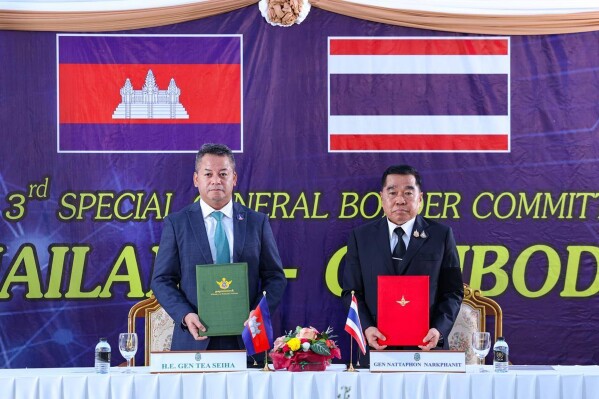
Thailand and Cambodia confirmed on Saturday that a new ceasefire agreement has officially begun, announced through a joint communiqué released by the defence ministers of both nations. The pact ends a period of sustained border hostilities that resulted in dozens of fatalities and triggered one of the largest population displacements in Southeast Asia this year.
The truce, which started at midday local time, requires both militaries to suspend all planned troop rotations and forward movements in border zones. This pause also opens a safe corridor for residents who were forced to evacuate to return to their communities. Estimates from regional agencies indicate that nearly one million people had been uprooted by the clashes, with at least 41 lives lost over the previous weeks.
Key Conditions and the Path to De-Escalation
The agreement was achieved after several consecutive days of negotiations between Thai and Cambodian officials, facilitated by regional diplomatic channels. The joint statement lays out specific measures aimed at reducing tensions, including a full stop to operations that could put civilians, public facilities, or essential infrastructure at risk.
Both governments also pledged to prevent any unprovoked use of weapons, unauthorized advances, or strategic repositioning that could be interpreted as hostile intent. The communiqué emphasizes that stability must be upheld through restraint rather than escalation.
A humanitarian element of the pact involves 18 Cambodian military personnel currently held by Thailand. Their release is tied to the durability of the ceasefire. If no violations are recorded within 72 hours, the detainees will be freed. The process is described in the statement as being guided by goodwill, drawing symbolic reference to the Kuala Lumpur Declaration, a previous bilateral peace document signed in October at an event attended by then-U.S. President Donald Trump.
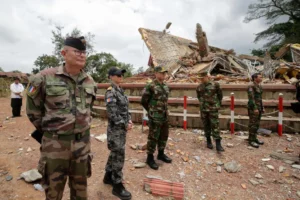
However, that earlier truce unraveled earlier this month when renewed exchanges of fire were reported. Since then, both countries have presented opposing narratives regarding responsibility for the breakdown. Thai officials stated their forces were reacting defensively to cross-border gunfire in Si Sa Ket province, where two Thai soldiers sustained injuries. Cambodian authorities countered that the initial aggression originated from Thai units operating near Preah Vihear, asserting that Cambodian troops held their positions without launching a counter-offensive.
Despite diplomatic efforts, the border remained volatile through most of December. On Friday, Thailand conducted targeted air operations in a contested zone, which Thai officials described as a strike on a fortified outpost after civilian movement had ceased. Cambodia rejected that characterization, accusing the attacks of lacking precision and impacting residential areas.
The territorial disagreement between Thailand and Cambodia has historical roots extending back more than 100 years, but the most recent surge began in May after a confrontation led to the death of a Cambodian soldier. The situation worsened again in July, when days of continuous fighting caused heavy casualties among both combatants and non-combatants, pushing thousands into temporary shelters.
In late October, international diplomatic pressure led to another fragile peace arrangement, branded by Trump as the Kuala Lumpur Peace Accords. The plan required withdrawing heavy artillery and creating a temporary observer group to oversee border conditions. But within weeks, Thailand stepped back from active involvement, citing ongoing security risks. The Thai prime minister later stated that the situation on the ground had not improved enough to ensure long-term safety, prompting the pause.