

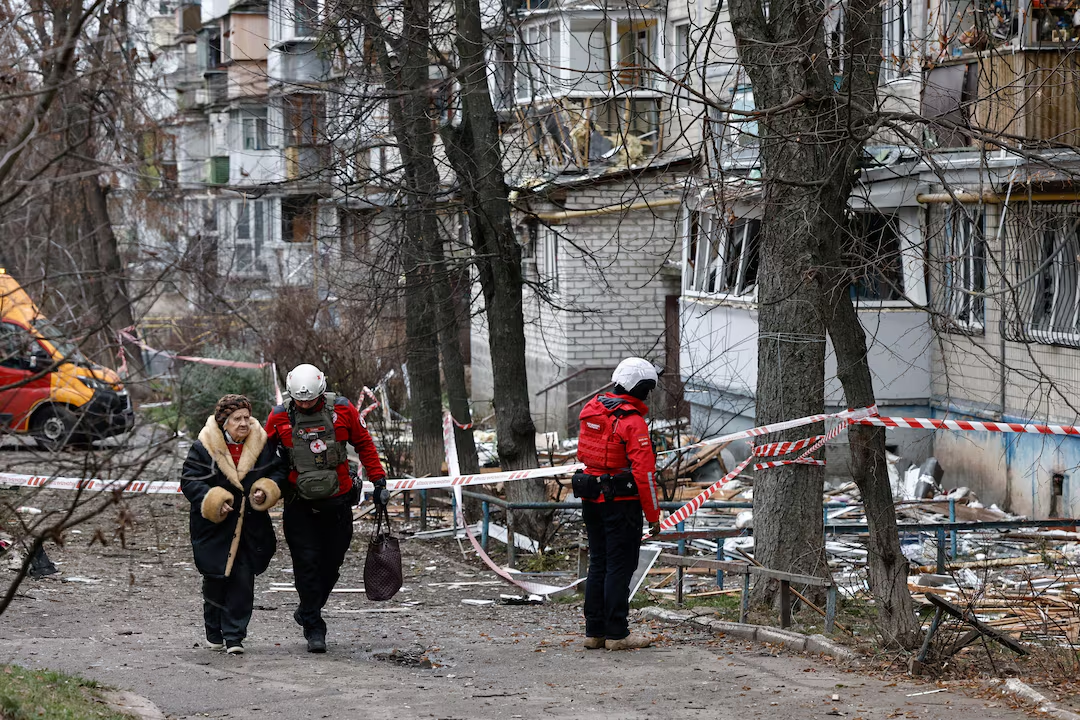
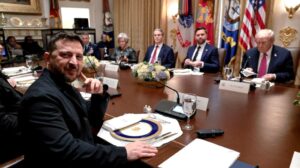
Russia launched a wave of missile and drone attacks on Ukraine on Saturday, hours before President Volodymyr Zelenskiy’s scheduled meeting with U.S. President Donald Trump at Mar-a-Lago in Florida — talks Kyiv says could shape a roadmap to end a war now nearing its fourth year.
The strikes, reported across the capital and multiple regions, came after Zelenskiy confirmed that Sunday’s negotiations would centre on post-war borders and which areas each side would hold under a proposed ceasefire. The conflict, triggered in February 2022, has become Europe’s most destructive ground war since the Second World War.
Air defence systems were activated in Kyiv as explosions echoed across the city overnight. Ukraine’s military said incoming missiles were detected and intercepted, while the air force warned that Russian drones were also operating over the capital. Alerts were extended to northeastern and southern provinces, including areas previously targeted around Odesa.
There were no early confirmations of major damage, electricity outages, or critical infrastructure disruption from Saturday’s assault. Officials said monitoring was still under way. The Kremlin did not issue an immediate public statement on the attacks.
Territory Still the Hardest Line
Diplomatic discussions this week have revealed competing visions for a settlement. Zelenskiy has said a 20-point peace draft — driven largely by U.S. mediation — is close to final form, though key sections remain unsettled. He described the plan as “largely ready” in earlier comments, estimating its progress at around 90%.
Security guarantees are expected to be one of the few areas nearing agreement. Ukraine says it wants assurances that are long-term, legally enforceable, and resistant to political turnover in Washington. Earlier guarantees issued after the Soviet collapse failed to prevent the current war and, according to Kyiv, lacked binding mechanisms.
Trump, speaking ahead of Sunday’s meeting, struck a different tone. He described U.S. leverage as the deciding factor and suggested Ukraine would need to present a convincing proposal for any final agreement. While the White House sees the Middle East and Europe differently in its latest strategy outline, Trump has hinted he plans to speak with President Vladimir Putin soon, though no call has been scheduled publicly.
The NSS, published earlier this month, highlights investment, trade, and regional alliances over large military deployments. That language signals a shift away from direct intervention, but it does not rule out defensive support for allies already in conflict zones.
Nuclear Plant, Ports, and Ceasefire Lines
Beyond land control, Ukraine and Russia remain divided on the status of the Zaporizhzhia nuclear power station, Europe’s largest, seized by Russian forces in the early phase of the invasion. The plant has become both a strategic asset and a diplomatic flashpoint, raising international safety concerns as negotiations unfold.
Russia has also continued attacks on Ukraine’s energy grid and southern port regions this week, including strikes around Odesa’s seaport corridors. Those assaults have tightened pressure on Ukraine’s maritime trade routes, which serve as its primary grain and industrial export channels through the Black Sea.
Ukraine wants the ceasefire drawn at the current frontlines, while Russia seeks wider withdrawal from parts of Donetsk and the broader Donbas area, which also includes Luhansk. Some U.S. policy advisers have proposed a compromise involving special economic access zones in exchange for territorial concessions, though the framework remains incomplete and has not been jointly approved.
Referendum Option Floated by Kyiv
Zelenskiy has suggested a public vote could be used to approve unresolved territorial clauses if diplomacy stalls. Ukraine says it would only hold such a referendum under a 60-day ceasefire, giving the country time to prepare polling infrastructure and allow public debate. Kyiv also wants any vote window conditioned on Russia committing to a minimum 60-day halt in fighting.
Russia, according to Ukrainian and U.S. sources, has its own version of the 20-point draft in discussion channels, though Moscow has not published it. Deputy Foreign Minister Sergei Ryabkov said this week that diplomacy had reached a “critical inflection point,” calling it a potential turning moment for both sides, but he acknowledged differences remain between Kyiv’s and Moscow’s frameworks.
Direct Channels Still Open
The Kremlin confirmed on Friday that Israeli-Ukrainian diplomacy has not replaced U.S.-Russia communication. Putin adviser Yuri Ushakov has continued calls with U.S. counterparts, and the Kremlin received new proposals from Washington this week. Officials declined to share Russia’s internal assessment of those proposals or whether Moscow intends to modify its military posture ahead of further talks.