

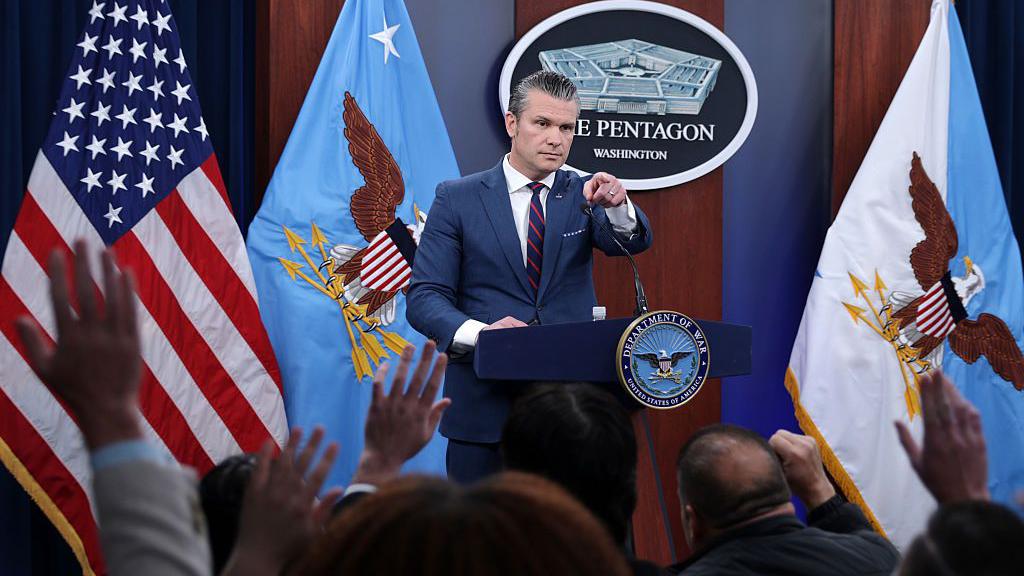
US Defence Secretary Pete Hegseth has stepped into the spotlight as one of the most visible figures behind President Donald Trump military campaign in Iran, using blunt and aggressive language that has quickly set him apart from past Pentagon leaders.
A military veteran and former Fox News host, Hegseth has become the administration’s most outspoken public defender of Operation Epic Fury. In press briefings, he has described the campaign in forceful terms, saying the mission is crushing the enemy and promising that US efforts are far from over.
His tone has stood out in Washington. While previous defence secretaries often relied on careful, bureaucratic language, Hegseth has adopted a more confrontational style. He presents himself not just as a cabinet official, but as a direct and unapologetic voice for American military power.
Strong Messaging Defines His Public Role
Now one of the main faces of the Trump administration’s war message, Hegseth has embraced a style built on confidence, sharp rhetoric and repeated references to strength. He often speaks of military pride, American power and what he calls a “warrior ethos”.
That approach has won support from some conservative voters who see him as decisive and clear at a time of conflict. Supporters argue that his direct language reflects strength and conviction, qualities they believe are important during war.
Analysts say that image is central to his appeal. Rather than sounding like a traditional defence official, Hegseth speaks more like a political fighter. His remarks often carry a sense of certainty and toughness, which some believe connects with audiences looking for firm leadership.
From Military Service to Television and Politics
Hegseth, 45, was born in Minneapolis and studied at Princeton and Harvard. During his military career, he served as an infantry platoon leader in Guantanamo Bay and Iraq, where he received the Bronze Star Medal. He later served in Afghanistan as a counterinsurgency instructor in Kabul.
His political background before joining the Trump administration was limited. He made an unsuccessful run for the Republican Senate nomination in Minnesota in 2012 and later worked with veterans’ charities for a short period.
But it was television that turned him into a national political figure. As co-host of Fox & Friends Weekend for eight years, Hegseth became a familiar face to conservative viewers, including Trump himself. That visibility helped raise his profile and eventually paved the way for his appointment as defence secretary.
Confirmation Fight Followed Him Into Office
Hegseth’s path to the Pentagon was far from smooth. Even with Republicans controlling the Senate, his confirmation faced heavy scrutiny. Lawmakers questioned his qualifications, personal conduct and ability to manage one of the largest departments in the US government.
During the hearings, he faced accusations involving misconduct, infidelity and alcohol use, all of which he dismissed as politically motivated attacks. Critics also raised concerns about tattoos linked by some to Crusader imagery, though Hegseth said they reflected his Christian beliefs rather than any extremist views.
Others questioned whether he had enough experience to lead a department with a budget nearing $1 trillion and a workforce of roughly three million people.
Supporters See Strength, Critics See Style Over Substance
As the Iran conflict has intensified, Hegseth’s communication style has drawn both praise and criticism. Backers say he is a skilled messenger who speaks with confidence and projects authority. Critics, however, argue that strong language cannot replace clarity and accountability.
Some opponents say the Trump administration has struggled to explain its broader goals in Iran in a consistent and convincing way. Hegseth has tried to answer that criticism by repeatedly outlining the operation’s stated aims: targeting Iran’s weapons systems, weakening its naval power and preventing it from developing nuclear weapons.
Still, detractors argue that his briefings often focus more on attitude than detail. They say his remarks can come across as dismissive, especially when he pushes back against media coverage of casualties or difficult questions about the war’s direction.
Controversies Continue to Follow Pentagon Chief
Hegseth entered office under pressure and has remained surrounded by controversy. Early in his tenure, he faced backlash after details of planned air strikes in Yemen were reportedly shared in a Signal group chat that mistakenly included a journalist. Critics said the incident endangered US personnel and showed poor judgment, though Hegseth remained in office.
He has also drawn attention for his broader cultural agenda inside the military. One of his most repeated priorities has been removing what he calls “woke” ideas from the armed forces. He has argued that diversity initiatives have weakened military effectiveness, a position that made him a lightning rod during confirmation hearings and beyond.
Under his leadership, the Pentagon has cut ties with some universities over diversity-related policies and taken other steps that reflect his conservative approach to military culture.
Media Rules and Legal Battles Add to Scrutiny
Hegseth’s Pentagon has also tightened its relationship with the press. New reporting restrictions have raised concern among journalists, and photojournalists have reportedly faced bans over images considered unflattering. Critics say these measures suggest a growing effort to control the public image of the department and its leadership.
He has also faced legal and political challenges over decisions made during military operations and personnel matters. Among the most closely watched disputes are lawsuits involving the Defence Department and questions surrounding actions taken against critics.
Even so, Hegseth has given little sign that he plans to soften his style. If anything, his public posture suggests the opposite.
A Central Figure in Trump’s War Message
As Trump’s military campaign in Iran continues, Pete Hegseth has become more than just defence secretary. He is now one of the clearest symbols of the administration’s wartime image: confrontational, confident and openly combative.
To supporters, he looks like a leader willing to project strength without apology. To critics, he reflects a Pentagon more focused on performance and politics than careful explanation.
Either way, Hegseth has made one thing clear: he intends to be seen as someone who does not step back from conflict, whether on the battlefield, in the briefing room or in the wider political fight.