

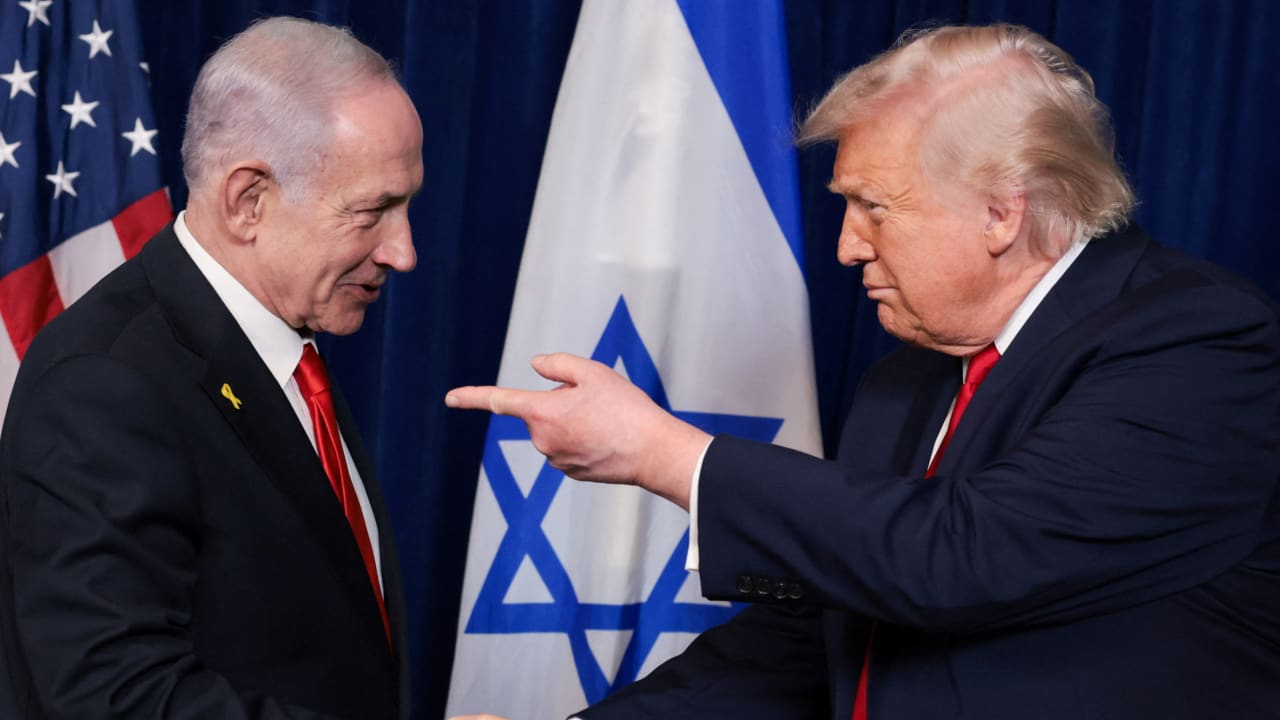
US President Donald Trump is set to host Israel Prime Minister Benjamin Netanyahu at the White House on Wednesday, as diplomatic efforts to rein in Iran’s nuclear programme reach a sensitive stage.
The meeting comes amid escalating tensions across the Middle East and renewed negotiations aimed at limiting Tehran’s nuclear capabilities.
Netanyahu has indicated he will urge Trump to pursue a comprehensive agreement that goes beyond uranium enrichment limits. Israeli officials want any deal to also address Iran’s ballistic missile programme and its support for armed groups such as Hamas and Hezbollah.
“I will present to the president our outlook regarding the principles of these negotiations,” Netanyahu said before departing for Washington.
Iran Signals Conditional Willingness
Iran has suggested it may accept restrictions on parts of its nuclear activities in exchange for sanctions relief but has rejected broader demands concerning missiles and regional alliances.
Ahead of the White House meeting, Iranian President Masoud Pezeshkian said Tehran would not bow to what he described as excessive demands.
“Our Iran will not yield in the face of aggression,” Pezeshkian said during a rally marking the 47th anniversary of the Islamic Revolution. He reiterated that Iran does not seek nuclear weapons and is prepared to accept verification mechanisms.
US Military Posture Intensifies
Netanyahu’s visit coincides with an expanded US military presence in the region. Trump has warned that failure to secure a nuclear agreement could result in military action.
The USS Abraham Lincoln carrier strike group was deployed to the Middle East last month, and Trump has said he is considering sending a second group.
“We have an armada heading there,” Trump said in an interview, adding that a diplomatic outcome remains possible and desirable.
He has stated that an acceptable agreement would ensure “no nuclear weapons, no missiles.”
Israel’s Strategic Concerns
Netanyahu, a longtime ally of Trump, has consistently described Iran as an existential threat to Israel. His office has stressed that any negotiations must include limits on Iran’s missile development and an end to its backing of regional armed groups.
After arriving in Washington, Netanyahu met Trump’s special envoy Steve Witkoff and Jared Kushner, who provided updates on recent talks with Iranian officials.
Experts say Israel is concerned that in a rush to secure an agreement, Washington might accept terms that fall short of its security expectations.
Daniel Byman of Georgetown University noted that Israeli leaders fear a deal could allow Iran to retain parts of its nuclear infrastructure or maintain missile capabilities.
Iran’s Position Weakened?
Analysts argue that Iran enters these negotiations from a more vulnerable position following widespread domestic unrest and a 12-day air campaign last year targeting Iranian nuclear and military sites.
Mohammed Hafez, a professor at the Naval Postgraduate School, said both the US and Israel may believe they hold leverage in the current talks.
However, some former US officials suggest Trump may prefer avoiding a major military confrontation, particularly during an election year.
James Jeffrey, a former US ambassador, said Trump likely seeks a diplomatic breakthrough rather than a prolonged conflict.
Gaza Ceasefire Also on Agenda
The meeting also takes place as Washington pushes Israel and Hamas to move forward with the next phase of their Gaza ceasefire agreement.
A White House spokesperson said Israel “has had no better friend” than Trump and reaffirmed cooperation on regional security and peace efforts.
Israel and Hamas reached a ceasefire last October following two years of conflict that began with the October 7, 2023 attack by Hamas inside Israel. Roughly 1,200 people were killed and 251 taken hostage in that attack. Israel’s subsequent military campaign has resulted in more than 71,000 deaths in Gaza, according to the territory’s Hamas-run health ministry.
Progress toward a second phase of the ceasefire — which includes disarmament of Hamas and full Israeli withdrawal from Gaza — has stalled, with both sides accusing each other of violations.
Diplomacy at a Crossroads
As Netanyahu and Trump meet in Washington, the direction of US-Iran negotiations — and the broader regional balance — may hinge on whether the two leaders can align on a strategy that satisfies Israeli security concerns while keeping diplomatic channels open.