

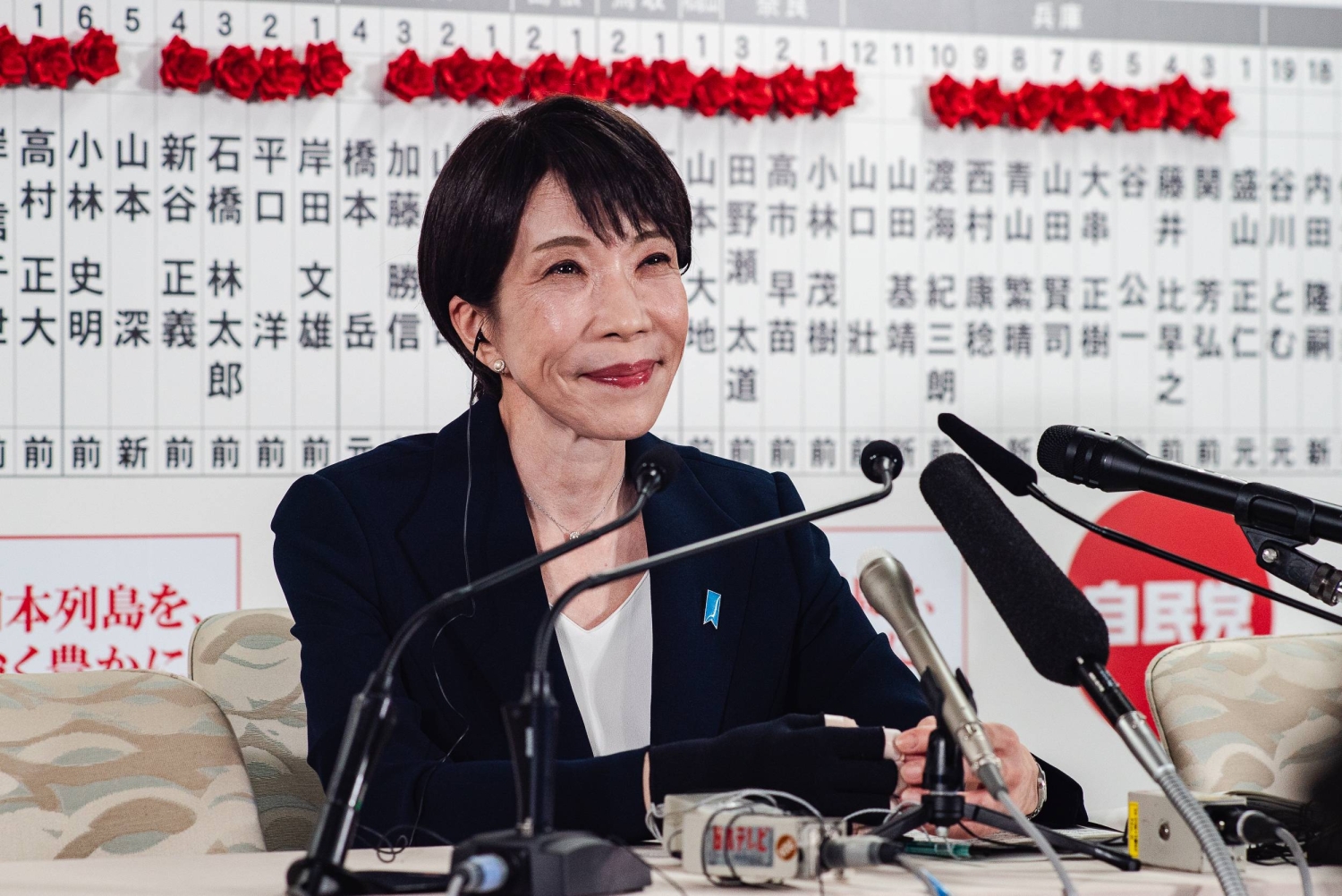
Japan’s Prime Minister Sanae Takaichi on Monday renewed her commitment to temporarily cut the sales tax on food, following a decisive election victory that strengthened her political mandate but continues to unsettle financial markets.
Takaichi’s ruling Liberal Democratic Party scored a sweeping win in Sunday’s general election, propelled in part by a pledge to reduce household costs by suspending the 8% tax on food for two years—a policy the prime minister has described as a long-held ambition.
Speaking at a news conference, Takaichi said the tax suspension would be implemented “as early as possible,” while stressing that no new government borrowing would be used to fund the measure.
“Responsible and proactive fiscal policy lies at the heart of our policy shift,” she said. “Japan must move away from an overly restrictive fiscal stance and chronic underinvestment.”
Mixed Market Response
Financial markets responded swiftly to her remarks. Japanese equities climbed to record highs, super-long government bonds recovered from early losses, and the yen strengthened after comments from Japan’s top currency official dampened speculative selling.
Earlier, however, uncertainty over how the tax cut would be financed—particularly given Japan’s status as the most indebted country in the developed world—had sparked a sell-off in government bonds and pushed the yen toward historic lows.
Some analysts had speculated that Takaichi’s strong electoral mandate might allow her to quietly scale back or delay the proposal, especially after opposition parties calling for even deeper tax cuts suffered heavy defeats. But her latest comments suggested no retreat.
Cross-Party Talks on Funding
Takaichi said discussions across party lines on social welfare and taxation would be used to determine both the timetable and funding mechanisms for the tax suspension. The government is considering options such as reallocating non-tax revenues and trimming existing subsidy programmes.
She also pledged to revamp budget planning to better support long-term corporate investment in growth-oriented sectors.
In television interviews on Sunday, as vote counts were still coming in, Takaichi had already signalled urgency, saying she intended to move quickly to fulfil the LDP’s election promise.
Analysts say her strengthened grip on power is likely to marginalise fiscal conservatives within her own party.
“Despite reservations among some LDP members, the election outcome clearly increases the likelihood of a consumption tax cut,” said Ryutaro Kono, chief Japan economist at BNP Paribas.
“The prime minister has consistently argued that past fiscal policy was too tight and appears determined to move away from the finance ministry-led approach.”
The Funding Challenge
The biggest obstacle remains funding. Suspending the food sales tax would cost an estimated 5 trillion yen ($32 billion) annually—roughly equivalent to Japan’s entire education budget.
Takaichi has previously hinted at tapping non-tax revenue sources, drawing attention to Japan’s $1.4 trillion in foreign exchange reserves, which are primarily held to stabilise the yen.
Economists warn that drawing too heavily on those reserves could spark fears that Japan might sell part of its U.S. Treasury holdings—an outcome that could unsettle global markets and raise concerns in Washington.
Extended uncertainty over funding could also trigger renewed pressure in bond markets, analysts said, particularly as investors remain sensitive to Japan’s weakening fiscal position.
Rising bond yields would increase the cost of servicing Japan’s public debt, which stands at roughly twice the size of the economy. Further yen depreciation could also drive up import prices and inflation, potentially eroding the benefits of tax relief for households.
Markets as the Final Arbiter
“Takaichi may have secured the voters’ backing, but market confidence is not guaranteed,” said Shinichi Ichikawa, senior fellow at Pictet Asset Management Japan.
“If concerns about fiscal sustainability lead to unintended yen weakness, higher import costs could push up food prices and hurt public support.”
As Japan adjusts to the implications of the election result, Takaichi now faces the delicate task of delivering on her tax-cut pledge while convincing investors that fiscal discipline will not be sacrificed—a balance that could define the early phase of her premiership.