

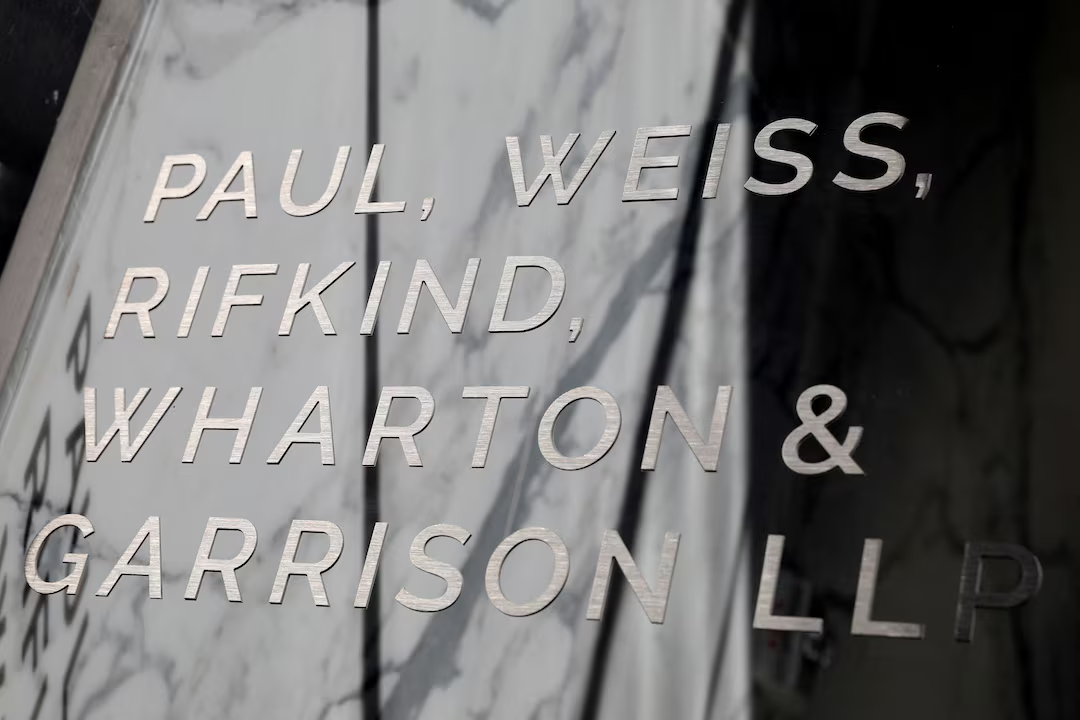
In November 2024, Brad Karp, the long-time chairman of elite U.S. law firm Paul Weiss, joined other prominent Democratic donors at election night gatherings in Washington, hoping to see Vice President Kamala Harris defeat Republican challenger Donald Trump. Months earlier, Karp had personally contacted hundreds of corporate lawyers to raise funds for Harris after she became the Democratic nominee in July 2024. One Paul Weiss partner also played a role in preparing Harris for her debate against Trump. The outcome, however, did not go as planned. Trump’s election victory and return to the White House triggered a chain of events that would ultimately end Karp’s tenure as chairman—first through political backlash, and later through renewed scrutiny of his past communications with the late financier Jeffrey Epstein.
A Rapid Unraveling
Although Karp has not been accused of any criminal wrongdoing, records released by the U.S. Justice Department earlier this year revealed extensive email exchanges between him and Epstein. Within days of those disclosures becoming public, Karp stepped down from his leadership role, marking a sudden collapse of influence for one of Wall Street’s most powerful legal figures.
A former senior Paul Weiss lawyer described the moment starkly. “If you were writing a Greek tragedy about a law firm leader, this would be it,” the attorney said, requesting anonymity.
Building a Global Powerhouse
Karp became chairman of Paul Weiss in 2008 and oversaw its transformation from a respected New York litigation firm into a global legal heavyweight. Under his leadership, the firm expanded aggressively into high-value corporate work while maintaining its strong litigation roots.
Paul Weiss also emerged as one of the most politically active major law firms, with lawyers and staff donating heavily to Democratic candidates during the 2024 election cycle. The firm devoted significant pro bono resources to progressive causes and recruited prominent attorneys from Wall Street and former Democratic administrations, including veterans of Barack Obama’s White House.

The Trump Factor
Trump’s return to office in January 2025 placed Karp and his firm under immediate pressure. Paul Weiss had represented clients involved in investigations of Trump and had sued individuals linked to the January 6, 2021 attack on the U.S. Capitol. Karp himself publicly condemned the riot, calling it an attempted coup.
In March 2025, Trump issued an executive order barring Paul Weiss from federal buildings and government contracts. The move was part of a broader campaign targeting firms perceived as hostile to the administration.
Facing the prospect of losing clients and destabilizing the 150-year-old firm, Karp chose to negotiate. With assistance from Republican lawyer Robert Giuffra, he reached an agreement under which the executive order was withdrawn in exchange for $40 million in free legal services for causes supported by Trump.
The deal sparked backlash inside the firm. Several partners resigned, including one closely tied to Harris’s campaign, viewing the agreement as a political capitulation.
Epstein Records Resurface
While the firm was still absorbing the fallout from the Trump settlement, a bipartisan congressional mandate forced the Justice Department to release long-sealed Epstein-related records. Emails made public in late January showed Karp thanking Epstein for an exclusive dinner in 2015 and later seeking his help in arranging a film-related opportunity for Karp’s son.
Other messages referenced disputes involving Leon Black, the Apollo Global Management co-founder whom Karp represented, as well as discussions related to Epstein’s 2008 non-prosecution agreement in Florida.
The correspondence showed that contact between Karp and Epstein continued into early 2019, months before Epstein’s arrest on federal sex trafficking charges and his death in jail.
Resignation and Aftermath
In announcing his resignation, Karp said recent reporting had become a distraction and that stepping aside was in the firm’s best interest. Paul Weiss stated that Karp regretted his interactions with Epstein and never witnessed or participated in misconduct.
Karp remains at the firm as a client-facing partner. He was replaced as chairman by Scott Barshay, whom Karp recruited in 2016 to expand the firm’s mergers and acquisitions practice.
A Cautionary Tale
Legal scholars say Karp’s exit underscores how proximity to political power can undermine even the most successful institutional leaders.
“What makes this episode so instructive is how quickly authority can erode once independence is perceived to be compromised,” said Kevin Burke, a former law firm chair and professor at the University of Southern California.
For decades, Brad Karp embodied Paul Weiss’ influence in both Washington and Wall Street. His fall, accelerated by politics and past associations, now serves as a reminder of how fragile that power can be.